


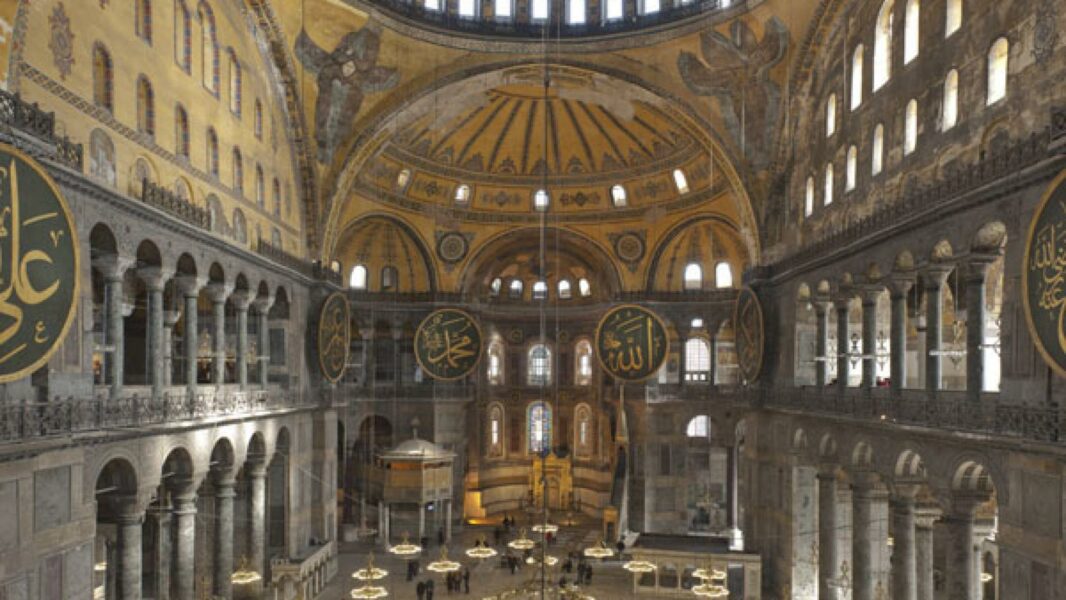
Los católicos en Turquía son pocos, pero muestran un catolicismo nada diluido y con una fe visible. La comunidad de católicos proviene de todas partes del mundo: algunos son exiliados de países donde no pueden practicar libremente su fe, como Irán; otros son estudiantes internacionales, inmigrantes y refugiados. La visita del Papa les ha dado fuerza, valor y un nuevo impulso para seguir adelante en su fe. Tras las reuniones oficiales en Ankara y las celebraciones del 1.700 aniversario del Concilio de Nicea en Iznik, el Papa León XIV llegó este sábado a Estambul. Visita a la mezquita Azul o mezquita del Sultán Ahmed, la gran ausente la vecina e impresionante catedral católica convertida en mezquita, el Papa no verá la basílica de Santa Sofía.
In the year 532, when Emperor Justinian decided to build a basilica on the shores of the Bosphorus inspired by the Pantheon in Rome. This architectural jewel became the beating heart of the Christian Church of the East and a symbol of its independence from Rome, a symbol that ended up costing dearly because in 1204, Santa Sofía was devastated by the crusaders during the sack of Constantinople. Two centuries later, the city fell into the hands of the Ottomans and the basilica was transformed into a mosque. It remained so for five centuries, until the arrival of Atatürk, who turned it into a museum to «offer it to humanity.» Santa Sofía was finally returned to Muslim worship in 2020 by President Erdogan. Today it is called Ayasofya. Pope Francis expressed his «great pain» and was «deeply afflicted.» Apparently, Leo XIV did not want Santa Sofía to overshadow the interreligious dimension of his trip to Turkey, but we ignore the ultimate reasons. The fact is that he did not want to pray even a few moments and in silence in the Blue one. We suppose that his gaze has rested with longing on Santa Sofia, hoping that one day it will return to being the cathedral where the successor of Peter can be received. In the Church of San Jorge, seat of the Ecumenical Patriarchate of Constantinople, he participated in a doxology and, subsequently, the signing of the Joint Declaration with Bartholomew I. In the evening, the Eucharist was celebrated in the Volkswagen Arena.
Leo XIV presided over the Eucharistic Celebration in the Volkswagen Arena in Istanbul . The Mass took place at a symbolic crossroads: the vigil of Saint Andrew , Apostle and Patron of this land , and the beginning of Advent , a time of waiting for the Lord and conversion. In his homily , based on the first reading from Isaiah (Is 2,1-5), the Pope placed two great images at the center: the mountain of the Lord , «exalted above the tops of the mountains», and the reconciled world , where weapons are turned into instruments of work and life: «they will beat their swords into plowshares».
The second of the homily is that of bridges . Recalling the logo of the trip and the three great viaducts that cross the Bosphorus , connecting Asia and Europe , Leo XIV spoke of the vocation of the Church to build bridges of peace in three levels: Within the Catholic community in Turkey, four liturgical traditions coexist—Latin, Armenian, Chaldean, and Syriac—, each with a specific spiritual and historical richness . Sharing differences , said the Pope, shows the most authentic face of the catholicity that unites. In ecumenical relations with other Christian confessions, the participation of representatives of other Churches and communities in today’s Mass offered a visible testimony of this communion. And in dialogue with other religions, at a time when religion is too often instrumentalized to justify violence and war.
The A320 in which the pontiff is traveling is also scheduled to change a component and this should not cause delays or even a modification of the program. The spare part that should resolve the possible problem with the plane is already on its way to Istanbul along with a specialized technician who will handle the replacement. Bruni speaks of the necessary update of the aircraft’s control system, potentially at risk due to a software vulnerability discovered in the last hours, which should not delay the departure to Beirut, the next stop on Pope Leo XIV’s apostolic journey. The French Minister of Transport, Philippe Tabarot, was willing to reassure everyone: «The updates were carried out without problems».
There are other topics in today’s news. We usually avoid topics that are too Italian, the media in these latitudes are full of them, but there are always some that can be paradigmatic. The bishop of Brescia, Tremolada , is about to write to the priests an extensive letter on the priestly ministry on co-responsibility , synodality and communion between the bishop, the priests, and the laity. The words are impeccable, but the problem arises when we leave the paper and enter the real life of the diocese, and this is a very widespread problem: how can one believe in this call to «shared planning and decision-making» when the most delicate decisions continue to be made and communicated from above, without true consultation with the presbytery?
The priests are stone guests, the fundamental issues are not discussed with the clergy or with the presbyteral council, but are presented as already concluded decisions «in a unified way». The same happens with the chapter on the laity. The bishop speaks of a «greater valorization of lay ministries», of co-responsibility and synodality. But in reality, in the Curia and in the diocesan bodies, priests often see a small circle of trusted laity , present in almost all commissions and councils, perceived as a small and stable class that effectively directs decisions, appointments, and priorities, without real rotation or transparent criteria. It is difficult to talk about «involving the people of God» when everything seems to revolve around a few names that are always the same. The curia revolves around worn-out names that have proven their uselessness, the diocesan newspaper is read by no one. Committed laity ask for an increase in remuneration if they have to work on Sunday. The bishop asks the priests to believe in a shared responsibility that, on a daily basis, they do not experience. It is called to consultation with the presbytery, but the crucial decisions arrive pre-packaged from the «control rooms». Much is said about synodality, but in practice exactly the opposite is seen.
Another case of abuses comes to us from the United States. A priest from Minnesota has been accused of sexually and physically assaulting a woman who had received his spiritual guidance. Joseph Paul Herzing, 61, from Milaca, was charged on Wednesday in Stearns County District Court with one count of third-degree criminal sexual conduct and stalking, and three counts of threats of violence in connection with the abuse and intimidation that extended from 2018 to 2022. His image says it all, biker, tight clothing, black of course, and hair too improper for his already advanced age. Once again it is confirmed that what it seems is usually what it is, his bishop asks for forgiveness, as expected, but he has never suspected anything. As usual, what everyone sees the mitred ones ignore, either fools, which there are and not a few, or accomplices who also are.
It is not a unique case the French one, it is happening throughout Europe. The Ifop (French Institute of Public Opinion) in a survey conducted for the monthly magazine Écran de veille , details how the Islamist temptation has captivated the younger generations of French people. In thirty-six years, attendance at prayers in the mosque among those under 25 has increased from 7% to 40%, and 57% of young people aged 15 to 24 surveyed believe that the laws of the Republic are secondary to those of sharia. This growth makes Islam the second religion in France, far behind Catholicism, which is in decline, but ahead of Protestantism. In 1989, among those under 25, observance of Ramadan was 51%; today, it rises to 83%. Regardingl the hijab, among young women under 25, its use increased from 16% to 45%, tripling the figures from 2003. «This survey describes the profile of a Muslim population in the process of re-Islamization , based on stricter religious norms and increasingly attracted to a political project inspired by Islamism». France is experiencing a metamorphosis in which Islam reveals itself as a faith that does not retreat, but advances and to which «the Republic» does not matter at all.
And we end with an interesting article that is especially illuminating at the beginning of Advent. Those who live today in Europe —and, in general, in pluralistic societies— experience a peculiar combination: on one hand, a level of material well-being without precedent ; on the other, a generalized climate of anxiety, uncertainty, and loneliness. Secularization has dissolved the senses of belonging: we no longer feel «something» for tradition, for environment, for inertia. At the same time, the great political and ideological narratives of the 20th century have become worn out. We live in a new freedom, but also in new disorientation. The search for meaning in life does not extinguish, the desire does not disappear, it shifts . It seeks elsewhere: in work, in relationships, in the body, in activism, in caring for the planet; and when these paths are not enough, we take refuge in consumption, constant distraction, and cynical irony. The truth is that no cultural or institutional crisis has really managed to extinguish the demand for justice , beauty , and truth that every person carries with them, even without giving it a religious name.
The nature of man manifests itself clearly in the experience of limits . The limits of the body, when health falters; the limits of relationships, when a love ends or betrays; the limits of society, when violence and injustice seem to have the last word; and the personal limits, when we realize that we have made a mistake, that we have caused harm, that we are not who we thought we were. We can react in many ways from anesthetizing ourselves , filling the void with noise, consumption, entertainment; or hardening ourselves , transforming disappointment into cynicism, resentment, or despair , concluding that «everything is useless». It is in the wound where a question emerges with force: «It can’t all be like this». The limit is not only a negation, but also a point of revelation : it shows how partial our attempts are and, at the same time, sharpens the thirst for something that does not collapse at the first try.
Speaking of an «ontology of desire» means holding that desire is not an accessory of the human being, but its deepest form of being . Man is not simply an organism that adapts; he is an open subject , who tends, who questions, who seeks. He is made in such a way that he never fully coincides with what he possesses or achieves. This disproportion can cause suffering , but it is also his greatness . In practice, this means at least three things: man is capable of recognizing beauty and being wounded by it, in the good: a gratuitous gesture, an act of forgiveness, a piece of music, a word said at the right moment, moves him more than a calculated advantage. Human beings cannot tolerate injustice for long : even those who say they believe in nothing are indignant before a serious injustice, an abuse, a betrayal. Man struggles to settle for relationships reduced to exchange: he desires fidelity , reliability , a meaning that is not merely temporal.
In a society where believers, agnostics, and non-believers coexist, the risk is that we speak only in terms of factions: identity languages, labels, frontal confrontations. But there is a prior, deeper foundation: the elemental experience of desire. Perhaps the true political, cultural, and spiritual question of our time is less abstract than it seems. It is not simply: «What model of society do we want?». It is, more radically: «Is the life we propose to people worthy of the desire they carry within?». Does the life I lead nourish my desire or is it slowly lulling it to sleep? .
«… at the hour you do not expect, the Son of Man will come».
Good reading.