


In the Angelus, Pope Leo XIV recalled that “with the closing of the Holy Door of St. Peter’s Basilica, we conclude the Jubilee of Hope, and the same Mystery of Christmas, in which we are immersed, reminds us that the foundation of our hope is the incarnation of God.” “Christian hope is not based on optimistic forecasts or human calculations, but on God’s decision to share our path, so that we are never alone on the road of life.” The Pope explained that “if God became one of us, every human creature is a reflection of Him, carries His image within itself, preserves a spark of His light; and this calls us to recognize in every person their inviolable dignity and to practice mutual love.” “The Incarnation demands from us a concrete commitment to promoting fraternity and communion, so that solidarity becomes the criterion of human relations, for justice and peace, for the care of the most vulnerable and the defense of the weak.”
Pope Leo XIV and Venezuela.
First reactions from the ecclesiastical side.
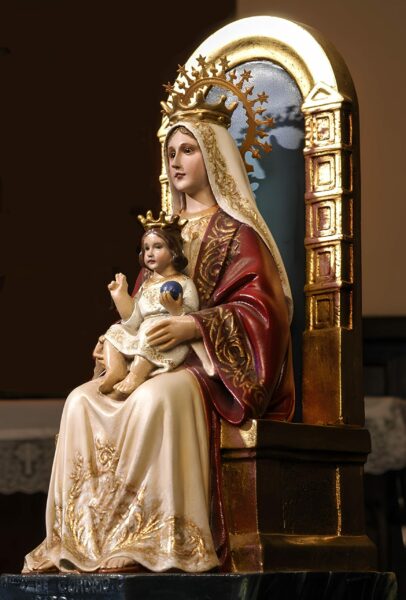
The bishops of Venezuela also invoke the patroness of Venezuela, the Virgin of Coromoto, so that she may accompany everyone on their path. «Let us persevere in prayer for unity.» In the face of the events unfolding today in our country, we ask God to grant all Venezuelans serenity, wisdom, and strength.» The bishops, who express their solidarity with the «wounded» and the «families of the deceased,» urged the population to «live with greater intensity the hope and fervent prayer for peace» in their «hearts and in society.» «We reject all forms of violence,» they added, encouraging «encounter» and «mutual support,» and hoping that «the decisions that are made are always for the good.»
Mario Proietti reflects on the words of Pope Leo XIV in the Angelus on the situation in Venezuela: «I follow with deep concern the events in Venezuela. The good of the dear Venezuelan people must prevail over any other consideration and lead to overcoming violence and seeking paths of justice and peace, guaranteeing the sovereignty of the country, ensuring the rule of law enshrined in the Constitution, respecting the human and civil rights of all persons, and working together to build a serene future of collaboration, stability, and harmony, with special attention to the poorest who suffer the difficult economic situation».
I think the most sensible thing is simply to focus on what he says. The Pope begins with an expression of pastoral concern: «With a heart full of concern, I follow the evolution of the situation in Venezuela». These are the words of a father looking at a wounded people, not those of an external observer. In the following passage —«The good of the beloved Venezuelan people must prevail over any other consideration»—, in my opinion, he carries out a silent and powerful operation that strips everyone of their moral alibi. No party, internal or external, can justify its actions with good intentions if the concrete result produces violence, chaos, or greater impoverishment. The people cease to be a slogan and become a reality that must be protected. By stating that the good of the population must prevail, the Pope sets a clear limit to any partisan narrative.
He introduces a second fundamental distinction, by speaking of the sovereignty of the country and the rule of law enshrined in the Constitution as two inseparable conditions. Sovereignty belongs to the law, not to arbitrariness. It is not the property of those who govern nor of those who seek to impose themselves by force. Here arises a barrier that protects both from external interference and from an internal power that uses the State as a shield to violate citizens’ rights. It is a stance that consciously renounces factional logic to defend a principle, and it is also the reason why this language cannot satisfy political partisans. The true core of the statement refers to the «special attention to the poorest who suffer the difficult economic situation». Perhaps, at these moments, the best thing is to join his invitation: “For this I pray and I invite you to pray, entrusting our prayers to the intercession of Our Lady of Coromoto and of the saints José Gregorio Hernández and Sister Carmen Rendiles”.
Formal start of the pontificate.
The intricacies of the Curia are not easy to understand and, much less, to manage; the Roman Curia does not surrender easily. In the sacred palaces, reports circulate, diplomatic contacts are activated, and attempts are made to condition the agenda through leaks to friendly media. The consistory will also allow identifying which cardenals are aligned with the new pontificate and which respond to the old order. Leo XIV is not Francis and avoids disruptive gestures. The consistory will be just the visible beginning of which no many concrete decisions are expected, but we will start to know what direction the pontificate is taking and we will see how affections reposition themselves. The deceased can be remembered, missed, but he is no longer here and it is impossible to follow him and everyone knows it.
Movements in the Sacred Palaces.
The Sacred Palaces are a tangle of rumorology and news and counter-news that are very complicated to assess. We did not want to comment on the episode already known as the Agostini case until today. Our infovaticana has reported adequately on the episode and how things stand. Agostini is a minor piece in the curia, but he is a man very significant with the traditional liturgy movement, that is well known and he has never hidden it, on the contrary. The core of the matter is a presumed disciplinary measure adopted by the Holy See of which, for now, we have no evidence. It points to a supposed dismissal due to the publication of an audio recording attributed to him, recorded in an unclear context, in which he supposedly made a comment considered offensive. Officially, the Vatican has said nothing, nor have the context of the recording, the authorship of the words, or their purpose been clarified. Nevertheless, the episode was considered incompatible with Agostini’s position, which presumably led to disciplinary measures.
In his native land, in Verona, he has defenders and the Honorable Vito Comencini , president of the Popolo Veneto association, publicly expressed his solidarity with Monsignor Agostini. In a published letter, he described the punishment as «unjust and senseless,» openly referring to a «worrying sign of persecution.» «The Agostini case confirms an ideological drift within the Church, which he links to the alleged pressure from LGBTQ lobby groups and a cultural stance that has its roots in the transformations after Vatican II. He maintains that the priest had been in the crosshairs for some time and that the telephone tapping incident is simply an excuse for his dismissal. In the absence of an official and detailed stance from the Vatican, the Agostini case remains open, oscillating between internal discipline, cultural clashes, and opposing ideological interpretations.
In this Vatican context, we must frame the recent statement by the president of the Pontifical Academy of Theology who again warns against the denomination of Mary Co-Redemptrix, based on non-existent risks and the usual arguments. It sounds like a defense of Tucho in ‘unstable’ moments and aligns with the Mater Populi Fidelis, which invalidates everything the Church has taught until now, including Vatican II. In a recent article published in the newspaper Avvenire, he adheres to the usual clichés about the supposed dangers of calling Mary «Co-Redemptrix,» without bothering to seriously consider the numerous theological and pastoral arguments in favor not only of the pertinence of this title. The article also expresses a desire to avoid discussion with those who, if consulted, would have drawn different conclusions from the Vatican Note: it is no mystery that the notable absences in the drafting and presentation of the document are precisely mariologists, who have expressed reservations and criticisms. What data does the president of the Pontifical Academy of Theology provide to support his claims? None. Resorting to the Most Holy Mary to avoid the supposedly severe face of Christ can also apply to the devotion to Our Lady of Pompeii, to Our Lady Help of Christians, to the Immaculate Conception, and even to the Mother of God. What should the Holy See do then? Publish a note prohibiting recourse to the Virgin Mary? If this were the case, we would have to erase practically all the dogmas of the Church. Does the affirmation of three divine Persons not risk undermining the truth of the existence of the one God? Is this not perhaps what Jews and Muslims still accuse us of today? Does the affirmation that the Pope is the head of the Church not endanger the truth that it is Christ? And is that not what the Orthodox reproach us for? Does the dogmatic declaration of the Immaculate Conception not risk suggesting that Mary did not need Christ’s salvation? Is that not the objection that Protestants continue to raise?
Mary’s singular participation in the redemption has never been understood as a human complement to an incomplete human-divine work, but, on the contrary, as the superabundance of Christ’s work, which allowed the Virgin to participate actively and immediately in His work. The stance of Staglianò, identical in this to what was expressed in the Doctrinal Note, is not at all motivated and arises from a reductive and insufficient consideration of the Most Holy Mary, understood solely in her dimension as «perfect disciple who points us to the only Redeemer», «luminous icon of the creature who, full of grace, fully trusts in the only God-Love». This approach causes the Church’s teaching on Mary to fall into the narrow Protestant horizon, erasing what the Magisterium, especially in the 20th century, including Lumen Gentium , has taught about her person and her singular, active, and immediate participation in the work of redemption. All these interventions have a very positive side; their protagonists confirm more and more the little theological depth of their arguments.
New empires with a dead Europe.
And we are finishing; we live in times when it is not easy to move. The world is in turmoil, from South America to Ukraine, from the Middle East to the Pacific Ocean, and everything is based above all on one thing: the dominance of raw materials and the energy necessary to drive the ongoing technological revolution: that of artificial intelligence, cryptocurrencies, massive robotics, electric mobility, quantum computing, and all the other technologies of enormous energy consumption that now appear on the markets. In short: whoever achieves technological and commercial dominance of these innovations will be the new ruler of the world. And whoever dominates the market for the raw materials necessary to produce them and the energy necessary to power them. It is a fragmented and relentless world war that has ridiculed multilateralism and supranational organizations and is destroying what little remains of international law as we know it.
Europe continues to be the true paradox of this new world: rich, but without raw materials, without energy, and without any kind of technological leadership in the sectors that will mark the future. The time has come to decide what we want to be when we grow up: helpless witnesses of a dying world? Faithful servants of the new empires? Or truly understand how to break this pattern, to avoid a dangerous return to the colonial 19th century or the 20th century of wars between superpowers? We greatly fear that the stance of pretending to be dead no longer works.
«Repent, for the Kingdom of Heaven is at hand.»
Good reading.