


The Pope is at his Villas, and February which is starting to wane, this doesn’t stop and the predictions of a particularly eventful year are coming true. In the Angelus he congratulated for the lunar new year: «The coming days will mark the Lunar New Year, celebrated by billions of people in East Asia and other parts of the world. May this joyful celebration encourage us to live family and friendship relations with greater intensity, bring serenity to homes and society, and be an opportunity to look together towards the future, building peace and prosperity for all peoples. With my best wishes for the New Year, I send my affection to all».There are appointments that raise suspicions due to their exceptional nature. Pope Leo XIV accepted on this February 14 the resignation of the Bishop of Amarillo, Patrick Zurek, and appointed Cardinal Daniel DiNardo to serve as Apostolic Administrator of the diocese of Texas (United States), until a permanent replacement can be found.
First visit to a Roman parish.
The parish of Maria Regina Pacis in Ostia Lido with a quota of altar girls against what has always been recommended and common sense, this is how it starts and we end up with archbishops. Ostia is traditionally linked to the Roman ‘malavita’. In Ostia, «violence exists and hurts», so «do not resign yourselves to the culture of abuse and injustice». «In the face of these phenomena I invite you all, as a parish community, together with the other virtuous organizations operating in these neighborhoods, to continue dedicating yourselves with generosity and courage to spreading the good seed of the Gospel in your streets and homes». «On the contrary, spread respect and harmony, starting by disarming tongues and then investing energy and resources in education, especially of children and young people». «This is my first visit to a parish in my new diocese. I am very pleased to start here, in Ostia. And then, in a parish dedicated to Our Lady, Queen of Peace, so important in these times we live in».
Leo XIV and Vatican II.
«Pope Leo XIV has chosen to reread and comment on the documents of the Ecumenical Vatican II Council in his Wednesday audiences. Sixty years have passed since its conclusion. For many, the so-called progressives, it is now an ancient event, surpassed by history, of little interest, for them it is the development of history, always and only that, which dictates not only the agenda, but also the content of the Church’s Magisterium. For others, however, the Council was the cause of the Church’s crisis, as if there had first been a golden age and then, suddenly, a storm broke out, unleashed by Vatican II. The truth has been patiently explained by all the pontiffs, in different ways and styles, from St. John XXIII to Francis: the Council, recognizing the difficulties of communicating the faith to modern man, tempted and seduced by ideologies and secularism, we must keep united «renewal and continuity», to avoid entering into the toxic dialectic that has wounded the Church in recent decades.
Matteo Matzuzzi in Il Foglio , of February 14 analyzes Pope Leo’s attempt to overcome the logic of confrontation between traditionalism and progressivism, as can be observed in some of his interventions, particularly in the letter addressed to the clergy of Madrid on January 28. In the letter, Pope Leo addresses the Spanish priests and reiterates the perennial priestly ideal, the «alter Christus», although this invitation may be unpleasant for some, including many bishops. Logic of the Pope is that we have the Council documents, we are in a historical moment that demands a new evangelization, new in methods, but not in doctrine, as St. John XXIII said in his first speech on the new evangelization when inaugurating Vatican II (October 11, 1962); we have understood that some have tried «to throw out the baby with the bathwater asking for a diaper change», and others have accepted this dialectical logic of conflict, harming the communion of the Church.
Is Leo a «too prudent» pope?
An anecdote from his past as prior general of the Augustinians has come to light that suggests that the 267th pontiff of the Catholic Church knows very well how to make decisions and command respect when the situation requires it, sometimes resorting to persuasive strategies. «Leo XIV takes his time»; «Will he be able to act with determination?»; «Will he know how to take a stand?»… These rumors have been heard for a few months in the Vatican and beyond. In his biography by Elise Allen, it recounts in particular an anecdote that took place when he was prior general of the Augustinians, at the head of a congregation of about 3000 members present in about fifty countries. When having to manage some problematic cases related to money and customs in Mexico. According to this account, one day when the Augustinians of this province were complaining about his reproaches, «Father Robert» pointed to a briefcase with his finger: «Wait a moment, in this briefcase I have the bank statements of several of you. So, either we start doing things right, or I start reading them one by one. You decide». At that moment, «everyone fell silent». Father Elías Neira also states that Father Prevost knew how to take «difficult but firm decisions». «He intervened forcefully», dismissing the leaders of the religious province of Mexico. The same opinion is held by Father Alejandro Moral Anton, who was his general vicar before succeeding him as prior. In an interview the day after the election, his colleague and friend stated that the new pope «will inform himself, consult, ask for advice, but in the end he will also know how to make decisions». Let us hope that the abuse case affecting Chiclayo during the time when Prevost was its bishop is resolved as soon as possible, it is essential for Pope Leo XIV to be free in his decisions, we will not tire of reminding it.
Interview with Radcliffe.
Interview with Timothy Radcliffe, the Dominican to whom Leo XIV entrusted, amid discontent, the introductory meditation of the recent Vatican Consistory. The English cardinal draws attention to those who feel «uncomfortable» with change, but reaffirms the participation of the laity and the diaconate for women. In the book “The Surprise of Hope. Meditations on a Church on the way” (Libreria editrice vaticana), which collects his interventions in the 2024 Synod, he states that the main enemy of the Church today is not atheism, but indifference: is it an irreversible trend? «The situation has already changed. In many Western countries, like France, Belgium, the United States and the United Kingdom, young people, especially men, are embracing Christianity, especially Catholicism. It is a «silent awakening». It is almost inevitable, because in every human heart, no matter how deeply buried it is, there exists a thirst for the true meaning of human existence, which is that infinite love we call God. It is something inextinguishable, and therefore, although there are moments of indifference or even hostility towards religion, this thirst for transcendence will resurface. It has its roots in our humanity.
How can we overcome «polarization»? «If you try to stay only in the middle, you run the risk of distancing yourself from everyone and becoming boring. It is often more fruitful to pay attention to people’s passionate concerns, even if expressed in overly extreme terms, and to be attentive to the truth they appreciate and that the whole Church needs.
Taking possession in Westminster.
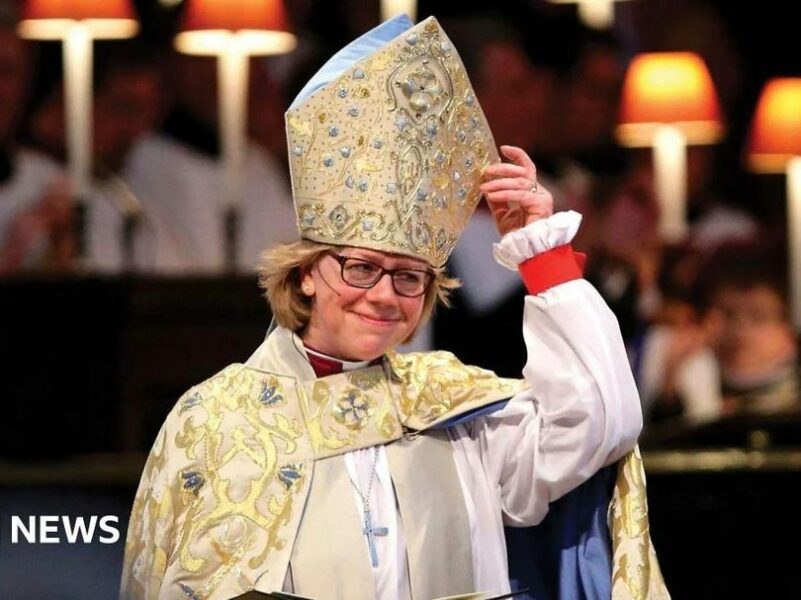
The welcome rite is inspired by an ancient Pontifical used in Canterbury during the time of Archbishop Chichele (1414-1443). In Westminster, this has been a tradition since the restoration of the Catholic hierarchy in England and Wales in 1850 and the appointment of Nicholas Wiseman as the first Archbishop of Westminster. Canon Lennard then pronounced the investiture formula: «By his authority, I, Shaun Lennard, provost of the Metropolitan Chapter of Westminster, install you, Lord Richard, archbishop of this Church of Westminster, in which the Lord Jesus Christ guards his entrance from now on, now and forever». Present was the Archbishop of Canterbury, Sarah Mullally who then greeted Archbishop Moth on behalf of the co-chairs of Churches Together in England: «I am here also as someone who was recently confirmed as Archbishop of Canterbury and who also awaits her investiture. In the coming months, you and I will share a special responsibility as presidents of Churches Together in England, and I look forward with great interest to working with you to deepen our relationship and strengthen our common Christian witness». A passage from the homily referred to Pope Benedict XVI in Westminster Hall in 2010: the dialogue between reason and faith as a mutual necessity «for the good of our civilization «, and religion as a «vital contribution». On this basis, Moth listed the «great issues of our time» that demand to be illuminated by the light of the Gospel: peace among peoples, the dignity of each person, the right to life in all its stages, the protection of the vulnerable, the difficult situation of refugees and those who find themselves deprived of everything, and the care of our common home.
Marco Rubio and common spiritual tradition.
It is not a topic directly ours, or perhaps it is because of its importance and content. We refer to Marco Rubio’s speech, it is not common to hear a politician, and one of the highest level, say the things he has said. We recommend reading it, you have it in Marco Rubio calls to found the West on the «historical consciousness of a common spiritual tradition» Equally highly recommended is the article Marco Rubio: the ideologue of 21st century Western civilization in the Trump era : «Rubio opens his speech with a masterful maneuver: he simultaneously dismantles the dogma of globalist neoliberalism and the imposture of the false lefts that for decades have lived by selling indignation while administering ruin». «We are faced with a declaration of civilization. Rubio did not speak as chancellor. He spoke as heir. He spoke as a man who understands that foreign policy is not a catalog of agreements, but an invisible battle for the moral architecture of the world. And in a single speech he traced, with surgical precision, the map of what is to come: a new Western century or the definitive collapse of the project that was born in Greece, perfected in Rome, spiritualized in Jerusalem and institutionalized in Europe before crossing the Atlantic and becoming the United States». «Rubio says it with elegant brutality: deindustrialization was not inevitable. It was a decision. Energy dependence was not inevitable. It was a decision. Outsourcing sovereignty to international institutions was not inevitable. It was a decision. Opening borders until dissolving the very concept of nation was not inevitable. It was a decision». «What Rubio has done is not speak. What Rubio has done is light a torch and when a torch is lit in the midst of darkness, it does not illuminate to contemplate the landscape; it illuminates to advance.
«Why does this generation ask for a sign?».
Good reading.