


Es sábado y siempre con asedia la pereza propia del fin de semana, hay oficios que no permiten relajarse. Nuestro Maquiavelo, que no era un santo padre, hablaba de tres clases de cerebros: el primero discierne por sí, el segundo entiende lo que los otros disciernen y el tercero no entiende ni discierne lo que los otros disciernen. El primero es excelente, el segundo bueno y el tercero inútil. Intentaremos ser buenos, y si es posible excelentes, de la tercera posibilidad: ¡liberanos domine!
Life in Abundance.
Pope Leo XIV is convinced of this in his letter «Life in Abundance,» to «illuminate from within the meaning of sporting action, showing how the pursuit of results can coexist with respect for others, for the rules, and for ourselves.» A good sports pastoral can contribute significantly to reflection on sports ethics. «The harmony between physical and spiritual development must be considered a constitutive dimension of an integral vision of the human person.» «Sport thus becomes a place where we learn to care for ourselves without idolizing ourselves, to surpass ourselves without diminishing ourselves, to compete without losing the sense of fraternity.» «Sport can and must be a welcoming space, capable of involving people from diverse social, cultural, and physical backgrounds.» «Freeing sport from reductive logics that transform it into mere spectacle or consumption» is the final invitation: «Abundance does not come from victory at all costs, but from sharing, respect, and the joy of walking together.»
Embassy of Ukraine to the Holy See.
Statement expressing sincere gratitude to the Holy See and to Cardinal Matteo Zuppi for their daily work and support, which will continue until all Ukrainian prisoners of war and civilians detained in Russian prisons return home. First exchange of prisoners of war this year, thanks to which 157 Ukrainian citizens returned home. These are members of the Armed Forces of Ukraine, the National Guard, and the State Border Service (soldiers, sergeants, and officers), as well as civilians. Most of them had been captive in Russia since 2022.
Courage International.
On Friday morning in Rome, Pope Leo XIV met with representatives of Courage International, an organization that helps Catholics struggling with same-sex attraction and gender dysphoria to live chaste lives according to the Gospel. Four members of Courage were present at the audience, including Bishop Frank Caggiano of Bridgeport, Connecticut, president of the group’s episcopal board; Father Kyle Schnippel, a priest from Cincinnati who chairs Courage’s international executive board; Father Brian Gannon, the organization’s executive director; and layman Angelo Sabella, a Courage member for 31 years. The group expressed its gratitude for being able to tell Leo how “providing pastoral accompaniment to people who experience same-sex attraction but strive to live chaste lives or accompany family members who have a loved one who identifies as LGBTQ was a transcendental occasion”.
Courage was founded in New York in 1980. It has grown steadily over the past 46 years. It currently operates in more than 15 countries and received the endorsement of the Pontifical Council for the Family in 1994, under John Paul II. Pope Francis never met with the organization, opting instead to elevate the public profile of the pro-LGBT Jesuit James Martin and other pro-LGBT clerics. Unlike Outreach, an organization led by James Martin, Courage does not support laypeople in sexual sin nor encourage them to promote gender ideology. Courage encourages them to live holy lives. Its five core principles are chastity, prayer and dedication, fellowship, support, and good example.
Leo’s meeting with Courage is significant, as it comes four days after Martin appeared on left-wing TV host Stephen Colbert’s late-night show. After explaining that he met with Leo last year after the conclave: “The message I received from him was that he continues the mission and message of welcome and inclusion of Pope Francis, and wants it to be conveyed.” Martin received a controversial audience in the Apostolic Palace with Leo XIV. After the conversation, Martin shared on social media that he believes “Pope Leo will continue with the same openness that Francis showed toward LGBTQ Catholics.” Leo met with the pro-LGBT heretical nun Sister Lucía Caram. The meeting was not published in the Vatican daily bulletin, and neither Caram nor friendly pages reported it. Caram had declared that homosexual couples should be able to marry in the Church. The patron saints of Courage are St. Charles Lwanga and his companions, St. Mary Magdalene, St. Augustine, and St. Monica.
Leo XIV and the pacification of the curia.
Diane Montagna analyzes the return to the previous situation regarding the use of apartments owned by the Holy See. «These are good news, right? Well, perhaps not entirely.» Pope Leo would have good reasons to recognize this injustice; he too paid market rent for his apartment when he was appointed head of the Dicastery for Bishops, immediately after the 2023 decree came into effect. The Pope Leo’s decision to repeal the 2023 decree can be seen as a matter of justice, but it can also be seen as a guarantee for the leaders of the Roman Curia. Has Pope Leo done anything since his election that cannot be seen as a guarantee for the Curia? Pope Leo seeks to heal divisions and restore morals: undoubtedly, a remarkable goal. But it is also possible to interpret his leadership to date as motivated simply by the desire to pacify the Vatican, restore normality, and thus ensure that those who keep the Vatican bureaucracy running feel happy in their positions. If Pope Leo were motivated by the desire to do justice to Cardinal Burke, it would be wonderful. But insofar as he was trying to satisfy the desires of the Roman Curia, this is only good news if one has full confidence in it.
The Laity, Family, and Life.
Plenary session of the Dicastery for the Laity, Family, and Life with an audience in the Apostolic Palace. The Assembly was inaugurated by Cardinal Kevin Joseph Farrell to address « issues of greater importance » and the « general principles », and not procedural files or merely organizational issues. Farrell, in his introductory speech, insisted on the urgency of basic formation capable of repositioning the encounter with Jesus Christ at the center, above any internal agenda. The most forceful passage was a bitter but realistic observation: «even before synodal participation, what is lacking today is faith », with alarm at the «alarming growth» of people who «do not know Jesus Christ at all ».
Leo XIV’s speech to the participants of the Plenary Assembly fits into this framework, confirming the direction and, at the same time, clarifying some aspects. The Pope acknowledged the value of the two central themes of the meeting —Christian formation and World Meetings—, but chose to focus especially on formation. Leo XIV pointed out that in the Church, «sometimes», the figure of the formator as a « pedagogue », committed to transmitting instructions and skills, has prevailed over that of the « father » capable of generating faith. «We cannot limit ourselves to transmitting a doctrine, an observance, an ethic», because the mission implies personal involvement: «sharing what we experience», with « generosity », « sincere love », «willingness to suffer for others», «unreserved dedication».
Women Church World.
The new issue of Donne Chiesa Mondo, the monthly women’s magazine of L’Osservatore Romano, edited by Rita Pinci. The new issue reconstructs the long and complex relationship between women, work, and social recognition, from Rerum Novarum to the words of Pope Francis, who called the gender pay gap a «pure scandal.» A journey that spans the 20th century and arrives today, when more than 70% of unpaid family care still falls on women. The issue completes the review of the documentary She and a account of the 1902 Piscinine strike.
Stefan Oster moves away from the heretical synodal path.
German Bishop Stefan Oster of Passau publicly rejected the heretical “Synodal Way,” announcing that it will not be implemented in his diocese. “I cannot and do not want to accept the essential ‘reform demands’ that the Synodal Way has already decided.” “I am convinced that the answers the Church can give from the depth of its tradition… cannot be given simply with the keyword ‘blessings’ nor even with a non-sacramental diaconal consecration.” The latest implementation of the Synodal Way “basically presupposes a new sexual morality and with it a new anthropology.” “In all these points, therefore, it is assumed that the doctrine must change —and that it has already changed in the consciousness of the vast majority of synodals—”. Due to his belief in the Church’s existing teaching and that it will not change, “I cannot follow the vast majority of points” in the follow-up phase “and its implementation demands.” “Furthermore, because I, as a deacon, priest, and bishop, have solemnly promised several times to preserve and proclaim the Church’s teaching.”
Oster questioned whether participants in the Synodal Way believe in the Real Presence of Our Lord Jesus Christ in the Most Holy Sacrament, lamenting that more than 90 percent of those surveyed in 2024 “are no longer interested in the sacraments,” at least in the Eucharist, which he referred to as the “source and summit of the entire life of the Church.” In 2023, an overwhelming majority of Synodal Way members, including more than two-thirds of German bishops, voted in favor of heretical documents calling for “ women deacons ”, “blessings” of homosexual relationships , changes to the Church’s teaching on the sinfulness of homosexual acts, and even “transgender” priests in a text full of pro-transgender ideology.
Interview with Burke.
Article by Michael Haynes in Per Mariam : «Atheistic promotion of anti-life policies leads to the self-destruction of nations». The interview was conducted following Pope Leo XIV’s speech to the Diplomatic Corps accredited to the Holy See, the State of the World Address, in which he strongly condemned abortion, surrogacy, and euthanasia. In recent years, a certain slowdown in the ecclesial momentum toward activism in defense of the sanctity of life has been observed, as an intense internal debate has arisen in some sectors of the U.S. episcopate on whether abortion is the preeminent moral issue of the moment. Pope Leo XIV’s personal message to the participants of the 2026 March for Life in Washington, D.C., certainly seems to have reiterated the gravity of abortion and represents a papal signal on the necessary response.
Welcoming Pope Leo XIV’s message —which differed from those sent in the name of Pope Francis by Cardinal Pietro Parolin, Secretary of State—, Cardinal Raymond Leo Burke urged Americans to respond by interacting more directly and deeply with anti-life activists, «because many people, for whatever reason, do not think deeply about these issues.» Burke also acknowledged that «there has been some confusion in the Church regarding moral issues related to human life». These issues, related to the sanctity of life, have been equated with lesser issues, such as «the environment, immigration, and other related topics, which require prudent judgment». His comments come at a time when the misuse of «Orwellian» language, condemned by Pope Leo XIV , is being used to attack pro-life Catholics and activists even in once-legendary democracies like the United States and the United Kingdom.
Hicks is already archbishop of New York.
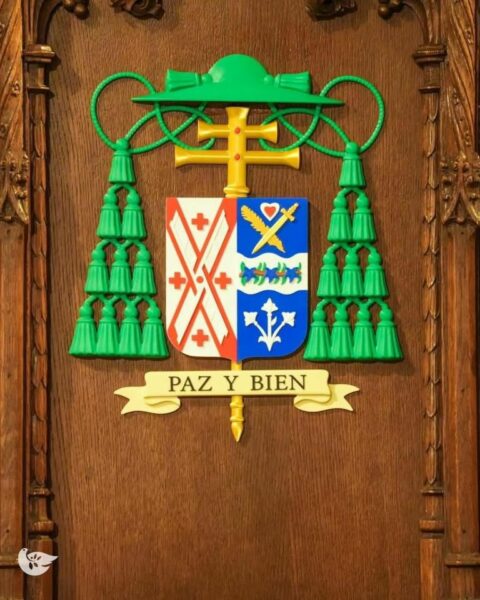
St. Patrick is very St. Patrick and New York is very New York; Ronald Hicks has been its archbishop since yesterday afternoon. Hicks knocked on the door and was received in St. Patrick’s Cathedral by Cardinal Timothy Dolan. Hicks spoke of his love for New York through songs, citing Frank Sinatra and Billy Joel. During the ceremony, the apostolic letters were read, Hicks sat in the chair that symbolizes his authority over the archdiocese, which already displayed his official coat of arms with his motto in Spanish: Peace and Good. The Hispanic community is especially large and vibrant in New York, and it shows, very affectionate in his interventions in Spanish. “We are called to be a missionary church. A church that catechizes, evangelizes, and puts our faith into action.” “A church made up of missionary disciples who go out to make disciples, passing on the faith from generation to generation. A church that cares for the poor and vulnerable. A church that defends, respects, and protects life, from conception to natural death.” Hicks is seen as a bishop very much in the style of Leo. Mayor Zohran Mamdani congratulated Hicks in a social media post, saying, in part: «I know that Archbishop Hicks and I share a deep and enduring commitment to the dignity of every human being and look forward to working together to create a more just and compassionate city where every New Yorker can thrive.»
Bishops without authorization from Rome.
The Superior General of the SSPX has granted an extensive interview , in which it is clearly understood that the episcopal consecrations will be carried out independently of any response from Rome, for the good of the «salvation of souls.» The leaders of the Fraternity do not intend to ask the Holy See to regularize their situation (something they have always refused), but rather that the Pope approve the existence and operation of the SSPX without canonical status in the Church, and thus accept the necessary episcopal consecrations to continue their apostolate. The proposal, «taking into account the very particular circumstances in which the Fraternity finds itself, consists concretely in asking the Holy See to allow us to continue temporarily in our exceptional situation, for the good of the souls who come to us. […] It seems to me that such a proposal is realistic and reasonable, and that, in itself, it could be accepted by the Holy Father».
The Fraternity essentially asks the Pope to approve its continued existence and operation outside any canonical structure; and this would be possible thanks to the axiom ‘ suprema lex, salus animarum’: the supreme law is the salvation of souls. There is no offer of regularization that the Fraternity could accept, not even that of a personal prelature or an ordinary, because in any case it would imply a reduction of that «freedom» which it enjoys today, i.e., the freedom to proceed with ordinations, to found or suppress seminaries, colleges, convents, to welcome or expel members, to open Mass centers and priories, to declare the nullity of marriages, without having to consult anyone and without depending on any higher authority. What Fr. Pagliarani does not say is that this freedom that the SSPX claims by virtue of its total independence from the Catholic Church hierarchy is called schism. The need to belong to the Church through juridical bonds is therefore not a matter of mere ecclesiastical law, but concerns the divine constitution of the Church; breaking or rejecting such bonds is therefore not simply illegal, but schism.
Confrontation between Paul VI and Lefebvre.
Very interesting at this moment. We end with Valli who republishes an article with the account of the dramatic confrontation that took place between Pope Paul VI and Archbishop Marcel Lefebvre in Castel Gandolfo on September 11, 1976, which contains all the elements that are still at the center of the dispute today.
«You are in a terrible situation! You are an antipope!
—That’s not true. I am only trying to form priests according to the faith and in the faith.
Let us imagine the scene. On one side, Pope Paul VI, seventy-nine years old, who led Vatican II to its conclusion. On the other, Monsignor Marcel Lefebvre, seventy-one years old, the archbishop who rejected the Council and founded the Society of St. Pius X. The confrontation takes place in the Pope’s summer residence, Castel Gandolfo. It is September 11, 1976. The two elders are divided on everything, but both feel at the service of Holy Mother Church. And they seek an agreement. It never comes.»
«On July 22, 1976, Archbishop Marcel Lefebvre, who had founded the Society of St. Pius X six years earlier, was condemned by the Holy See to the very grave penalty of suspension a divinis. This was a consequence of the priestly ordinations conferred by Lefebvre in Ecône, but the archbishop, who firmly opposed the reforms promoted by Vatican II, did not give up. ‘We have two thousand years of Church and not twelve years of a new church, a ‘conciliar church’,’ he declared on August 22, the feast of the Immaculate Heart of Mary, citing the letter in which Archbishop Giovanni Benelli had asked him for an act of submission. ‘I do not know this ‘conciliar Church.’ I only know the Catholic Church. Therefore, we must stand firm in our positions. In the name of our faith, we must accept anything, any abuse, even if we are despised, even if we are excommunicated, even if we are punished, even if we are persecuted’.
In Father Leonardo Sapienza’s book, «La barca di Paolo,» we have its full transcription: eight typewritten pages, including the start and end times of the meeting compiled by an exceptional writer, Monsignor Benelli himself, who at the time was acting Secretary of State and a few months later would be promoted to Archbishop of Florence and made a cardinal. The Pope and the French monsignor had known each other for a long time, and in the past, during his time in Milan, the then-Archbishop Montini had expressed flattering opinions about Lefebvre.
On that September 11, Paul VI was not willing to make concessions. He began: ‘You condemn me. I am a modernist, a Protestant. It is unacceptable! You are misbehaving.’ He said: ‘I hope to have before me a brother, a son, a friend,’ but he accused Lefebvre bluntly: ‘Unfortunately, the stance you have taken is that of an antipope. You have allowed no moderation in your words, your actions, and your behavior.’ What is at stake, the pontiff explains, is not the person, but the Pope: ‘And you have judged the Pope unfaithful to the faith of which he is the supreme guarantor. Perhaps it is the first time in history that this has happened. You have told the whole world that the Pope has no faith, that he does not believe, that he is a modernist, etc. I must be humble, yes, but you are in a terrible situation. You are committing acts, before the world, of the greatest gravity’.
Archbishop Lefebvre responded in a softer tone, but with the same firmness. While admitting that perhaps some of his words were inappropriate, he explained that he never intended to attack the Pope: ‘It is not I who wants to create a movement; it is the faithful who are torn by pain and cannot accept certain situations. I am not the leader of the traditionalists. I am a bishop who, torn by the pain of what is happening, has tried to form priests as was done before the Council. I behave exactly as before the Council. Therefore, I cannot understand how it is possible that suddenly I am condemned for forming priests in obedience to the sound tradition of the Holy Church’.
Paul VI invited Monsignor Lefebvre to continue his explanation, and the founder of the Society of St. Pius X declared: ‘Many priests and faithful find it difficult to accept the tendencies that emerged the day after the Second Vatican Ecumenical Council with regard to the liturgy, religious freedom, relations between the Church and Catholic states, and the Church’s relations with Protestants. It is not clear how what is said fits with the sound Tradition of the Church. And, I repeat, I am not the only one who thinks this way. There are many people who think this way. People who cling to me and push me, often against my will, not to give in. I don’t know what to do. I try to form priests according to the faith and in the faith. When I look at other seminaries, I suffer terribly: unimaginable situations. And besides: religious who wear the habit are condemned and despised by the bishops, while those who are appreciated are those who live a secular life, those who behave like people of the world’.
Paul VI admits that the Council gave rise to «abuses» and explains that he works to eliminate them, but criticizes Monsignor Lefebvre for not trying to understand the Pope’s motives, while he strives to ensure the Church’s fidelity to tradition and, at the same time, respond to new demands. We, says the Pope, «are the first to deplore the excesses. We are the first and most eager to seek a remedy. But this remedy cannot be found in a challenge to the authority of the Church. I have written to you repeatedly. You have ignored my words.»
Lefebvre, in turn, responds that the battle he has undertaken is in defense of the faith. What we read in the conciliar texts, he says, referring in particular to religious freedom, is contrary to what previous popes have said, and this is unacceptable. Individual matters, the Pope observes, cannot be discussed in audience. What is being discussed is «your attitude against the Council». And it is at this point that the discussion takes on the characteristics of a classic dialogue of the deaf.
Monsignor Lefebvre: «I am not against the Council, but against some of its actions».
Paul VI: «If you are not against the Council, you must adhere to it, to all its documents».
Monsignor Lefebvre: «We must choose between what the Council said and what its predecessors said».
Paul VI: «As I said, I have taken note of your perplexities».
At this point, Lefebvre, having the opportunity to address the Pope directly, formulates a prayer on behalf of all the faithful who do not wish to depart from tradition: «Would it not be possible —he asks— for bishops to have a chapel in their churches where prayer could be offered as it was done before the Council? Today, everything is permitted to everyone: why not allow us something too?». Paul VI replied: «We are a community. We cannot allow different parties to exercise autonomy in their behavior».
However, «the Council», Lefebvre observes, «allows pluralism. We ask that this principle be applied to us as well. If His Holiness did so, everything would be resolved. Vocations would increase. Those aspiring to the priesthood wish to be formed in true piety. His Holiness has in his hands the solution to the problem that torments so many Catholics in the current situation. As for me, I am willing to do anything for the good of the Church: that someone from the Congregation for Religious take charge of supervising my seminary; I will no longer give lectures; I will remain in my seminary. I promise never to leave it; agreements could be reached with various bishops to place seminarians at the service of their respective dioceses; possibly, a Commission for the Seminary could be appointed.
Paul VI reminded Lefebvre that Bishop Adam «came to speak to me on behalf of the Swiss Episcopal Conference, to tell me that he could no longer tolerate your activity… What should I do? Try to restore order. How can you be considered in communion with Us, when he positions himself against Us, before the world, accusing Us of infidelity, of wanting to destroy the Church?» «I never intended…», Lefebvre defended himself. But Pope Montini pressed him: «You said it and wrote it. I would be a modernist Pope. By implementing an Ecumenical Council, I would betray the Church. Understand that, if that were the case, I would have to resign and invite you to take my place and lead the Church.»
Lefebvre: «The Church is in crisis».
Paul VI: «We suffer deeply because of this. You have contributed to making it worse with your solemn disobedience, with your open challenge to the Pope».
Lefebvre: «I am not judged as I should be».
Paul VI: «Canon Law judges you. Are you aware of the scandal and the damage you have caused to the Church? Are you aware of it? Would you feel comfortable presenting yourself to God in this way? Evaluate the situation, make an examination of conscience, and then ask yourself before God: What should I do?»
Lefebvre: «It seems to me that by slightly widening the range of possibilities to do today what was done before, everything would be fine. That would be the immediate solution. As I said, I am not the leader of a movement. I am willing to stay locked in my seminary forever. People contact my priests and are instructed. They are young people with a sense of the Church: they are respected on the street, in the subway, everywhere. Other priests no longer wear cassocks, no longer confess, no longer pray. And the people have chosen: these are the priests we want».
Does the Pope know, the archbishop wonders at this point, that in France there are «at least fourteen canons» used for the Eucharistic Prayer? Paul VI replied: «Not only fourteen, but a hundred. There are abuses, but the good that the Council has brought is great. I do not want to justify everything; as I said, I try to correct what is necessary. But it is right, at the same time, to recognize that there are signs, thanks to the Council, of a vigorous spiritual rebirth among young people and of a greater sense of responsibility among the faithful, priests, and bishops».
Lefebvre: «I do not say that everything is negative. I would like to contribute to the building of the Church».
Paul VI: «But certainly not in this way do you contribute to the building of the Church. But are you aware of what you are doing? Are you aware that you are going directly against the Church, the Pope, the Ecumenical Council? How can you arrogate to yourself the right to judge a Council? A Council, after all, whose acts, for the most part, were also signed by you. Let us pray and reflect, subordinating everything to Christ and to his Church. I too will reflect. I humbly accept your reproaches. I am at the end of my life. Your severity gives me cause for reflection… I am sure that you too will reflect. You know that I held you in high esteem, that I recognized your merits, that we agreed, in the Council, on many topics…».
“That is true,” Lefebvre acknowledges. «You will understand», Paul VI concluded, «that I cannot allow that, not even for reasons that I would call ‘personal,’ you be guilty of a schism. Make a public statement retracting your recent statements and behaviors, which all have considered acts not intended to build the Church, but to divide and harm it… We must rediscover unity in prayer and reflection». The conversation ended and Monsignor Benelli noted: «The Holy Father then invited Monsignor Lefebvre to recite with him the “Pater Noster,” the “Ave Maria,” the “Veni Sancte Spiritus”». After that September 11, there will be no more meetings. The minutes drafted by Benelli, Thouvenot writes, essentially reflect Lefebvre’s account, but there is a difference. Benelli’s report does not mention at all the reprimand that, according to Lefebvre, Paul VI had directed at the archbishop for the oath against the Pope that, according to Montini, the Écône seminarians had to take.
Next, on the matter of the oath, Lefebvre’s version of the conversation.
Paul VI: «You have no right to oppose the Council. You are a scandal to the Church, you are destroying it. It is terrible, you are inciting Christians against the Pope and against the Council. Do you feel nothing in your conscience that condemns you?»
Monsignor Lefebvre: “Absolutely not”.
Paul VI: «You are reckless.»
Monsignor Lefebvre: «I have the conscience of continuing the Church. I form good priests…»
Paul VI: «It is not true! You form priests against the Pope, you make them sign an oath against the Pope!»
Archbishop Lefebvre: «Me? How is it possible, Holy Father, that you tell me something like that? I, forcing someone to sign an oath against the Pope! Could you show me a copy of that oath?»
Paul VI: «You condemn the Pope! What order do you give me? What should I do? Should I resign so that you can replace me?»
According to Lefebvre, when he heard that no oaths against the Pope were made in Ecône, Paul VI was «astonished, because he was truly convinced of the truth of this information that had probably been given to him by Cardinal Villot». In any case, the conversation of September 11, 1976 was fruitless. Paul VI expected a public statement from Lefebvre retracting his statements against the Council; Lefebvre expected a papal gesture in favor of «traditionalist» Catholics. Neither got what he wanted.
«Come to me, all you who labor and are burdened, and I will give you rest.»
Good reading.