


Another heart-pounding day, the mild temperature of the eternal city allows us to take advantage to enjoy a beauty that is always surprising and unique. Touching daily reality is feeling the perishability of human things before the eternity of the divine. It’s what we have, we are mortals, it’s February tenth, tomorrow is a holiday in the Vatican, a civil holiday, it’s the anniversary of the birth of the Vatican State with the Lateran Pacts, and the anniversary of the unforgettable resignation of Benedict XVI.
Letter from Pope Leo XIV to the priests of Madrid.
The papal visit to Spain.
Yago de la Cierva is the general coordinator of the organizing committee, he already was for Benedict XVI’s WYD, the last trip of a Pope to Spain, he calls for citizen participation and the contribution of resources without resorting to state funding. The team includes other well-known faces from the 2011 event, such as Giménez Barriocanal, Rafael Rubio, Paula Rodríguez, Javier Sobrino and Mariano Rodríguez. The Vatican has not yet officially confirmed the visit, the coordinator believes there is much to be thankful for, starting with the choice of Spain as one of the first stops of Leo XIV’s pontificate. «We don’t know if he comes because he loves us or because we need him more than others, but the fact is he comes,» he joked, specifying that the dates and itinerary are not yet defined, but that «the bishops are very optimistic.»
The preacher of the Pope’s exercises.
Andrea Gagliarducci analyzes: «The choice of preachers for the Lenten Spiritual Exercises has always had a special meaning, and Pope Leo XIV’s choice of a Norwegian Trappist bishop to lead this year’s retreat in the Roman Curia is no exception.» «Karol Wojtyla, whom Paul VI introduced to the Curia by having him preach the 1976 Lenten Spiritual Exercises. This was the case with Joseph Ratzinger , whom John Paul II chose as preacher for the 1983 Lenten Spiritual Exercises upon his arrival in Rome. Benedict XVI almost always chose cardinals, in part to confer greater authority on the role. Pope Francis almost always chose friars or priests.» Leo XIV, in his first choice, appointed Eric Varden, Bishop of Trondheim, a Trappist with a traditional mindset and strong personal devotion. He analyzes Pope Leo’s way of acting: «This means that he is a Pope who avoids conflicts when he can and absorbs impacts when he cannot avoid them . He has his own approach to diplomacy, both internal and external» . «The choice of Varden, in this sense, is revealing. It shows where the Pope’s heart beats. And now it’s a matter of it continuing to beat for a long time.»
Epstein’s black hole and the Vatican.
All very curious and disconcerting. A few days after Benedict XVI’s resignation, Jeffrey Epstein sent the following email to Larry Summers, former U.S. Treasury Secretary: «The most important change in the Vatican may not be the sudden retirement of Pope Benedict XVI, but the change of leadership at the Institute for the Works of Religion, the Vatican bank. Thanks to its sovereign status, the Vatican is exempt from transparency regulations not only in Italy, but also in the European Union. This status allows its elite clients to evade any scrutiny of their money transfers. Last May, the president of the Vatican Bank, Ettore Gotti Tedeschi, was fired after Italian authorities launched an investigation into a vast corruption plot in which he was allegedly involved. A search of his home found 47 files, including compromising files on his internal enemies in the Vatican. They contained instructions on how to use them in case something happened to him. Tedeschi’s intercepted phone calls also revealed that he feared being murdered because he knew Vatican secrets. By the end of 2012, he was collaborating with the ongoing Italian investigation. It was at that moment… That the all-powerful College of Cardinals, in one of Benedict XVI’s last acts of his papacy, appointed German lawyer Ernst von Freyberg as president of the bank. Then came the extraordinary resignation of Pope Benedict XVI.»
It is not clear if these assessments were really written by Epstein. Given that his other emails contain spelling errors and erratic punctuation, Epstein did not seem capable of producing two well-structured sentences in a row. Therefore, it is more likely that the message was drafted by someone else or extracted directly from one of the reports he regularly received from various sources (JP Morgan, diplomats, business partners, etc.). In any case, why did Epstein share this Vatican-related information with Summers? Was it simple curiosity? A warning about possible risks for some clients involved in international finance?
Shortly before Ratzinger’s resignation on January 1, 2013, the Vatican was excluded from the Swift system, which caused a blockade of credit cards, debit cards and other ATM services. The shutdown came after a directive from the Bank of Italy, which prohibited Deutsche Bank (the operator of the Vatican’s electronic payment services) from providing these services for failing to comply with anti-money laundering regulations. And by a surprising coincidence, everything was resolved on February 12, 2013, the day after Benedict XVI announced his resignation, thanks to an agreement with another provider, the Swiss company Aduno SA, which restored the services in compliance with current regulations. It is no surprise that these disconnections tend to coincide with geopolitical changes that go far beyond finances: for example, Iran was excluded in 2012, readmitted in 2016 after the nuclear deal and expelled again in 2018 after President Trump’s withdrawal from the deal.
Did the White House also exert some kind of pressure on the Holy See? Currently, there is no evidence, it remains a mystery, who ordered the shutdown of the Vatican’s ATMs for a month and a half, nor who suddenly restored them immediately after Ratzinger’s resignation. The unanswered questions join the references to a possible «Vatican Spring» in John Podesta’s emails published by WikiLeaks. Let us remember that in those messages, prominent figures close to the Clinton network openly speculated about the need for internal reform in the Catholic Church, describing it in language surprisingly similar to that used elsewhere for political transitions: pressure from below, modernization and alignment with liberal thinking. Podesta spoke in cultural and theological terms, but the financial dimension—IOR reform, regulatory compliance, access to global payment systems—was clearly implied.
The Bishop of Denver.
Pope Leo XIV appointed Bishop James R. Golka as the sixth Archbishop of Denver. Golka, 59 years old, is currently Bishop of Colorado Springs and speaks Spanish fluently, created a shrine in Colorado Springs dedicated to Our Lady of Guadalupe, Mother of the Divine Redeemer and patroness of the diocese. The Bishop Golka also serves as Episcopal Moderator of the Diocesan Fiscal Management Conference. in 2024, Bishop Golka also published a pastoral letter for the jubilee year titled “ Christ, our hope ”, in which he encouraged pastors to “make the Sacrament of Reconciliation available to the faithful as much as possible” . An analysis published by Catholic World Report last November revealed above-average results in the number of vocations in the Diocese of Colorado Springs. In an open letter to his brother bishops in the state last year, Golka also spoke out openly against the so-called Pregnancy-Related Services Coverage legislation, which sought to allocate a minimum of 1.5 million dollars of taxpayers’ money per year to abortions. The Archdiocese of Denver is Colorado’s largest metropolitan see, with 600,000 Catholics, 148 parishes and 31 Catholic schools.
Meeting between Fernández and the Lefebvrians.
On Thursday, February 12, Davide Pagliarani, Superior of the Society of St. Pius X, will climb the stairs of the Dicastery for the Doctrine of the Faith to meet with the Prefect, Fernández, it will be a face-to-face meeting, without witnesses. Could personal sympathy, even from completely different positions, induce the interlocutor to suspend the announced episcopal ordination for the next July 1 ? A risky hope, which finds, on the part of the prefect, the singular condition of having established a «personal» parish for the Traditionalist Fraternity in his former diocese of La Plata, Argentina. A unique case worldwide.
In recent years, the Lefebvrian dialogue with the Dicastery for the Doctrine of the Faith (after the suppression of the Ecclesia Dei commission), in addition to the direction of the Dicastery, has involved Cardinal Kurt Koch, prefect of the Dicastery for the Promotion of Christian Unity, and Archbishop Guido Pozzo, his lifelong interlocutor. On the part of the fraternity, two bishops, Bernard Fellay and Alfonso de Galarreta, have participated actively.
Benedict XVI’s concessions to celebrate according to the ancient rite (2007), the lifting of the excommunications of the four bishops in 2009 and the very favorable proposals made to them in the subsequent dialogue were in vain. Their distancing and denial of Vatican II remain intact: from ecumenism to religious freedom, from the judgment on modernity to relations with Israel, particularly regarding liturgical reform. The supreme law of ecclesial action ( salus animarum , salvation of souls) is invoked today, as Archbishop Lefebvre did in 1988 for the appointment of the four bishops. There is a curious element that links the Fraternity with the Vatican authorities responsible for exempting those whom priestly ordination (reduction to the lay state) requires. The numerous cases involving them are usually referred to Rome, and the Fraternity abides by the Vatican’s assessment. These cases are not rare, as the number of their priests (about 700) has remained practically stable for years, despite the numerous vocations and predictable deaths. If the hope of perpetuating the planned episcopal ordination is not fulfilled, it is difficult to avoid censure or excommunication. What consequences? Father Pagliarani also responds: «Any canonical sanction would have no real effect. However, if it were issued, it is certain that the Fraternity, without any bitterness, would accept this new suffering as it has accepted those of the past».
Fellay and the new bishops.
Fellay explained the intention of the Superior General to proceed with the consecration of new bishops.«The role of the Pope is to preserve the faith, not to establish a new one», «We will not sign ambiguous doctrinal declarations». During the homily, examples were cited of what has been called «diabolical disorientation»: from theology professors who deny the divinity of Christ, to the loss of fundamental notions of the catechism among the faithful, passing through Francis’s recent doctrinal openings. “We are here to save souls, not to save trees”. Fellay hastened to point out that the Fraternity recognizes the authority of the Pope («No one can judge the Holy See»), but distinguished between the possession of supreme power by the Pope and its use . «Authority is tied to truth and good,» he stated. If authority is used for purposes contrary to the salvation of souls, said power becomes an abuse that cannot bind the conscience of the faithful.
The newly elected Pope Ratzinger asked how to proceed to close the gap. The FSSPX’s response was a clear denunciation: «Normal Catholic life in the Church has become practically impossible » . According to Archbishop Fellay, Benedict XVI did not question this analysis. « I understand that we will have to proceed step by step, but we must not delay too long », was Ratzinger’s response. The climate became more tense in 2009. The bishop recounts that he requested a meeting with the then Secretary of State, Cardinal Tarcisio Bertone, but was diverted to Cardinal William Levada, then Prefect of the Doctrine of the Faith. On that occasion, the Society raised the issue of «constant contradictions» of Rome : «Every time I come to you, I find contradictory versions. One says one thing, another, the opposite ». This fragmentation of authority is one of the reasons that make a formal agreement impossible. Reporting the meeting with Pope Francis , who reassured the Fraternity by saying: “You are Catholics, I do not condemn you” . Cardinal Müller , then Prefect of the Doctrine of the Faith, defined FSSPX members as “schismatics” .
Archbishop Fellay cites an episode that occurred during Francis’s pontificate, related to a priest who had decided to join the Society. The Congregation for Religious had sent him a formal letter declaring him «excommunicated» for having adhered to the schism of Monsignor Lefebvre . However, when this document reached the Vatican, the reaction was surprising: Archbishop Guido Pozzo (then secretary of the Ecclesia Dei Commission) interrupted the reading of the document, declaring it practically null. «We already told you three weeks ago that you cannot write these things, that you are not competent,» Pozzo would have snapped, suggesting that the FSSPX superior literally ignore the «decree of excommunication.»
The dangerous media.
The case of the ‘suspension’ of Alberto Ravagnini’s ministry is having a lot of presence in the media. The Father Carlo Vassalli, assistant to Youth Pastoral in Tesino, who knows Ravagnani well, addresses the topic. The relationship between young people and the Church, and between the Church and technology. Is it a minefield or fertile ground? «Both. A minefield because we find absolutely everything and we have to be very careful, but on the other hand, it is a place like any other where dialogue can be initiated.» «Not everyone has the tools to enter it. There are priests or even lay leaders who navigate the internet better. Everyone must leverage their own charisms (attitudes, ed.)». But what are young people looking for in the Church today? «First we must understand what they are looking for in a broad sense, in religion, in spirituality. Because we are facing a really vast world. Father Carlo does not deny, as the influencer priest also stated, that the Church can seem a bit outdated and unattractive to young people. «It’s true, I can’t deny it. But it’s like having a small boat or a gigantic ship. The Church, in addition to its organization, also has tradition and history: that’s why it must make very slow changes. So yes, we go slowly, but this also helps us avoid skidding.»
The untouchable bishop.
The Catholic Bishops’ Conference of India (CBCI) elected a Dalit cardinal as its new president, making history for the Church in India, the Archbishop of Hyderabad, Cardinal Anthony Poola, was elected for a two-year term. Dalits, or “untouchables”, belong to the lowest caste in Hindu society and, although the caste system was officially abolished long ago in India, they continue to be discriminated against. Born in 1961, Cardinal Poola was ordained a priest on February 20, 1992 and, 16 years later, Pope Benedict XVI appointed him Bishop of Kurnool, a city in the south of the state of Andhra Pradesh. During his tenure, he erected 11 new parishes. In January 2021, he was appointed Archbishop of Hyderabad, the following year he was named cardinal.
A new type of priests?
We have known for a long time that the shortage of priests is sought and does not worry at all because it is the necessary step to force things. How can religious communities continue to celebrate the Eucharist despite the shortage of priests? The Viennese pastoral theologian Paul Michael Zulehner analyzes this topic. For Zulehner : «the celibacy is one of the reasons for this shortage. It is theologically incomprehensible that this form of priestly life is more important to us than the ability of believing communities to celebrate the Eucharist. If it is true that the Eucharist is the heartbeat of faith, then we must address this issue. How can believing communities in general continue to celebrate the Eucharist? The number of celibate male priests is slowly running out. This is where the new model comes into play, which focuses on the people of the parishes. In addition to the celibate priest, this introduces another form of priestly ministry.
Zulehner is clear: «the solution is not the «viri probati» which refer to men of proven experience who are ordained priests according to tradition. I speak, rather, of «personae probatae», the believing communities elect, for example, three people with parish experience, married or single men or women. These people receive training and are ordained in a local team of priests. The «experienced catechists» already active, for example, in the Amazon region, would be these «personae probatae». As a «team of priests», they lead the parishes and preside over sacramental celebrations. In this way, «priests of a new type» are created. «The celibacy, like marriage, is a high-risk lifestyle. According to my surveys, a third of young people fail in both lifestyles. Regardless of the lifestyle a person chooses in the future, what is important is that they are satisfied with the one they have chosen. This applies to all pastoral caregivers in a parish.»
Ten years in prison for Jimmy Lai.
The game moves to the international arena. The Chinese government, through Foreign Minister Lin Jian, in expressing its «full support» to the Hong Kong government and to the judges’ sentence in defense of national security, sent a clear message to London and Washington: the countries involved must «respect China’s sovereignty and Hong Kong’s legal system, refrain from making irresponsible statements and not interfere in Hong Kong’s judicial system or China’s internal affairs in any way.» The U.S. Secretary of State, Marco Rubio, denouncing the «unjust and tragic conclusion of this case,» requested that China grant Jimmy Lai «superhuman parole,» a request shared by the British government, through the Foreign Secretary, Yvette Cooper. The request is justified both by Jimmy Lai’s age (he turned 78 last December) and by his health, which has deteriorated further during his years in prison.
The exorcist Malachi Martin.
The late exorcist – a true prophet – Father Malachi Martin warned in 1990 that “we may finally have to face a false Pope”. In a talk he discussed corruption and the loss of faith among the Catholic clergy, as well as the Third Secret of Fatima, the priest predicted that a “false pope” would arrive some time after the death of Pope John Paul II. Father Martin said that at the time of his speech, 114 of the 140 cardinals with voting rights were “liberals.” Father Martin boldly stated that since approximately 1963, the Church’s hierarchy has been infiltrated by Satan. “He is doing all the possible damage. But he has been formally installed in the structure of the Church by Catholic satanists.” This is the theme of his book, Windswept House , which is a fictional account of the enthronement of Lucifer in St. Paul’s Chapel, in Vatican City, in 1963. The novel also describes efforts to force a pope to resign in order to elect a successor who would revolutionize the Church and help establish a New World Order. When asked about his thoughts on Archbishop Marcel Lefebvre, founder of the Society of St. Pius X (FSSPX), Father Martin called him “a blessing for the Church.” he “Excommunication is a joke,” Father Martin stated. “No, he is not excommunicated. One can only be excommunicated if a mortal sin has been committed. He has committed no mortal sin.” “They cannot get rid of him. He is growing and they cannot absorb him. He refuses to be absorbed.”
Another president against abortion.
Good news. Costa Rica has elected a staunchly pro-life president who describes abortion as “nothing more than murder.” Laura Fernández Delgado won in the first round on February 1 with 48.3% of the votes. The result «not only redefines the country’s leadership, but also signals the enduring influence of religious values in Central American public life.» Fernández was congratulated by the Catholic bishops of Costa Rica and the episcopal conference. The President Carlos Alvarado Quesada, had sought to relax abortion restrictions in 2019. Fernández has promised to make pro-life policy a pillar of her presidency. «Protecting the lives of Costa Ricans who have not yet been born is a duty of the State.» “Thank God for this election day… Today, surrendered before You, I place Costa Rica in Your hands.” Last month, Chile’s newly elected president appointed thirty-year-old Judith Marín as Minister of Women and Gender Equality and recognized opponent of abortion.
Protest against Martin SJ.
Another good news and it’s in his native parish. More than two dozen Catholics showed up in extremely cold and windy weather, with -20, to protest in prayer for an announced talk by Martin, SJ, on Saturday in his native parish, Epiphany of Our Lord Church, about his new book. “It is essential to defend the truth in a culture that attacks natural law, God’s law and family values.” “The most shocking, especially coming from a Catholic priest, is that Father Martin has clearly supported and favored child transgenderism. In other words, he has favored the destruction of the idea that God created us male and female.” Martin seemed to defend previously the administration of puberty blockers to children with gender dysphoria, while criticizing Texas Attorney General Ken Paxton for cracking down on this dangerous practice. Last year, the Jesuit priest also compared schoolchildren reading books that promote transgenderism and «homosexual marriage» to Jesus’ parables.
The Pastor defends himself: “We welcome Father James Martin to the Epiphany with a specific purpose: to speak about his upbringing in Plymouth Meeting, his roots in the Epiphany as his parish and his new memoirs. This is not an event about LGBTQ issues, same-sex marriage or any controversial moral issue.” The excuse does not convince: “I don’t think it’s right to invite an abortion professional to speak in a parish, even if he claims he will only talk about a neutral topic like planting flowers. Therefore, I don’t think it’s appropriate for a priest who promotes heresy and sins against nature to be invited and given a platform in a Catholic church, even if what he is saying may sound neutral. It is confusing, undermines Catholic teaching and is harmful to the faith. It causes tremendous scandal.”
The martyrs of Algeria.
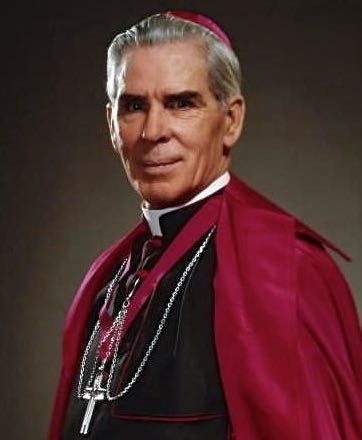
Fulton Sheen Blessed at last.
And we end with another joy. The Vatican has given the green light, again, to beatify Archbishop Fulton Sheen, the popular U.S. radio and television preacher whose path to holiness was postponed first by a prolonged legal battle over his remains and then by concerns over how he handled clergy sexual abuse allegations. After a rare six-year delay to investigate the allegations, Sheen’s beatification can now take place in Peoria, Illinois, as originally planned.
Il coordinatore del viaggio del Papa in Spagna: “Servono molte teste, mani e portafogli”
Leone XIV ai sacerdoti: «Siate adoratori, uomini di profonda preghiera»
Dozens of Catholics hold Rosary rally to protest Fr. James Martin talk
Canadian justice: Half-indigenous man receives lenient sentence for ‘major sexual assault’
Costa Rica elects pro-life Catholic president who calls abortion ‘murder’
Fr. Malachi Martin warned in 1990: ‘We may have to face finally a false pope’
Pope Leo names bishop outspoken against abortion laws as sixth archbishop of Denver
Epstein et le départ de Benoît XVI
Epstein, il Vaticano, lo Ior e la rinuncia di Benedetto XVI