


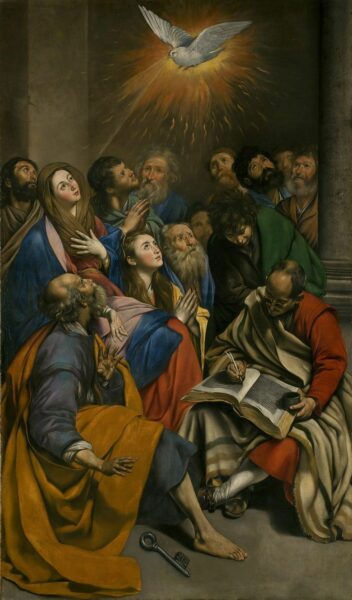
It is Sunday, Pentecost, a day lighter on news but no less light on dense arguments which, in our view, are extremely interesting. We run the risk of devouring the topics in search of novelties and losing sight of the fact that there are underlying issues of great depth that we cannot ignore. Today is a day very focused on the arguments to justify, or not, the state of necessity for the ordinations of the Priestly Fraternity of Saint Pius X. What seems more interesting to us is what this entire situation reveals to us about an unprecedented decomposition in the Catholic Church: the chain of command has been destroyed because the doctrinal structure that makes it possible has been destroyed. To be clear: if any Pope can change revealed Truth at whim, and morality as a consequence, then it is the Pope himself who has lost all his authority: “another will come who will change it.” It is a good day, Pentecost, to meditate on these issues. Let us begin…
The visit to the land of fires.
In Italy everything is dressed in poetry; in reality we are talking about an immense garbage dump that burns without end. Four hours in Campania, a few days after his visit to Pompeii and Naples, to express his solidarity with that region where, over the years, tons of waste have been dumped and burned, and whose consequences people are now suffering because of the pollution. “I have come to gather the tears of those who have lost loved ones, victims of environmental pollution caused by unscrupulous individuals and organizations that for too long acted with impunity.” “I am here, however, also to thank those who responded to evil with good, especially a Church that dared to denounce and prophesy, to instill hope in the people.”
Pope Leo fulfills a wish of Pope Francis with this visit on the anniversary of Laudato Si’ (his visit was scheduled for 2020, but was canceled due to the pandemic): “The cry of creation and of the poor among you has been heard with greater drama, due to a lethal concentration of dark interests and indifference to the common good, which has poisoned the natural and social environment.” “A culture of privilege, arrogance and inaction must be eradicated, which has caused so much harm to this land, as to many other regions of Italy and the world.” In Piazza Calipari, where the mayors of the ninety affected municipalities have gathered, the bishop finally thanks Pope Leo XIV: “His words have highlighted this wounded land; let us hope they do not now fade away.”
Luxembourg and Brussels participated in this ruling, and the case became a test for the European judicial system, made up of the Court of Justice of the European Union (CJEU), the German Federal Constitutional Court (BVerfG) and the other constitutional and supreme courts of the EU Member States. Luxembourg is traditionally characterized by a secular spirit with greater French influence. Karlsruhe, on the other hand, usually interprets the scope of ecclesiastical self-determination very broadly. European law takes precedence over the law of the nation states, including their respective constitutions. However, the EU cannot do everything; it can only regulate what the Member States have delegated to it as sovereignty.
In the field of religious constitutional law, there is an additional particularity: the EU explicitly lacks jurisdiction in this matter. Article 17 of the Treaty on the Functioning of the European Union (TFEU) stipulates that the EU cannot affect the status of religious communities. Therefore, when the Court of Justice of the European Union (CJEU) rules on issues related to religion, it must resort to another route; in labor law, this is usually the protection against discrimination regulated by the EU.
The central question was to what extent religious communities are allowed to select employees based on their denomination. For some professions, this is completely indisputable. No one disputes that a Catholic priest must be Catholic, or that a Protestant pastor must belong to that confession. The situation becomes complicated as job descriptions move away from pastoral care. The question is whether working on a research project against racism fits sufficiently within the central protected sphere of the Church’s autonomy, which stipulates that it may only employ members of its community. Is this a task that any NGO could perform? Or does it involve an application of the Church’s social ethics linked to religious convictions?
The Court of Justice of the European Union (CJEU) ruled that the churches’ right to self-determination does not extend to the point of preventing the hiring practices of religious communities from being subject to objective judicial review, and that the prohibition of discrimination enshrined in the EU Charter of Fundamental Rights requires that conflicting national legislation yield and protect the worker.
The constitutional complaint filed by Diakonie (a German Protestant social assistance organization) against the decision of the Federal Labor Court (BAG) was highly anticipated: Would the Federal Constitutional Court abandon its hitherto very favorable stance toward self-determination in order to avoid a conflict with the Court of Justice of the European Union (CJEU)? Or would it defend its interpretation of the self-determination of the churches in an “ultra vires” decision against Luxembourg, thus risking a European constitutional conflict?
“The Federal Constitutional Court avoided confronting the Court of Justice of the European Union and offered something to both sides.” The Federal Constitutional Court remained within the framework of the European Court and reaffirmed its requirement that the Church’s hiring practices be subject to review by state courts. At the same time, it instructed the Federal Labor Court to pay greater attention to the importance of the Church’s right to self-determination.
State courts do not examine the beliefs of a religious community, its “ethics,” as the Court of Justice of the European Union calls it. The State cannot determine whether a religious belief is convincing. The only thing examined is whether that ethic can be applied to professional requirements. “The Federal Constitutional Court’s ruling now requires the churches to clearly demonstrate, in a way that is verifiable from the outside, whether a particular religion is essential for a given position.”
The truth is that the churches have growing difficulty finding suitable candidates. Both German churches now place less importance on religious affiliation outside the ministerial sphere. Currently, according to the regulations, an employee’s resignation from belonging to the church is usually grounds for dismissal. However, the CJEU ruled in the case of an employee of a Catholic counseling center for pregnant women that she could not be dismissed for leaving the church. The reasons given were that she had not participated in activities contrary to the church and that her resignation was mainly for economic reasons, and that the Caritas organization that dismissed her also employed non-church members in similar positions.
Sodalitium Christianae Vitae.
Bertomeu, papal commissioner for the Sodalitium case, revealed that during the ten days he spent in Lima, more than 140 victims of sexual abuse contacted him, people who had never before reported the abuses. We do not repeat what has already been published; you can find it extensively in our Infovaticana, which follows this case very closely.
The Master of the Sacred Apostolic Palace.
Alberto Lepidi, OP (1838-1925) before being called to Rome in 1885, taught mainly in Louvain (with the exception of a brief period in France). Once in Italy, he directed the Pontifical Dominican College of Saint Thomas in Minerva, precursor of the current Angelicum, until Leo XIII called him to serve as Master of the Sacred Apostolic Palace (which since 1968 has been called Theologian of the Pontifical Household), a position he held until his death on July 31, 1925. Among his publications, mention should be made of the three volumes Elementa philosophiæ christianæ, published between 1875 and 1879, which express the philosophical approach of Saint Thomas Aquinas, interesting his critique of Kantian philosophy, expressed in the volume The Critique of Pure Reason according to Kant and the True Philosophy (1894) and a critique of the ontological current in the Examen philosophico-theologicum de ontologismo (1874).
The imposition of abortion in Europe through the back door.
“It is serious that the European Union is entering, at double speed, into the sovereignty of the States, binding them with ideological positions on abortion, with a European ‘Zan bill’—the same one the Italian Parliament rejected in 2021—and with norms that prevail over the rights of parents. But what is approved in the different countries is imposed from above. Vote in Strasbourg on the revision of Directive 2012/29/EU regarding the rights of victims of crimes, approved with 440 votes in favor, 49 against and 84 abstentions. “It is even more serious that this text was the result of negotiations between the European Parliament and the Council of the EU last December, in which the representative of the Italian government voted in favor. A document that contains provisions completely unrelated to the protection of victims, namely: abortion introduced for the first time in the binding legislation of the EU; a true neo-bill that introduces “gender identity” as a legal category in the assessment of victims of crimes; the undermining of parental authority, given that parents will be excluded from decisions regarding their children in case of a “conflict of interests.” As if that were not enough, NGOs become privileged channels in criminal proceedings, thus granting immense power to LGBTQIA+ organizations.”
Altar girls at the traditional Mass?
One of the characteristic elements of the traditional Mass that most catches the attention of the faithful who, accustomed to parish Masses, attend for the first time, is the exclusive presence of male acolytes. Would it be possible for so-called “altar girls” to participate in the traditional Mass? The Roman Missal (typical edition of 1962, but the same rule is also found in earlier editions) is very clear on this point. The Praenotanda Missali Romani contains all the norms that strictly regulate the celebration of Holy Mass: the general rubrics, the general rubrics of the Roman Missal, the year and its parts, the rite to be observed in the celebration of Mass and the defects that occur in the celebration of Mass.
Precisely in this last part (De defectibus in cerimonia Missæ occurrentibus), located not by chance almost at the end of the Praenotanda, chapter X is dedicated to the defects that occur in the ministry itself (De defectibus in ministerio ipso occurrentibus) and in n. 1 we read: “Defects may also occur in the ministry itself, when something necessary for its celebration is lacking: […] if someone who is not fit to serve, such as a woman, is present.”
In the traditional Mass, a woman is not fit to serve and only a modification of the Praenotanda by an act hierarchically equal or superior (a pontifical decree) could allow the presence of an “altar girl” in the traditional Mass; no bishop, pastor, rector or priest may authorize, much less oblige, the presence of an “altar girl” in the traditional Mass.
Does absolute power corrupt absolutely?
Lord Acton (1834-1902) is credited with the maxim: “Power corrupts, absolute power corrupts absolutely.” In democracies, this has led to the conclusion that power must be distrusted and limited. Therefore, it is restricted, among other things, by the recognition of fundamental rights, the separation of powers (legislative, executive and judicial), subsidiarity and federalism, referendums and term limits. Through a “social contract” of all citizens, the Constitution, they agree to share political power in this way. But even this does not always limit it sufficiently; we are tired of seeing the consequences of this lack of checks.
In the Church, the problem of power is even more pressing. In fact, not all the means mentioned for the fragmentation of power exist there. Rather, according to the doctrine of faith and the Code of Canon Law (CIC/1983), the Pope, “by virtue of his office, has supreme, full, immediate and universal ordinary power over the Church” (c. 331). The pope holds absolute power.
The question is: Does absolute power in the Church lead to absolute corruption? If the Church is viewed solely from a human perspective, the answer would be affirmative. But if viewed from faith, this is not true. In fact, there is only one instrument to limit papal omnipotence: unconditional obedience to Sacred Tradition and Sacred Scripture, to which the pope is bound in conscience. Only because the Church as a whole, and the pope in particular, are subject to this limitation of power, is it possible to entrust absolute power to a single man within it. In the Church, distrust of power is thus overcome by trust that the pope, through unconditional obedience to the faith, knows he is bound in the exercise of his inherently unlimited power.
Today we find that this trust within the Church has been shaken and is now destroyed. Consider Pope Francis, who with “Amoris Laetitia” has turned the indissolubility of marriage into a farce, valid now only in theory. In practice, with a certain “pastoral discernment,” one can live in adultery with a clear conscience. The brief extraliturgical blessing from the Vatican for homosexual and extramarital couples (“Fiducia supplicans”) represents a further deviation from Christian marriage. Ambiguous gestures such as the worship of Pachamama in the Vatican and the “Document on Human Fraternity” of 2019 (Abu Dhabi Declaration) have in fact denied the universalism of Christian salvation. The appointment of lay people to Vatican governing positions, linked to the exercise of power, means a break with the Second Vatican Council (LG 21; Nota explicativa praevia 2), which undermines the sacramental-hierarchical order of the Church.
This situation persists during the pontificate of Leo XIV. In the context of “synodality,” the Holy See published a document that attempted to justify its rejection of the Second Vatican Council (Final Report of Study Group 5 on the Sacrament of Holy Orders and “Potestas Sacra”). Without comment—and irresponsibly—the Holy See has also published a heretical text that relativized the Church’s doctrine on marriage and the family (Final Report of Study Group 9 on “Complex Issues”). Even the most serious liturgical abuses are ignored or minimized by the bishops and the Holy See, and the faithful who follow the extraordinary form are harassed. Priests and faithful are forced to practice the liturgy in clandestinity or to join the Society of Saint Pius X.
The Pope allows the German bishops, who for years, with their “Synodal Way,” have been undermining the sacramental order of the Church and institutionalizing the blessing of homosexual couples, to continue their practices. It is said that they were consulted. However, the Society of Saint Pius X is threatened with excommunication with the help of the Pope’s absolute power.
The announcement by the Society of Saint Pius X that it intends to consecrate bishops on its own initiative is an expression of loss of trust in the Pope. And the interpretation of this gesture, which far transcends the supporters of the Society, shows that trust has given way to distrust. Too many things have happened, and the consequences are devastating. In fact, more and more faithful are realizing that the doctrine of the Church no longer constitutes the limit to the actions of the hierarchy. This is the disease that truly afflicts the Church. And it cannot be cured by exercising papal omnipotence through threats and excommunications. If the unlimited power of the strongest is decisive in the Church, there too there is only one conclusion: this power must be limited. At bottom we are seeing how the consecration of bishops against the will of the Pope is, ultimately, an attempt—undoubtedly very problematic—to limit papal omnipotence, when its limit no longer seems to be the doctrine of the Church.
If new schisms are to be avoided in order to limit papal omnipotence, there is only one solution: the Pope must urgently remedy the violations of the Church’s doctrine. Only in this way can he counter distrust and restore trust. Impositions, threats and double standards will not succeed. What is happening with the Society of Saint Pius X is not the disease, but a symptom of where we stand. It is curious that in the forecasts, we will see if they are fulfilled, but these boys being ordained, the attendance of more than a thousand priests is planned when the Fraternity has about seven hundred. An excommunication can be applied but the disease will not be cured this way and will continue to worsen, dividing and weakening the Body of Christ, the Church.
“Peace be with you.”
Happy reading.