


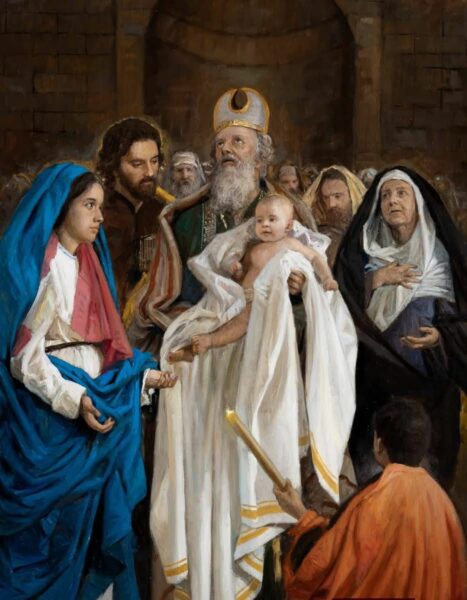
Candlemas, day of the ‘Light to enlighten the nations’. Managing chaos is not an easy task and everything points to chaos and confusion accompanying us for a long time, perhaps too long for the earthly life of human beings.
Like Francis but with a better tailor?
Interview with John-Henry Westen of Father Charles Murr, who is always very much worth considering: «Pope Leo XIV is like Pope Francis, but with a more refined tailor». For Murr, there is no doubt that Leo XIV maintains the same theological direction, the same liberal mentality, and the same contempt for Tradition that characterized Pope Francis, but presents it with a more polished external appearance. The traditional attire of Pope Leo is simply a decorative facade that hides the same ambiguity and progressive orientation inherited from Francis.
The life of Father Charles Murr reflects a priest formed through difficult experiences, deep pastoral involvement, and a close view of both the beauty and corruption within the Church. His years in New York exposed him to chaotic parishes, abandoned communities, and clerics who had abandoned their responsibilities, which sharpened his awareness of how poor management and ideological drift damaged the faith. His time in Rome immersed him even further in ecclesiastical politics, and his close relationships with important figures like Malachi Martin and Cardinal Edouard Gagnon placed him near investigations into corruption within the Roman Curia. These experiences shaped his perspective and gave him the conviction that corruption must be fought rather than hidden.
Father Murr communicates his ideas through his writings, particularly his novels and memoirs. One of his most well-known books is » Murder in the 33rd Degree , which recounts Cardinal Édouard Gagnon’s investigation into Freemasonry and the entrenched corruption in the Vatican. He is also the author of The Godmother , a compelling account of his relationship with Mother Pascalina Lehnert, the powerful and fiercely loyal secretary of Pope Pius XII, who became his mentor and spiritual guide. His most recent published work, And It Was Night , offers a reflective and deeply personal look at the darkness, spiritual confusion, and internal decay he witnessed within the Church.
Tucho and Leo XIV.
Cardinal Tucho moves at the center of Vatican power as one of the key figures of Leo XIV’s pontificate. His mission is to sustain the Bergoglian orientation without forcing definitions that expose the new pontiff to a premature internal war. During the last consistory, that tension became visible. In the Vatican corridors, several cardinals agreed that Leo XIV avoided “opening a storm front” by postponing definitions on the most sensitive issues. The exclusion of debate on Fiducia supplicans, the declaration on blessings for same-sex couples; or the Tridentine liturgy, was read as an indirect protection maneuver for Tucho: “This pope does not confront, but neither does he retreat”. The phrase condenses the strategy of the new pontificate: manage times, avoid frontal clashes, and consolidate alliances before advancing. The figure of the Argentine cardinal proved inseparable from his role in the theological architecture of the previous pontificate. Fernández was ghostwriter, doctrinal interpreter, and conceptual translator for Francis. Evangelii gaudium, the exhortation that Leo XIV asked to reread as a preparatory key for the consistory, bears his imprint. Leo XIV will avoid an immediate curial turnover, postpone sensitive definitions, and protect Tucho Fernández without displaying him too much. In that game of silences, the Argentine cardinal is the thermometer of the ecclesiastical course. At stake is whether Francis’s legacy continues coherently or dilutes under institutional neatness. The tightrope walkers in Rome do not last too long.
Leo XIV and Artime.
Leo XIV and Cuba.
Pope Leo XIV expressed this Sunday his “great concern” over the increase in tensions between Cuba and the United States, at the end of the Sunday Angelus. “I have received with great concern news about an increase in tensions between Cuba and the United States of America, two neighboring countries. I join the message of the Cuban bishops, inviting all those responsible to promote sincere and effective dialogue, to avoid violence and any action that could increase the suffering of the dear Cuban people. May the Virgin of Charity of Cobre assist and protect all the children of that beloved land!”.
The Gentlemen of His Holiness.
Leo XIV received in audience the Gentlemen of His Holiness , the Assistants of the Antechamber , and the Pontifical Presidents , and decided to dedicate the meeting «specifically to you» as an explicit gesture of gratitude and encouragement. The last meeting of this kind dates back to 2014, when it was granted by Pope Francis and has not been repeated since. He proposed a style : careful preparations down to the last detail, gestures of welcome and greeting «noble but not forced», «elegant but not sophisticated», capable of conveying affability to any person, «whether prince or pilgrim, patriarch or petitioner». Care, he insisted, does not vary according to rank : the solicitude of the Successor of Peter remains «identical toward all and loving toward each one». The Pontificalis Domus defines the Pontifical Household as a group of clerics and laity, divided into the Pontifical Chapel and the Pontifical Family (ecclesiastical and lay). It is precisely within the lay Pontifical Family where the normative text places the Gentlemen of His Holiness and the Antechamber Assistants, up to the Pope’s Family .
The Holy See in Bratislava.
In defense of the unborn.
Leo XIV has cited the clamor of Mother Teresa in defense of the unborn, without the ambiguity of Francis, who had praises for the abortionist Bonino. Twenty-four hours before the Day for Life, celebrated yesterday, Sunday, February 1, the Pope spoke about abortion . He did so during a meeting with participants in the One Humanity, One Planet conference. These are his words: «Mother Teresa of Calcutta, saint of the last and Nobel Peace Prize winner, affirmed […] that ‘the greatest destroyer of peace is abortion’ (cf. Speech at the National Prayer Breakfast , February 3, 1994). Her voice remains prophetic: no policy can, in fact, serve people if it excludes from life those who are about to come into the world, if it does not assist those who are in material and spiritual poverty». Pope Francis had repeatedly used harsh expressions regarding abortion, calling it «murder» and describing doctors who perform it as «hitmen», but on the political plane, as was usual, he had been ambiguous. He praised King Baudouin of Belgium, who had refused to sign an abortion law, and on the other hand, Emma Bonino, who dedicated her life to recruiting new instigators and hitmen of abortion, presenting her as an «example of freedom and resistance».
Truth and charity.
This theme has been at the center of numerous papal speeches, from Pius XII to Pope Francis, and continues to guide the work of judges. In a recent meeting with the Prelate Auditors of the Apostolic Tribunal of the Roman Rota. His words focused on the intrinsic connection between the truth of justice and the virtue of charity: «It is not a matter of two opposing principles, nor of values that must be balanced according to purely pragmatic criteria, but of two intrinsically united dimensions, which find their deepest harmony in the very mystery of God, who is Love and Truth». «The actions of judges must be motivated by «that true love for neighbor that seeks above all his eternal salvation in Christ and in the Church, which implies adherence to the truth of the Gospel», the horizon is the salus animarum as «the supreme law in the Church». In this way, «their service to the truth of justice is a loving contribution to the salvation of souls». The Christian criterion must be love for Truth, the abbreviated and secular version is called intellectual honesty: it would suffice to start from this.
The Becciu process.
More publications on the Becciu process: Justice beyond the pillory. The ghost of Tortora and the judicial calvary of Becciu», by Alberto Vacca , author of the book «That ugly mess of the trial against Becciu: A surreal case of unjust justice », followed by reflections titled « The sacrifice of a cardinal and the shadow of the hidden «directors». Who really feared Becciu’s participation in the conclave?», by Fari Pad. «Arranged» justice? If the conviction was only a stratagem to ensure exclusion from the Conclave without legal basis, we are faced with an irreparable wound. Becciu, by stepping back, decided not to participate in this conflict, thus preserving the serenity of the papal election, but the «Pandora’s box» is now open.
Tobin against Trump.
Brenes and Nicaragua.
Cardinal Brenes announced this Sunday the transfer of 23 priests in the Archdiocese of Managua, a reorganization forced by the expulsion of religious that has left many parishes without care. Nicaragua is one of the most serious scenarios of religious persecution on the continent. Among the moves, the appointment of the recently ordained priest Kevin Mayorga stands out to take charge of the parish of Our Lord of Esquipulas, which was left vacant after the exile of Father Héctor Treminio in January 2024. The reorganization includes parishes whose pastors were forced into exile due to government pressure, such as the parish of Our Lady of the Americas, previously led by Father Fernando Téllez Báez, who left Nicaragua in December 2023 amid police threats. Brenes also appointed a new director of the Major Seminary La Purísima. According to the report “Faith under fire” by the NGO Collective Nicaragua Never Again, at least 261 religious have been banished from the country since 2018, including four bishops, nearly 140 priests, more than 90 nuns, a dozen seminarians, and three deacons. In March 2023, the late Pope Francis described the Nicaraguan regime as a “crude dictatorship”. Ortega dissolved and expropriated the Society of Jesus, the religious order to which Pope Francis belonged, and has repeatedly labeled the Catholic Church as a “mafia” and anti-democratic. In March 2022, Apostolic Nuncio Waldemar Stanislaw Sommertag was expelled from the country.
The German Way.
Church reform processes must not be reduced to issues of structure and power, a kind of parliamentary process, but must have a spiritual basis. A new method, the «conversatio in Spiritu», a form of spiritual exchange, already tested in the World Synod on Synodality, is at the center of the sixth and final Assembly of the German Church Synod. The “conversatio in Spiritu” differs from traditional debates because the goal is not to reach a majority, but rather to listen and participate in a shared discernment based on trust in the work of the Holy Spirit. Bätzing : «We want to be in tune with the path of the universal Church», he declared on January 29. Small groups of eight members were led by 28 specially trained facilitators. According to a report on the website katholisch.de (1/29), the constructive role of discussions with representatives of the Roman Curia was also noted in the Assembly.
the statutes of the new permanent supra-diocesan synodal body, in which the laity could have significant influence compared to the traditional one of the bishops, will be sent to the Vatican for approval after the plenary assembly of the German Episcopal Conference in Würzburg in February. The last meeting with the Roman Curia on this controversial body took place on November 12 and concluded with a joint statement that described the debate as honest, open, and constructive. The «council» has traditionally been rejected by Rome due to its size and supra-diocesan responsibilities, which would annul episcopal authority and violate Canon Law. Several bishops canceled their participation for various reasons, including Cardinal Rainer Maria Woelki of Cologne and all his auxiliary bishops. Also absent were Bishop Rudolf Voderholzer of Regensburg, Bishop Dominicus Meier of Osnabrück, and Bishop Ulrich Neymeyr of Erfurt due to illness.
Pope Leo has spoken on this topic on more than one occasion. On December 1, during the press conference on the return flight from his apostolic journey to Turkey and Lebanon, he spoke about the Synodal Way in Germany, expressing his awareness that many German Catholics believe that some aspects of the path so far do not reflect their hopes for the Church and that, therefore, greater dialogue and listening within the German Church is necessary, so that no voice is excluded. He trusts that the situation will be resolved positively.
The Blessed Pius IX
On Saturday, February 7, 2026, liturgical memorial of Blessed Pope Pius IX, on the 148th anniversary of his pious death. There is a celebration in the Basilica of San Lorenzo Outside the Walls in Rome, on the initiative of the Blessed Pius IX Institute of Historical Studies. On June 16, 1846, at just 54 years old, he was elected the 255th Bishop of Rome and Roman Pontiff, taking the name Pius IX, reigning from 1846 to 1878. He was also the 163rd and last sovereign of the Papal States, from 1846 to 1870. His pontificate, which lasted 31 years, 7 months, and 23 days, remains the longest in the history of the Catholic Church after that of St. Peter. He died in Rome on February 7, 1878, at the age of 85. Pope Pius IX himself arranged in his will that his burial be carried out in the Basilica of San Lorenzo Outside the Walls, in a simple and sober place, with a modest monument.
Pope Pius IX is a martyr pope who endured persecution, hatred, insults, and threats. He loved his enemies and prayed for them, as he declared to Giuseppe Garibaldi, who attacked him in November 1867, as well as to King Victor Emmanuel II, who attacked him in September 1870, and the subsequent looting, the humiliation of his volunteer soldiers, the unilateral «law of guarantees», and the religious persecution that continued until the Conciliation. John Paul II said: «In the midst of the turbulent events of his time, he was an example of unconditional adherence to the immutable deposit of revealed truths. Faithful in every circumstance to the commitments of his ministry, he always gave absolute primacy to God and spiritual values. His very long pontificate was certainly not easy, and he had to suffer much in the fulfillment of his mission in service to the Gospel. He was greatly loved, but also hated and slandered». His private life passed with the simplicity of a «country priest», as he liked to call himself. He got up at five in the morning on the dot and spent an hour in his room praying on a kneeler before a crucifix. He celebrated Holy Mass and then attended a thanksgiving service, during which he recited the canonical hours and prayers of piety with a little book that had belonged to his mother. At three in the afternoon, he concluded his audiences and went to eat. He did not want to spend more than one shield a day on his meals. After eating, he loved to take long walks or ride in a carriage around the city. Upon returning to the Quirinal, he read his correspondence and then prayed Vespers. After dinner, he received his confessor and retired to his private chapel to pray before the tabernacle. He often recalled the importance of praying to Eucharistic Jesus, to whom everything could be entrusted.
and glory of your people Israel».