


Monday morning in Rome, already spring-like days that invite little to sit in front of a screen and much more to enjoy the never-lost steps through the tortuous streets of the Eternal City. Morning with a meeting of the heads of the curia’s dicasteries and with another appointment coming to us from the brothers of the United Nations. It’s not first-level, but it’s a way to adorn oneself with pontifical appointments and enter a circuit of well-paid conferences and meetings. Ordinary Member of the Pontifical Academy of Social Sciences to Vera Songwe, from Cameroon. In August 2017 Songwe was appointed Executive Secretary of the United Nations Economic Commission for Africa, worked at the World Bank, and in 2015 was appointed regional director for West and Central Africa of the International Finance Corporation. Forbes included her in 2013 as one of the «20 Young Powerful Women of Africa» and the following year the Choiseul Institute for International Policy and Geoeconomics chose her as one of the «African leaders of tomorrow.» We don’t understand with the quantity, thousands, of Catholics who collaborate in so many first-level institutions, thousands, we always end up placing ‘brothers’.
The Angelus.
It focused on the Gospel of the Samaritan woman and linking the reflection with the path of Lent, the meaning of Baptism and the mission of the Church. At the end, the Pope made an appeal for peace in Iran and throughout the Middle East and greeted the pilgrims present. In the final part of his reflection he focused his attention on the international situation, speaking with concern about Iran and the Middle East. He said that news continues to arrive that causes «deep consternation» and described a panorama marked by violence, devastation, hatred and fear, with the concrete fear that the conflict could spread to other countries in the region, including Lebanon. The Pope invited people to raise a humble prayer so that the bombs would cease, the weapons would be silenced, and a space for dialogue would open where the voice of the people can be heard. The supplication was entrusted to Mary, Queen of Peace, so that she might sustain those who suffer because of the war and accompany hearts on paths of reconciliation and hope. Finally, the usual greetings to the groups present in the square were not missing. Leo XIV welcomed students from the United States and Spain.
Pastoral visit in Rome.
Pope Leo XIV arrived at the parish of ‘Santa Maria della Presentazione’ in Torrevecchia, his penultimate Lenten visit to the churches of the Diocese of Rome, and met with the children’s catechism, youth groups, and the elderly, reminding them of their filiation in God: «At the same time, however, I would like to emphasize one thing: each one of you, even the oldest, the sickest, the weakest, each one of you has immense value, because we are all created in the image of God, we all share this dignity of being sons and daughters of God. And many times the world of today would like to make us forget this fact, but it is not so». In his homily: «It is an important stage in our following of Jesus, which leads us to his Easter of Passion, Death and Resurrection. On this path, the closeness of God and our life of faith are deeply intertwined: by renewing the grace of Baptism in each one of us, the Lord calls us to conversion, while at the same time purifying our hearts with his love and the works of charity that he invites us to perform. In this sense, the encounter between Jesus and the Samaritan woman deeply moves us. Today’s Gospel, in fact, not only speaks to us, but also speaks about us and helps us to rethink our relationship with God».
A new Dicastery for the Internet and AI?.
It’s not bad, we were few… we have to be austere but the boys who pull the strings are already putting a candy on Pope Leo to distract him, so he doesn’t get into too many troubles and we can continue with our own. In the Report of Study Group 3 (“The Mission in the Digital Environment”) of the General Secretariat of the Synod of Bishops, the « Creation of an office, department or commission responsible for overseeing the mission in the digital environment: a Pontifical Commission for Digital Culture and New Technologies, for example, could oversee emerging theological, pastoral and canonical issues; prepare documents, guidelines and manuals; define training strategies for different levels (bishops, priests, religious and laity); and support Episcopal Conferences in integrating the digital mission into their pastoral plans. It could also convene working groups to study the necessary canonical adjustments related to the oversight of the digital mission and work synodally with all the Dicasteries, Commissions and Offices of the Vatican to share best practices and accompany them in the exercise of their mission in digital culture».
The members of this Group propose to Leo XIV the creation of a pontifical commission to provide advice on digital challenges (Internet) and new technologies (obviously, Artificial Intelligence). The proposed activities are divided into six points: monitor emerging theological, pastoral and canonical issues, develop documents, guidelines and manuals; define training strategies for different levels (bishops, priests, religious, laity); support Episcopal Conferences in integrating the digital mission; convene working groups for canonical adaptations and work synodally with all Dicasteries to share best practices.
It is evident that now, after the pontificates of Ratzinger and Bergoglio, they seek the Pontiff’s signature to create a useless and dangerous entity for the fragile resources of the Holy See, which already spends millions of euros on «communications» without effective results. These experts believe that the Church and the Pope are like a brand that must be promoted to sell itself and believe that their advice and experience drive evangelization and extend the mission. After more than ten years of operation of the Dicastery for Communication, we are dusting off terms that experience has proven to be outdated and manipulated, tired and empty. These are structures that arise without a true «why» and end up appearing only as small centers of power, financially dependent on the Apostolic See and the People of God. Shouldn’t the Dicastery for Communication already take care of these tasks? Some of the signatories of the «Group 3» proposal already hold positions in the Dicastery for Communication.
Cupich attacks Trump.
Pope Leo calls for peace and the Archbishop of Chicago attacks Trump. The US government has published a video on social media that mixes war images and action movies. The Cardinal of Chicago declared: «This is a profound moral failure. Iran is a nation of people, not a video game that others play to entertain us.» «A real war with real death and real suffering treated like a video game or a movie is nauseating.» In the statement, published on the archdiocese’s website, » A Call to Conscience «, Cupich: «while more than 1,000 Iranian men, women and children lay dead after days of bombings with US and Israeli missiles, the official White House Twitter account posted on Thursday night a video with scenes from popular action movies linked to real images of attacks in its war against Iran. The video was titled: ‘American-style justice’. A real war with real death and real suffering treated like a video game is nauseating «.
The nuncio in the United States.
It’s not just another appointment and even more so now at this moment. Pope Leo XIV adopts a clear alignment with the diplomatic and geopolitical approach of the Secretary of State, Parolin. The presence of Archbishop Caccia in Washington indirectly indicates continuity in the Holy See’s diplomatic and pastoral actions toward Asia, particularly toward China.
Leo XIV is the first American pope and the presence of Archbishop Caccia in Washington indicates that the Holy See considers its relationship with the United States under the Trump government not only as a bilateral relationship between states nor as the management of affairs between Church and State. For the Holy See, the situation in the United States under the Trump administration is an international issue that must be framed in a multilateral geopolitical context. Faced with an irreversible crisis in the UN, the Holy See has opted to move its representative to the Vatican Embassy in Washington. The Holy See values three geopolitical principles: the primacy of multilateral diplomacy; respect for international law and its reformulation to make it effective in addressing the current situation of world affairs; and work toward a supranational and global institution based on the legacy and highest aspirations of the United Nations.
Caccia’s career has been intertwined with that of Parolin. Together they were consecrated archbishops on September 12, 2009, by Benedict XVI, before receiving their first appointments as nuncios: Caccia in Lebanon, Parolin in Venezuela. It was the classic «Promoveatur ut amoveatur» desired by Cardinal Tarcisio Bertone to give a personal touch to the Secretariat of State and leave behind the previous era. The two curial «twins,» Caccia and Parolin, occupied the strategic positions of advisor for general affairs and undersecretary for relations with States. The other connecting thread between the two Italian prelates is their closeness to Villa Nazareth, under the aegis of Cardinal Achille Silvestrini. Caccia was one of the powerful cardinal’s favorites and remained so even when he became personal secretary to Cardinal Giovanni Battista Re.
Banned from preaching to German priests?
It’s what it sounds like, more than authorizing laypeople to preach it seems that what is not liked is that priests preach, the new generations of priests, also in Germany, are very synodal, dispensing with them is impossible, someone has to open the church so we don’t end up alone, but better that they stay quiet. The German Episcopal Conference will formally request authorization from the Holy See to allow laypeople to preach during Eucharistic celebrations. Observers approved a regulation regarding the ministry of preaching that provides that duly trained and officially registered men and women may assume this function in the mission. For the provision to take effect, the corresponding approval from Rome will be required. Wilmer explained that he will personally carry the regulation on his next trip to Rome to request Vatican recognition and explain the content. Canon Law (canon 767 §1) reserves the homily during the Eucharistic celebration to the priest or deacon, so any modification requires the explicit permission of the Holy See. Here, those who send the objects are the thousands of well-paid laypeople who flood German institutions. It seems they lack public prominence in parishes and want to control the matter by asking pastors to administer the sacraments in silence, now. The world upside down, the apostles thought of deacons so they could dedicate themselves to preaching, now this should not be important.
Chaplains for the war.
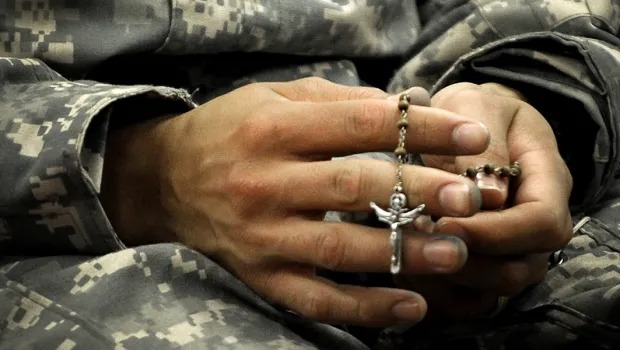
The celebrations of the centenary of the Italian military chaplains culminated with the meeting with the Pope on March 7. The international climate marked by the war launched by the United States and Israel against the Islamic Republic of Iran—with the involvement of other Middle Eastern countries—made the opportunity especially important to clarify the Vatican’s positions on ongoing conflicts.
It is difficult not to relate it to the interview granted last January by the American Military Ordinary, Timothy Broglio, at that time, President Trump was threatening to invade Greenland. The archbishop then recalled that it was permissible for a Christian soldier, despite the obvious difficulties he faced, to evade immoral orders. By presenting the military attack on the Danish island as a case of this kind, Broglio offered a broad interpretation of article 2313 of the Catechism of the Catholic Church, published in 1997. Within the discussion of «just war,» the believing soldier would evade the duty of obedience to his superiors when ordered to carry out «actions manifestly contrary to the law of nations and to its universal principles.» The American Ordinary added an additional element to this category: even the violation of international law constituted an ethically illicit act that could be disobeyed. It is true that his argument introduced a limit, as immorality was limited to a specific case: the invasion of a sovereign and allied state.
The official media of the Holy See, while not giving special relevance to Broglio’s interview, have disseminated it. This raises the question of understanding the Vatican’s assessment of the war that Trump has recently launched against Iran. This emerges from an interview that the Secretary of State, Cardinal Parolin, gave on March 4 to L’Osservatore Romano , recalling the positions expressed on the matter by John Paul II, the cardinal declared that any preventive war is immoral. Parolin affirmed that it demonstrated the failure of the post-World War II effort to establish the United Nations as a forum for the peaceful resolution of disputes between States. The use of military force had replaced justice and international law in the illusory belief that peace can only be achieved after annihilating the enemy.
Is Broglio’s stance on refusing to obey immoral orders applicable to the current conflict? The current Vatican stance on conscientious objection emerges from Cardinal Parolin’s homily on March 3, in the Mass celebrated on the occasion of the centenary of the Italian Military Ordinariate. The cardinal adhered to the dictates of the Catechism : conscientious objection refers to violations of international humanitarian law. On the contrary, Leo XIV’s speech to the representatives of the Ordinariate did not address the issue of conscience. The Pope held that war is inevitable due to the sin in which humanity lives, adding, however, that thanks to the coming of Christ, violence can be overcome. The mission is «To protect peaceful coexistence, intervene in disasters, work in international missions to preserve peace and restore order». The Pope omitted to mention the sacralization of wartime violence to which military chaplains sometimes surrendered during the two world wars and has carefully avoided any possible legitimation of national Catholicism that constituted the guiding ideology of the Military Ordinariate in Italy and in several countries of the world. Chaplains are now at the service of humanitarian interventions led by the United Nations.
The foundation of the Catholic renaissance. What do we expect from the new Pope?
And we’re finishing, the week starts strong. Interview with Guido Vignelli: «We can and must ask the new pope to remember that he freely chose to be a son of the great St. Augustine of Hippo and to have taken the names of glorious pontiffs like St. Leo I, St. Leo IV and Leo XIII. Considering the Augustinian legacy and his papal predecessors, it is expected that the new pope will govern in a manner consistent, if not with his holiness, at least with his commitment. The first and most important task of the new Pope is to restore the Catholic Church, now «half in ruins,» as the visionary Sister Lucy foresaw in 1917 in the «third secret» confided to her by Our Lady at Fatima. Therefore, we hope that he will govern the Church using the authority and powers that correspond to him as pontiff and that still remain to him, before they are diminished and dispersed by the threatened disintegration of the ecclesial structure attempted by «synodal» assemblyism.
We hope that the son of St. Augustine will restore the primacy of the supernatural over the natural, condemning and repressing naturalism, rationalism and theoretical and ethical relativism, now so widespread even in the Catholic Church. We also hope that he will recover a genuine and combative Christian spirituality, today contaminated by forms of psychological quietism that lead to surrender to the enemy. We hope that the successor of Pope Leo XIII will resume his full program of restoration, summarized in the encyclical Aeterni Patris . This program encompasses not only theology, liturgy, philosophy, morals and spirituality, but also the Church’s social doctrine, which confirms the rights of God the Creator, Christ the Redeemer and the Sanctifying Spirit over the cultural, legal, political and economic life of humanity.
We hope that the new Pope will begin his reign imitating Pontiff Adrian of Utrecht, when he denounced the grave responsibilities of the ecclesiastical hierarchy for having given the false Protestant reformers the pretext to devastate the Lord’s Vineyard: «The disease has spread from the head to the members, from the popes to the prelates; we all, bishops and clerics, have deviated from the straight path; (…) therefore, we promise to employ all our care to ensure that the Roman Court improves first; (…) just as the disease began with it, so too will the recovery begin with it» (Adrian VI, speech of 3-1-1523 at the Diet of Nuremberg).
We ask the Pope to take care not to imitate the disastrous behavior of one of his former Augustinian brothers, the heretic Martin Luther, whom they would now like to absolve and even promote as a doctor of the Church; his false reform was a distant precursor of the current crisis of the now Protestantized Christian world. We ask the new Pope not to imitate the behavior often exhibited by the Augustinian cardinals Gil de Viterbo and Jerome Seripando (16th century). In fact, they first benevolently tolerated the revolt of their brother and friend Luther; then, seeing themselves forced to contain its consequences, they tried to reach a religious understanding with the Protestant leaders by adopting an irenist «middle way» that reconciled the claims of the heretical leaders with the needs of the Church. Their moderation caused the Church to lose valuable strength and ended in a predictable failure.
The current crisis of the Church has been caused by cultural confusion, theological errors, moral aberrations, weak spirituality, minimalist apologetics and compromises with the enemy. Therefore, religious rebirth cannot arise from a generic call to «overcome theoretical differences» through the establishment of an «ecclesial pastoral approach» that attempts a «reconciliatory middle way.» The rebirth must necessarily be based on a clear, vigorous and coherent return to the roots of Christian faith and Catholic civilization. The first signs of this return are already glimpsed on the horizon; it is up to the new Pope to promote it, preparing the ecclesial conditions for it.
«…no prophet is welcome in his hometown.»
Good reading.
Siccardi. Ten years after Amoris Laetitia
Hospital chaplain abuses a woman: caught by «Le Iene» and suspended
Angelus. Leo XIV: «How many people seek listening and delicacy in the Church»
Leo XIV in the Roman periphery: «The parish should be a mother that welcomes»
Iran: the Archbishop of Chicago judges the White House video as ‘nauseating’
Msgr. Caccia, «twin» of Parolin, new nuncio to the USA
German bishops will ask the Vatican to authorize laypeople to preach during Mass
Pope Leo XIV: the center of parish life is the Eucharist
The American course of Leo XIV
Vignelli. What do we expect from the new Pope? On recent exhortations to reconcile for peace in the Church
The Holy See, Trump’s wars, conscientious objection