


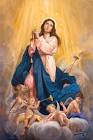
Solemnity of the Immaculate, the Purísima, as our elders called her, which in the Hispanic world is celebrated with special devotion. She is the patroness of Spain, but also of the United States and so many other countries and institutions. A day to remember our mothers to whom we owe so much. The temptation to take the day ‘off’ is great, Rome is filling up with high-level Christmas events that can distract us. As we approach the daily information, we realize that the world doesn’t stop and forces us not to stop. Let’s go with another day, of the Immaculate, yes, but full of interesting news.
Seven months after his election, we still have no clear idea of where the pontificate is heading, but the steps are starting to become visible. The tension continues between the continuists with Pope Francis and those expecting a radical change. Pope Leo is fully aware of the situation and this explains his caution, both in confirming Francis’s changes and in halting them. Three were the main points of attack from the conservatives on the eve of last May’s conclave: the homosexual issue, the role of women, and the relationship with Islam. Leo XIV made it clear that it will not be modified an important innovation desired by Francis: the so-called blessing of same-sex couples. The current norm requires a blessing that does not seem ritualized like the sacrament of marriage, but which, nevertheless, recognizes the existence of a committed homosexual couple on a shared path. The controversial blessing seems to be maintained, and it is foreseeable that each episcopal conference will regulate it in the coming years. The approach to the «women’s issue» is different. Leo will continue placing women in prominent positions in the Vatican Curia, but nothing about deaconesses: «For the moment, I have no intention of changing the Church’s teaching on this.»
Rumors about a document, we don’t know of what level, that closes the liturgical war seem close, and everything points to creating a broader framework and not focusing solely on the so-called traditional Mass. We all remember Pope Leo’s intervention on the richness of rites, and things seem to point in that direction. The friends of the Neocatechumenal Way may be some of the affected, and everything points to resuming what was planned by Benedict XIV and shelved by Pope Francis. So many freedoms for some and so few for others would not be understood. The recent advance meetings of Way leaders with total secrecy obligation point in this direction.
Another no lesser issue is the blessed synodality, which is a Trojan horse to undermine hierarchical authority. It is presented as a remedy for an impasse, but the impasse it identifies is simply the Church’s refusal to redefine its teachings according to modern criteria. The danger is obvious: synodality becomes a tool to replace doctrinal clarity with incessant consultation, where the Church listens and listens until finally reaching the conclusions that its critics desired from the beginning. In the traditional Catholic conception, all hope flows from Christ, and all prophecy proceeds from divine revelation, not from nature. But what do we know, we traditional Catholics, backward, rigid, «heretical» and «schismatic»? The Church has survived every empire, ideology, and revolution; it will surely survive the fashionable doubts presented by authentic contemporary heretics of ours. What cannot endure is the empty, insecure, and desacralized church; a church without clarity, without authority, and without the triumphant Christ who rose not as a «failed individual,» but as Lord and King.
Many articles about the success of the Christmas concert in the Vatican with Michael Bublé’s presence. Very grateful that an artist is not afraid to confess his faith. The artist revealed that the Holy Father himself asked him to sing Schubert’s Ave Maria for the occasion: «I have sung it only once in my life, more than ten years ago, in a recording studio, when I recorded the Christmas album in 2011: I’m a bit nervous, but I don’t want to disappoint him. There is so much joy to live.» He met with Leo XIV before the concert, along with his wife and his parents, born in Italy. It was a great emotion for him: «My mother was my catechist. And faith, in my life, has always been strong. Even in the problems of health that have affected members of my family. When I talk to people and reveal my enormous faith to them, they look at me in astonishment, because nowadays it’s rare to hear someone admit to having faith.» He recounted the difficult experience of his family when, in 2016, his firstborn, Noah (who was then 3 years old), was diagnosed with a rare liver tumor. After an intense battle and treatment, the family announced Noah’s full recovery in March 2017: «Today he is 10 years old and, thank God, he is well. He is a strong boy: the way he fought against the illness was moving. He loves music. Just like his little brother Elias and his little sisters, Vida Amber Betty and Cielo Yoli Rose. I don’t know if they will follow in my footsteps, but I’m glad that God has blessed them with love for music.» Faith played a fundamental role in helping him and his wife, Luisana Lopilato, to cope with that traumatic moment. The experience of his son’s illness deeply changed his perspective on life, teaching him to live with more intensity and gratitude.
Upon becoming Pope, Leo XIV explained that he chose his name in honor of Leo XIII, who in 1891 published Rerum Novarum; now the Church must «respond to another industrial revolution and advances in artificial intelligence, which pose new challenges for the defense of human dignity, justice, and work.» In June, he delivered a message at the Second Annual Conference on Artificial Intelligence, Ethics, and Corporate Governance, pointing out that AI raises «worrying questions about its possible repercussions on humanity’s openness to truth and beauty, and on our unique capacity to understand and process reality.» Last November, the Pope received a delegation of film celebrities in the Vatican and also spoke on that occasion about the increasingly crucial role of algorithms in our lives: «The logic of algorithms tends to repeat what ‘works,’ but art opens up to what is possible.»
This type of statement has caught the attention of some figures in the American tech sector, which invests more than any other in artificial intelligence. Partly due to the enormous interests and capital at stake, many of these companies radically oppose any attempt to regulate the sector, to the point that last May they tried to get the U.S. Congress to approve a moratorium that would have prohibited all regulation of AI. The growing unease of a segment of Silicon Valley toward some of the Pope’s statements became evident last November, when, on his X profile, Leo XIV invited «all AI builders to cultivate moral discernment as a fundamental part of their work; to develop systems that reflect justice, solidarity, and a genuine respect for life.»

In a forceful interview with Dr. Thomas Ward, president of the John Paul II Academy for Human Life and the Family (JAHLF), the renowned German Catholic sociologist and author Gabriele Kuby denounced the recent document from the German Episcopal Conference that supports «sexual identity diversity» in Catholic schools. Kuby described the document as the most recent and alarming manifestation of the rebellion that the German hierarchy has maintained for decades against the Church’s teaching on sexual morality. The document, titled «Created, Redeemed and Loved: Visibility and Recognition of Sexual Identity Diversity in School,» was published on October 30, 2025, by the German Episcopal Conference, presided over by Bätsing. It declares that «sexual identity diversity is a fact» and instructs Catholic schools to accept students’ self-identification as lesbians, gays, bisexuals, transgender, queer, intersexual, or non-binary, and to use affirmative language. Only three German bishops—Stefan Oster of Passau, Rudolf Voderholzer of Regensburg, and Cardinal Rainer Maria Woelki of Cologne—publicly opposed this heretical text. The Vatican, which has repeatedly condemned gender ideology as an attack on the divine differences between men and women, as well as on the anthropological foundation of the family, has not taken disciplinary measures against the German episcopate.
Kuby: «The bishops promised in their ordination to protect the faith, build the Church, follow Peter, and guide souls to salvation; instead, they are tearing down the Church and forcing Catholic schools to adopt the LGBTQ agenda and gender ideology.» The four key «Action Texts» of the Synodal Way explicitly demand the following:
- Reevaluate homosexuality as something innate and morally neutral,
- Recognizing as legitimate any consensual sexual relationship if labeled as «love,»
- Presenting official blessing ceremonies for same-sex couples,
- Normalizing «gender diversity,» including the ordination of self-identified transgender people.
The German sociologist particularly despised the Synodal Way’s argument that sexual abuse in the Church is caused by Catholic sexual doctrine itself. «80% of clerical abuse is homosexual abuse of post-pubescent children,» she noted. «If we maintained the Church’s doctrine—sexual activity only within marriage between a man and a woman—we would have neither the homosexuality problem nor the abuse problem.» While Pope Francis intervened to block the Synodal Way’s attempt to dilute episcopal authority by sharing it with laity, «he never said a single word» against its deconstruction of sexual morality. The situation has worsened so much that, in some countries, parents who refuse to affirm their children’s declared gender identity risk losing custody. «The Church should protect these families; instead, it is abandoning them.»
Christmas is a time of good music and today we have a long article about its presence in the liturgy. Pius XII, in his great encyclical Musicae Sacrae Disciplina, states that among the gifts with which God has enriched humanity «music must be included,» capable of providing «spiritual joy and delight of the soul» and of elevating the mind toward the Creator. St. Augustine already intuited that song opens a window to the infinite in man: the modulated voice «ignites piety» and inspires a fervor that words alone could not awaken. Israel sings after the liberation from the Red Sea, David organizes worship through choirs and instruments, the early Church gathers «singing hymns to Christ as to God.» Music has always been a response to God’s initiative: wherever God reveals himself, a song is born. The Christian tradition does not limit itself to appreciating music as art: it recognizes it as an essential part of worship. The Second Vatican Council, in Sacrosanctum Concilium, states that sacred song «is a necessary and integral part of solemn liturgy» (SC 112). Benedict XVI reiterated it in his Regensburg speech, recalling that music is not an aesthetic accessory, but a completely specific form of participating in the sacred action: «not an adornment… but the liturgy itself.»
The organ, defined as «the king of musical instruments,» is not mere accompaniment: it gathers «all the sounds of creation» and returns them as praise, thus becoming a sign of divine greatness. Its multiple possibilities, the Pope states, «transcend the merely human sphere and point to the divine.» The Church preserves Gregorian chant and polyphony, and welcomes everything that respects the nature of the liturgy. Music, when authentic, opens to the dimension of the transcendent. Benedict XVI compares the organ to the Church itself: many pipes, many voices, which, however, must be tuned by an expert hand, otherwise dissonance is generated. Thus, the liturgy, when preserved in its truth, harmonizes hearts and unites them in praise. The art of sound is perhaps the most immaterial of the arts: it leaves no trace, it cannot be retained, it only exists while it vibrates. Precisely for this reason, the Christian tradition has perceived it as an icon of the action of the Spirit, which makes itself felt but cannot be possessed: it reveals something that surpasses man, but reaches him deeply.
And we’re wrapping up, the Immaculate Conception is lived intensely in Rome. The long weekend, which began on Saturday, December 6, and will conclude with the religious celebrations on Monday, December 8, will see a massive influx of tourists and pilgrims, constituting one of the final events of the 2025 Jubilee. 370,000 tourists are expected in Rome during the three-day Immaculate Conception bridge. Today we have the Angelus and in the afternoon Pope Leo will pay homage to the image of the Immaculate Conception before the Spanish embassy.
«Hail Mary, full of grace, the Lord is with you.»
Good reading.