


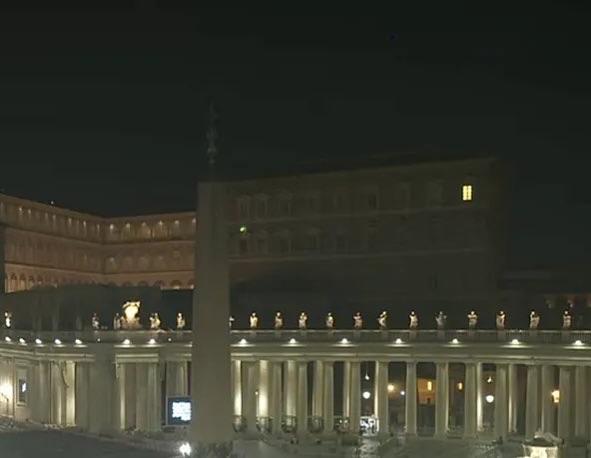
It’s Lent, Easter is coming, and we’re in Laetare Sunday. Without a doubt, it’s a minor topic, or perhaps not so much, when we talk about the Pope, nothing is minor, every detail is significant. Today’s news is that a light is turning on again in the Apostolic Palace after thirteen years. Each one is very free and very responsible to do what seems best to them, Pope Francis did it, what already seems like not understanding anything is pretending that his successors do the same as an impossible «post mortem» imposition. Leo seems to be distancing himself from Pope Francis, which sits badly with those who think he must do and say the same to be respected. The return to the apartment is a sign of freedom that we hope will be shown in other decisions. Continuing a disastrous pontificate will bring us no good, steering it back will not be easy, a small light in the darkness of the Roman night gives us hope.
Life returns to the Apostolic Palace.
The Pope’s return to the Apostolic Palace, after 13 years and 14 days, is news that fills the Romans with joy. In recent years, the Pope has always frequented the Apostolic Palace, but it had become more of an official office than a home. The Apartment, as it is called in the Vatican, remained empty most of the time, because Francis wanted to live, for psychiatric reasons, in Santa Marta. The official communication is that yesterday afternoon the Pope «took possession» of the apartment. The Pope is there and the light turned on illuminates St. Peter’s Square and this signal is comforting. It comforts especially those who lived through the era of John Paul II’s papacy and see in that window a sign and a sign of prayer. In fact, yesterday afternoon there were already those who gathered in St. Peter’s Square for the usual fraternal procession and prayed the Holy Rosary, feeling interiorly closer to the Pope, because that light turned on is a sign, but it contains much more than it shows, as happens with every authentic symbol.
The traditional papal apartment had not been inhabited since February 28, 2013, the day when Benedict XVI’s pontificate ended with his historic resignation. The papal apartment in the Third Loggia is much more than a simple dwelling. It is a space deeply linked to the history of the modern papacy. The complex is part of the great Apostolic Palace, the administrative and symbolic heart of the Vatican. It houses the Secretariat of State, the Vatican Library, several state rooms and chapels, and the Pope’s personal residence. The rooms of the Third Loggia are linked not only to the daily life of the papacy, but also to moments of great spiritual and historical intensity for the Catholic Church.
After Benedict XVI’s resignation in 2013, the apartments were closed according to the procedures established during the vacant see. With the election of Pope Francis, an unexpected decision was made: the new Pontiff decided to continue living in the Vatican residence of Casa Santa Marta, where he had stayed during the conclave.
It was necessary to renovate and adapt the spaces to allow the new Pope’s entry. From now on, looking toward the Apostolic Palace from the square, it will once again be possible to glimpse the light turned on in the papal office at dusk. An almost intimate detail that has always had a special meaning for many faithful: the silent signal that the Pope is there, working or praying, in the heart of the Vatican.
The latest appointments of Pope Leo XIV.
Michael Haynes in the Catholic Herald, reflects on the latest appointments of Pope Leo XIV, which could shed light on the characteristics that will define the new papacy. According to Haynes, the last seven days have highlighted the newly formed pontificate of Pope Leo XIV , the first American pontiff in the history of the Catholic Church, elected on May 8, 2025, with the name of Leo XIII. The most notable news of this week is the transfer of Cardinal Konrad Krajewski from Rome to the Archdiocese of Łódź, Poland. Krajewski, a prominent figure in Francis’s pontificate, had been Papal Almoner since 2013 and had transformed the role into a peculiar mix between a Vatican aid agency and a left-leaning social justice office. His aid to Ukraine was well known, but so were his controversies: from defending immigrants who illegally occupied homes in Rome to the presence of transgender groups at Vatican events. His dismissal from Rome has been interpreted by some as a sign of a break with Francis’s «activist» style on social justice issues. He will be succeeded as Almoner by Archbishop Luis Marín de San Martín , a Spanish Augustinian who collaborated closely with Prevost (then Prior General of the Augustinians) and, since 2021, Undersecretary of the Synod of Bishops. Marín was one of the main organizers of the Synod on Synodality and a defender of the «synodal style.» While the appointment is technically a promotion, it is a position with less theological impact than in the past.
Another significant move is the appointment of the new apostolic nuncio to the United States: Archbishop Gabriele Giordano Caccia , permanent observer to the United Nations in New York since 2019. He replaces Cardinal Christophe Pierre , considered a controversial remnant of Pope Francis’s pontificate. The Middle East has dominated the papal agenda and the Vatican reaffirms its constant attention to Lebanon. The Cuban regime announced the imminent release of 51 political prisoners due to Vatican influence. This is a positive step after years of perceived inconsistent Vatican diplomacy. The Iranian cardinal Dominique Mathieu was transferred to Rome along with the Italian embassy, he was the only Catholic cleric left in service, which raised serious doubts about the sacramental life of the community. The resignation of the Iraqi cardinal Raphael Sako , patriarch of the Chaldeans of Baghdad, motivated by the desire to dedicate himself to prayer, but in the context of a scandal linked to the bishop Emanuel Shaleta (detained in the United States for financial crimes and accused of frequenting brothels; Leo XIV immediately accepted his resignation. Among appointments, transfers, and positions filled, the Leonine papacy is beginning to clarify itself, balancing synodal continuity, attention to peace in the Middle East, and an apparent course correction in some aspects of Pope Francis’s legacy.
Parolin and the Vatican judicial system.
We come from a pontificate in which law has been replaced by the monarch’s decisions to the point of disappearing. It seems that Pope Leo wants to reverse this, it won’t be easy and few trust the Vatican judicial system. We have lived through episodes that are in everyone’s minds and that must demonstrate to us with facts that something has changed, for now it is not seen. Parolin celebrated Mass yesterday in the Pauline Chapel, before the opening ceremony of the 97th Judicial Year of the Tribunal of the State of Vatican City. He concelebrated with Cardinal Artime who is Applied Judge of the Court of Cassation of the State of Vatican City and who in his congregation has little to do. Strengthen «the re-educational purpose of punishment, long recognized in contemporary penal systems, but unfortunately often misapplied in practice.»
«This reflection of divine justice—oriented to emphasize the re-educational purpose of punishment—must shine even more in the Vatican legal system, which includes among its sources—and in a primordial place—canon law, described as ‘the principal normative source and the principal interpretive reference criterion.’ «In continuity, moreover, with the very purpose of all canon law, which consists in the «salus animarum» , or in the «salvation of souls which, as indicated in the final canon of the 1983 code, must always be the supreme law in the Church.»
Vatican justice and the Becciu process.
Pope Leo XIV made a call for truth, procedural guarantees, and institutional accountability. These words resonate in the context of the trial over the management of the Secretariat of State’s funds, which has involved several defendants, including Cardinal Becciu, who was convicted in the first instance. In his speech it is in Vatican News , Pope Leo XIV insisted on a fundamental point: justice is not merely a procedural mechanism, but a service to truth and ecclesial communion. Leo XIV stated: «The trial is the instrument through which justice seeks to reconstruct the truth of the facts through the just confrontation between the parties and the impartial judgment of the court.» «Only a trial that fully respects the rights of the parties can be an authentic instrument of justice.» This passage has been interpreted by many observers as particularly significant in the context of the debate on Vatican justice in recent years.
The Pope’s speech comes after a particularly delicate period for Vatican justice. In recent years, the Tribunal of the State of Vatican City has faced the most complex financial trial in its modern history: the one related to the management of the Secretariat of State’s funds and the real estate investment in London. This case has involved several defendants and has sparked widespread international debate. In a comment published in Faro di Roma , Salvatore Izzo and Letizia Lucarielli observed that the Pope’s speech can also be interpreted as a reaffirmation of the value of the rule of law in the Vatican. This is, perhaps, the core of Leo XIV’s speech. Justice is not merely a technical matter for magistrates and jurists. It is one of the areas where the credibility of institutions is measured. And in the case of the Church, this credibility inevitably also has a moral dimension.
The dust from the interview with the former Vatican auditor.
Milone sat down with EWTN News correspondent Colm Flynn for an exclusive interview about his case against the Vatican, in which he alleges unfair dismissal, loss of income, and reputational damage. The case has been dismissed, and he is filing his final appeal. “We need to be sure, and I say this as a Catholic and as an accountant, that we are properly informed about the state of the Vatican’s finances. Because if the Vatican’s finances are solid, it means our Church will continue. If the Vatican’s finances are not solid, it will have problems.”
For decades, the Vatican has struggled with transparency and accountability in its finances. To address this, Pope Francis appointed Pell to head the Secretariat for the Economy and appointed Milone as the Vatican’s first auditor general. Milone was a top-tier financial auditor who spent more than 30 years at Deloitte in Italy and the United States, as well as at several other firms. But after two years, Milone resigned abruptly, which he has said he was forced to do after discovering financial irregularities. Milone took legal action alleging that Cardinal Angelo Becciu pressured him to resign after he began finding evidence of fraud. The Vatican dismissed his complaint, arguing that, even if Becciu did force his resignation, he acted in a personal capacity, not as an official of the Secretariat of State.
The Vatican has said that Milone “has not maintained his confidentiality agreement regarding the reasons for his resignation.” “When they handed me the decree of the crimes I committed, the document said they had a document… that proved they had conducted seven months of investigation on me and included all the details of any crimes I might have committed.” “This happened in June 2017. Eight years and some months have passed, and we have requested this document many, many times and they have never delivered it to us. So I have no element to know exactly what I am accused of.» “My impression is that I have never seen it because perhaps it includes nothing, because if it had included something real, they would have confronted me with it.” The Vatican did not respond to an EWTN News inquiry, which Milone says is because “they are very ashamed.” “They are very ashamed of what two individuals did inside the Vatican from an institutional point of view, and they have no response. So they try to dodge the matter without commenting, which is what happened in the legal case.”
In an interview with Crux, Pope Leo XIV said that claims of a financial crisis in the Vatican have been exaggerated, pointing out that the Holy See actually recorded a surplus of 60 million euros in 2024. Milone said: “I was very concerned that the Pope was not properly informed about the situation in the Vatican because there were too many, let me use the word, skeletons in the closets that needed to be preserved. And therefore it would be very difficult to understand the issues at hand.” “The financial situation may be better than he expected. I don’t know what has happened between 2017, when I left, and today, except for what I read in the newspapers. But I also know, as an experienced accountant, that some of the issues there would have been very difficult to eliminate in a very short period of time.” “Now, the fact that the consolidated financial statements are not being disclosed, to me, is an indication that there is a problem.” Milone’s case is progressing; if the next appeal is rejected, “that would technically be the end of the road in the Vatican.”
The Latin Mass.
The Wanderer reminds us how the issue stands. “On March 5, 2026, Leo XIV met privately with the authors of the largest sociological study ever conducted on Catholics attached to the traditional Mass. An audience that went unnoticed. But perhaps much more important than it seems.” “Bullivant and Cranney are the authors of Trads: Latin Mass Catholics in the United States, a major sociological study on the reality of Catholics attached to the traditional liturgy in the United States. The volume will be published in 2026 by Oxford University Press.”
«The preliminary results are interesting. According to the data collected, around two-thirds of traditional Mass attendees declare that they accept Vatican II to some extent. The truly schismatic groups represent a very small minority compared to the traditional world as a whole. In the United States there are hundreds of parishes with the traditional Mass, many more than the chapels of the Society of St. Pius X. In other words: the image often spread in ecclesial debate, that of traditionalists as a marginal and rebellious enclave, does not necessarily correspond to what the figures say.»
«If Pope Leo XIV has decided to receive two sociologists in private audience who work precisely with this data, it is not necessarily a sign of a break with the recent past. It could be something much simpler. The sign of a Church that does not fear looking at reality as it is. The sign of a pontificate that wants to understand the facts before making decisions. The sign that, perhaps, after years of controversies, someone in the Vatican has decided that it is time to listen to the numbers.»
The European Union and «Christianophobia».
«Dear Amazonia».
The VI General Assembly of the Ecclesial Conference of the Amazon (CEAMA) is being held in Bogotá from Monday, March 16 to Friday, March 20. One hundred people are invited to the Assembly: among them, 45 with voting rights and about thirty special guests, plus the secretariat and assembly services staff. Representatives of the Amazonian indigenous peoples, bishops, religious men and women, priests, and laity are also present. All are called to debate the roadmap of the ecclesial entities operating in the Amazon for the 2026-2030 period. They must approve the «synodal pastoral horizons.» The Assembly must reassign the positions in the CEAMA leadership, starting with that of President, currently held by Cardinal SJ Barreto, emeritus of Huancayo. Among the participants is the Vietnamese Conventual Franciscan Dinh Anh Nhue Nguyen, general secretary of the Pontifical Mission Society (PMS), sent by the Dicastery for Evangelization. A few months after his papal election, Pope Leo XIV sent an extensive and detailed telegram to the bishops participating in the Amazonian Ecclesial Conference in Bogotá, from August 17 to 20, 2025.
The Anglican boycott.
Since 2008, the Global Anglican Future Conference has denounced Canterbury’s doctrinal excesses, but this time the 347 bishops gathered in Abuja rejected the official structures of Anglicanism, accusing them of following the world instead of the Gospel. Even within a centennial schism, the longing for orthodoxy remains more or less explicit. More than a «schism within another schism,» it seems like a boycott declared in the name of «Anglican orthodoxy» that Africa has launched against the primatial see of Canterbury, whose first archbishop is Sarah Mullally. The former primate Justin Welby is accused of having struck both hoops and barrels, of having «affirmed both a ‘traditional teaching’ and a ‘different teaching'» and «gravely compromised the moral and spiritual authority of the See of Augustine.» For it seems that the ardent desire for orthodoxy is breaking through even within a schism that has lasted five hundred years.
The challenge of democracy.
It’s not that it’s a topic proper to the Church, but it has become a true dogma of faith even within the internal governing bodies. Roberto Menotti and Maurizio Sgroi have just published «The Challenge of Democracy: Strategies for the Best of All Possible Worlds.» Democracy, or more precisely market liberal democracy, is going through a difficult period, and many doubt its viability as a system of government. The democratic form of government is a political act that characterizes human society, distinguishing it from that of other animals. Ants, eusocial beings like us, build perfectly organized systems, where the individual practically disappears. Wolves, closer relatives of Homo sapiens, have a marked individualistic orientation, although they live in packs, recognize hierarchy, and understand the importance of collaboration. But wolves often challenge that hierarchy and must constantly deal with conflict and violence. Thomas Hobbes would compare men to wolves in describing the eternal dilemma between political order and freedom.
Human beings are at once conformist and savage, gregarious and individualistic, sometimes loyal and sometimes cynically opportunistic. From this perspective, human societies are not radically different from those of other animals, but they do possess unique characteristics. In the words of Aristotle, we are zoon politikon , a term usually translated as «social animal» based on an ancient Latin tradition, but which can also be translated as «political animal,» where the adjective political derives from polis , which in classical Greek culture had a very peculiar meaning. Aristotle associates the zoon politikon with the zoon logon echon, that is, a being endowed with language. It is with «discourse» (logos) that the polis is born. The ability to weave a discourse leads to intelligere , or to choice, which is no coincidence the Latin root of intelligence.
Democracy, as an experiment of the polis and, therefore, as a political expression of human society, requires the capacity for intelligere , that is, to choose. While all human beings are intelligent, since intelligence—that is, the capacity for understanding— is common to them, not all act intelligently. Without freedom, which also implies having time to understand , intelligence withers. Moreover, without freedom there is not even the possibility of understanding , because someone does it for us. If we do not practice understanding , we end up weakening our capacity for discernment.
It is in this construction that fear also flourishes, the origin of the Leviathan, that is, the State that in certain cases can oppress to avoid the danger of anarchy. Democracy is based on a delicate balance between security and freedom. In historical development, a growing tendency has been observed to exchange freedom for security and this has been called «social welfare.» This is one of the «problems » that the West has generated throughout its long history of progress and which is now eroding the very roots of well-being.
«I have come into this world for judgment, so that those who do not see may see, and those who see may become blind.»
Good reading.