


It’s Sunday, Lent in sight, carnival days. Life in the Vatican goes on, surprises are published on Saturdays that might land worse, hoping they are forgotten by Monday. We now have Brambilla in bishops, she’s not the first nun, Petrini is already there. It’s curious that the dicastery is filled with cardinals, religious, some nun and priests? They are the main sufferers of the chosen bishops and from what we see, they are quite misguided elections. It’s not possible that they keep asking us to accept the authority of a bishop «by the grace of God and the apostolic see» and when they are dismissed no one gives explanations and no one is responsible. We start another day.
First visit to a Roman parish.
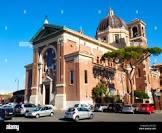
The waves of the Tyrrhenian Sea reflect the 42-meter dome, which the inhabitants of Ostia call «the cupolone,» designed by the architect Giulio Magni in the early 20th century. The parish of Santa Maria Regina Pacis, which for almost a century, with its stained glass windows dedicated to St. Augustine and St. Vincent Pallotti, rises on the highest dune in the Roman neighborhood of the Lido. The church ordered to be built by Benedict XV during the First World War to prevent war. From John XXIII in 1963 to Paul VI in 1968, then John Paul II in 1980, and Francis, who visited it in 2015 to meet with the local community and even with the workers at the nearby Luna Park, almost all recent pontiffs have stopped at the Regina Pacis. Now, even Leo XIV, who on the afternoon of February 15 begins his pastoral visits here to five Roman parishes, one for each sector of the diocese, on the Sundays before Easter.
The mercies of Italy.
On Saturday, the National Confederation of the Misericordie of Italy was received in audience. Founded in Florence in 1244, the Misericordie represent one of the oldest volunteer organizations in Europe. From its beginnings, the brothers have dedicated themselves to caring for the sick, aiding the wounded, supporting the poor, and burying the dead, applying the seven corporal works of mercy to daily life: feeding the hungry, giving drink to the thirsty, clothing the naked, welcoming pilgrims, visiting the sick, visiting prisoners, and burying the dead. Today the service of Mercy continues in the form of emergency health care, social support, civil protection, and closeness to the most vulnerable, keeping intact the bond between charity, community, and evangelical witness. Today it has more than 670,000 members and 100,000 active volunteers in nearly 700 offices throughout the country. At the head is the reinstated Domenico Giani, who was everything in the Vatican gendarmerie in times it’s better to turn the page on. The Pope: “The Misericordie have a centuries-old history, rooted in the Middle Ages, and embody three important dimensions of lay Christian life: spirituality, charity, and attention to today’s needs.” To conclude, the Pope encouraged Mercy to continue its commitment as a community where faith is lived intensely and charity is practiced. Strive to grow in spirit and serve with joy and simplicity, far from any logic of power, dedicated to the praise of God and the good of those the Lord places in their path. Be always messengers of hope, charity, and peace.
Brambilla in Bishops.
Including the Prefect of the Dicastery for Consecrated Life and Societies of Apostolic Life among the members of the Dicastery for Bishops undoubtedly makes sense, given that many religious are called to the episcopate. In that framework, Francis had inserted, without a credible plan, the figure of Cardinal Ángel Fernández Artime, more to «park» him than for a project in favor of consecrated life. Pope Francis first decided to promote him and then looked for a position to place him in positions that, moreover, are increasing today, considering that he has nothing to do in St. Pius XII Square.
Within the Dicastery, Brambilla’s own collaborators describe a management improvised and laborious , marked by a climate that contrasts sharply with the public image. They say that, «behind the videos for social networks and that cloying smile shown on camera «, there are dynamics of retaliation , sullen attitudes full of anger and decisions dictated more by the need to reiterate «who’s in charge»—to the point of real authoritarianism—than by a government guided by paternal concern for religious, monks, and nuns. Moreover, outside the palace walls, there are several religious , monks and nuns who denounce a dicastery increasingly less oriented toward its task of support for religious life and increasingly marked by an ideological stamp, with the feeling of a system that protects » friends » and takes advantage of those who have no contacts or internal support.
The power of government: an unresolved issue
In recent years, in the Roman Curia , a series of appointments have occurred that we never would have wished for. It’s not about questionable decisions based on sensitivity or ideology, but about profiles objectively inadequate : people placed in crucial positions without the fundamental qualifications to hold them, without stature commensurate with the role, without that credibility that, in the Church, is not so much a matter of pride as a condition for governing. Benedict XVI, in his catechesis on the munus regendi , recalled a fundamental principle: ecclesial government arises from a mandate and a form, not from a sociological investiture. The priest is called to » lead with the authority of Christ, not his own «. This phrase is enough to clarify that authority in the Church does not coincide with a delegation of power in the modern sense, because it remains linked to an origin and a responsibility that are not exhausted in man.
In Praedicate Evangelium the center of gravity shifts from the Sacred Order to the papal appointment . In this logic, the power of government would no longer derive from the sacrament , but from the administrative act by which the Pope confers a task. It is a construction that seeks to replace the sacred origin of authority with a merely human source of decision-making. This does not hold up. It is a false position, and anyone who repeats it today has a basic duty: explain it and demonstrate it on the basis of sacramental law , theology , and canon law . Formulas are not enough, nor is invoking the Apostolic Constitution enough: here we touch the very architecture of authority in the Church. Benedict XVI reiterated that authority is always exercised «with responsibility before God» and, by separating from the reference to the Transcendent , «inevitably ends up turning against man.» Presenting the power of government as a simple managerial competence means shifting the focus from the sacramental order to a functional model, a paradigm shift that Benedict XVI considers dangerous and, even more, theologically incoherent.
The idea that women guarantee a «feminine gaze «, «a maternal gaze», «a better gaze» is an empty thesis, useful more for justifying one’s own ideologies than for truly improving the processes of appointing the successors of the Apostles or the formation of future priests.
In the past, an absolute prohibition on women’s access to seminaries was imposed because «they would induce the clergy to temptation «. Today, the opposite maneuver is attempted, as if their mere presence could automatically produce balance, growth, even affection. Some still have not understood that most of those women who are «literally thrown into the seminaries» are ideological women and, often, more bitter than the feminists marching in the square. A seminarian, seeing these women, will only learn to hate them, nothing more.
There is a crucial point: in recent years, the clergy has been progressively marginalized, while the priest remains the bishop’s main collaborator. In recent years, we have seen too many bishops seek the approval of the people, with whom they often come into contact almost exclusively in ceremonies , without knowing how to maintain a real, everyday, and frank relationship with their priests. While the life of a diocese is sustained by the silent ministry of the clergy, the simplest question—»who is truly suitable to be a bishop?»—is no longer posed to the priests : we pose it to the nuns or to the laity . Why?
Bannon and Epstein against Pope Francis.
The 58 of San Egidio.
Interview with the ineffable Paglia who resists disappearing from the media Originally from Boville Ernica, Don Paglia is one of the most recognizable figures in Italian Catholicism. The occasion to reflect on the challenges of the present was the 58th anniversary of the Sant’Egidio Community , celebrated in the Basilica of St. Paul Outside the Walls in Rome. He recounts his vocation: «There was no specific moment. I was an altar boy and accompanied my uncle, the archpriest, to catechism classes in the countryside. At six years old, I imitated the liturgy at home, with my mother’s complicity. At ten, I entered the seminary. My father asked me: ‘Do you want to study or be a priest?’ I replied: ‘I’m going to be a priest.’ After ordination, I met Sant’Egidio. ‘They offered me the Ecclesiastical Academy and I chose pastoral life. In Casal Palocco, I understood that a different missionary impulse was needed. I met a group of young people who later became the Sant’Egidio Community. There were three pillars: the word of God, fraternity, and service to the poor. From there, we launched into the world.» «It seems to me that we are going crazy . We must not forget that the two world wars began in Europe. Today we find ourselves in the middle of a third world war fought in pieces , as Pope Francis said. If we are not careful, we risk a third world war that is no longer fought in pieces, but is total . Except for the intervention of Cardinal Zuppi, the Churches seem too silent to me.» The pontificate of Pope Leo XIV has begun. What kind of Church will it be? ‘I believe that Pope Leo will follow Francis’s line. The style may be different, but the essence will be similar. The challenges are the same: peace, inequality, poverty, demographic crisis ‘.
Viganò and the Lefebvrian ordinations.
Viganò has made a direct and immediate appeal to the Priestly Fraternity of St. Pius X not to suspend the episcopal consecrations announced for July 1. In a statement published in Viterbo and republished by the Vatican correspondent Marco Tosatti on his blog, Archbishop Viganò comments on the declaration of the Dicastery for the Doctrine of the Faith. The archbishop expresses his «pain and indignation» at the Vatican’s request to suspend the consecrations as a prerequisite for dialogue. According to Viganò, this request would repeat a pattern observed in 1988, when the episcopal consecrations performed by Archbishop Marcel Lefebvre without papal mandate led to the excommunication of the prelates involved and marked a deep rupture with the Holy See.
For Viganò, the new consecrations do not represent an act of rebellion, but a necessary gesture to ensure the continuity of apostolic succession in a context he defines as a state of necessity. The archbishop maintains that the Church is experiencing serious doctrinal and liturgical deviations and that the Fraternity has the duty to safeguard Tradition without concessions.
The archbishop challenges the proposal for a «theological dialogue» on issues such as religious freedom, episcopal collegiality, ecumenism, and the conciliar document Nostra Aetate, arguing that the problem is not one of interpretation, but of the compatibility of the Second Vatican Council with Tradition. Viganò also rejects the accusation of schism against the Fraternity, reversing the argument: in his view, the true schism would be that of a «conciliar and synodal hierarchy» that has denied immutable doctrine.
Santa Maria di Grottaferrata.
Interview in the Spanish newspaper ABC with Manel Nin, monk of Montserrat and until now apostolic exarch (bishop) of the Catholics of Byzantine rite in Greece. He faces a new stage at the helm of the historic monastery of Santa Maria di Grottaferrata (Italy), a millennial abbey governed by the Greek-Byzantine rite and directly subject to the Holy See. «It is a monastery with an extraordinary library, with a great publishing tradition and with restoration work on ancient books among the most important in Italy. At the ecclesial level, it is a place at the gates of Rome, therefore, in some way an Eastern presence next to the heart of the Latin Church. Grottaferrata is, moreover, a place with a strong ecumenical vocation: it was founded in the year 1004, fifty years before the schism of the East. It is, therefore, before any division, and can be a privileged space for dialogue with the Orthodox Eastern Christian churches.»
«The Pope has asked me to promote the renewal of the monastery, because the community is living a moment of fragility: currently there are only five monks. Leo XIII said more than a century ago that Grottaferrata was ‘a precious stone set in the pontifical tiara.’ I have made that image my own, and, in some way, I hope, with the help of Our Lord and the brothers, that Grottaferrata will again be this precious stone, a reference for spirituality, Christian life, monastic life, and also a cultural place. He wants it to shine again with its own light.» Why do you think vocations have fallen in Spain? «In Spain, vocations do not arise because I have the impression that Christian families are becoming fewer and fewer. In the last 30 or 40 years, Spain has not only secularized a lot but has de-Christianized. That vocations have fallen is not because of celibacy. The root is the deep de-Christianization of society.»
The abandonment of the priestly ministry.
Deep union with Christ and fraternity: the first remedies to avoid greater abandonment of the priestly ministry. The use of communication media: when is it good? The bishop-priest relationship, chastity, the life of the saints. From the video meeting with Msgr. D’Ercole. Why do so many priests abandon the habit? Is there a formation problem in the seminaries? And what are the risks of media overexposure? These and other questions characterized the Venerdì della Bussola of yesterday, titled «Priests in identity crisis» «. «A priest, like any other person, makes mistakes, can sin, can fall.» «When I can, I tell priests: ‘Don’t worry, come and tell me your mistakes too. I will never judge you because I have no right to do so, and also because I should be the one judged first. But know that God loves you; never forget that the secret of your life is that God loves you.»
Four hours swimming to save his family.
Singles’ Day.
And we’re finishing up. The day after Valentine’s Day is February 15: St. Faustinus and it is considered «singles’ day.» A modern and fun label that has filled with memes, jokes, and social media posts, but which actually has a more interesting origin than it seems. St. Faustinus was not born as an «anti-couple» saint nor protector of solitary hearts: he is a Christian martyr, and his story, as usual, is much more serious and profound than the contemporary caricature. The name «Faustinus» has long been linked to the word «auspicious,» which means luck or good omen. From there, in a spontaneous and somewhat playful way, the connection was born: if St. Valentine is the celebration of lovers, St. Faustinus can become the day when we wish «good luck» to those still waiting for love. Christianity has never considered singleness as a «deficiency» or failure, although common mentality sometimes does. St. Faustinus can become a counter-current symbol: not the saint of «romantic misfortune,» but the saint who reminds us that life does not stop waiting for someone. Life is lived now. And love, true love, is not limited to a romantic relationship: it also involves the ability to love oneself, to build healthy bonds, to never settle, to never underestimate oneself just to avoid loneliness.