


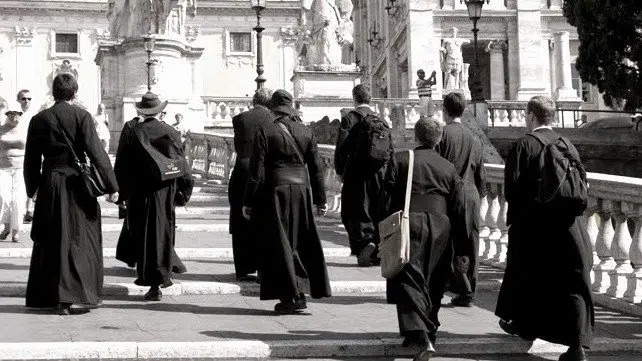
Leo XIV in Monaco.
Day of the Grandparents.
«But I will never forget you», is the theme chosen by Pope Leo XIV for the Sixth World Day of Grandparents and the Elderly, which will be celebrated on Sunday, July 26, 2026, feast of Saints Joachim and Anne, grandparents of Jesus. Pope Leo XIV invites Catholic communities around the world to celebrate this day with an Eucharistic liturgy in the cathedral of each diocese. The pontiff sees this celebration as an opportunity to strengthen the relationship between young and old, promoting a culture of care, gratitude, and listening.
We continue with the letter to the priests of Madrid.
The letter that Pope Leo XIV addressed to the presbytery of the Archdiocese of Madrid on the occasion of the Presbyteral Assembly «Convivium» (February 9, 2026), published just yesterday, once again highlights the essential issues of priestly life. The Pope, by his use of the expression “alter Christus ”, ridiculed as a residue that should be erased: “I hoped never to hear the expression ‘to be alter Christus’ again in my life, and instead the Pope even defines it as the ‘most authentic core of the priesthood’”. A mediocre episcopate selected in past years according to ideological criteria is beginning to emerge, which today wants to take the measure of Leo XIV with the same stance with which, in other times, a section of the clergy and the episcopate chose to wear down Benedict XVI . In the end, the Pope is saying: «It is not a matter of inventing new models or redefining the received identity, but of reproposing… the priesthood in its most authentic essence: to be an alter Christus » . Leo XIV does not launch a slogan: he summarizes what the Church means when it speaks of the ordained priest. Fraternity also derives from it : pastoral charity requires that priests work in communion with bishops and other brothers in the priesthood , because the «alter Christus» is not a spiritual monad, but a man inserted in a body, responsible for concrete bondshis own Pastores dabo vobis reminds us that the authority of Christ, the «Head», coincides with his condition as a servant , with the «total gift of himself»; and Benedict XVI, in the same line, clarified that the priest is not «master», but «servant», «voice» of the Word, to the point of «losing himself» in Christ, which makes the proclamation credible. This is what is questioned today when the «alter Christus» is ridiculed: not a word, but the Catholic content it preserves, that is, Christ at the center , the sacraments as the axis of the ministry, the prayer as breath, the communion as ecclesial discipline, the service as a form of authority.
The traditional world.
It is important to recall the passage from the letter to the bishops that Benedict XVI wrote on the occasion of the Summorum Pontificum , an apostolic letter issued as motu proprio on July 7, 2007 , which liberalized the use of the Tridentine Mass, or «extraordinary form» of the Roman rite, that is, the liturgy according to the Roman Missal promulgated by St. Pius V (1570) and revised by St. John XXIII (1962), in Latin and with the priest facing the altar (ad orientem). Said passage says the following: Looking back at the divisions that have torn the Body of Christ over the centuries, one continually has the impression that, in critical moments when division emerged, the leaders of the Church did not do enough to preserve or achieve reconciliation and unity; one has the impression that the omissions of the Church were partly responsible for these divisions being able to consolidate. This retrospective look imposes on us today an obligation: to strive to the utmost to ensure that all those who truly desire unity can remain in it or rediscover it.
Will the Priestly Fraternity of St. Pius X reach an agreement with Pope Leo XIV?»
Interesting the article by Jan Filip Libicki, senator of the Polish Parliament. «The context is completely different from that of 1988, both doctrinally and ecclesiastically. The answer is yes (…) What is at stake is whether the Church can today find a formula for stable coexistence with a traditionalist movement that is no longer a marginal phenomenon, but a permanent feature of its internal landscape. What is my cautious optimism based on? «First, the growing interest in the traditional Latin liturgy means that it is no longer a marginal phenomenon. This was directly facilitated by Benedict XVI’s motu proprio Summorum Pontificum. Despite the drastic restrictions subsequently imposed by Pope Francis, traditional liturgy today has a permanent place in the Church». «Second—and this is crucial—the controversy is not purely liturgical in nature. The liturgy is merely the external expression of a doctrinal conflict. Precisely for this reason, no agreement was reached between the Fraternity and Benedict XVI, despite being very close to achieving it. Benedict XVI demanded unequivocal acceptance of the Second Vatican Council, setting doctrinal rather than liturgical conditions. His successor, Pope Francis, addressed doctrine—with caution—with less rigor. He was not concerned that some episcopal conferences adopted the Fiducia supplicans document on the blessing of irregular couples, including homosexual ones, while others openly declared that they would not apply it. For Benedict XVI, such a situation was unacceptable; for Francis—regardless of his intentions—it has become a model for the functioning of the Church».
«An expression of this logic was also the statement by Cardinal Fernández: «We cannot cling obsessively to doctrine». In the same spirit, Francis, without demanding any doctrinal declaration from the Lefebvrists, granted their priests the faculty to confess and witness weddings validly and licitly. From the perspective of canon law, this was, in my opinion, a peculiar solution, to say the least. If Cardinal Fernández remains consistent with Francis’s line, he should not be concerned that some traditionalist communities fully accept the Council, others do so selectively, and all function within the Church; just as, let us admit it, with a rather peculiar analogy, those who bless same-sex couples and those who declare they will never do so coexist today within the same Church».
«Third, there is a precedent in the form of an agreement between the Holy See and communist China. Father Pagliarani himself referred to this example in a recent interview, noting that if the Vatican has accepted a model in which the authorities of the People’s Republic of China have decisive influence in the selection of episcopal candidates—who are then approved and recognized by the Holy See—it is difficult to understand why a similar formula could not be applied to the Priestly Fraternity of St. Pius X». «The Holy See recognizes their ordinations and jurisdiction, guided by the logic of the «lesser evil» and pastoral pragmatism».
Fourth, thirty-eight years have passed since the last episcopal consecrations performed by Archbishop Lefebvre. During this period, the phenomenon often—unfortunately—labeled as «traditionalism» has not only not disappeared, but has grown significantly». «All this leads to the conclusion that, both doctrinally and canonically, models already exist in Rome that are recognized and would allow a lasting and systematic solution to the problem of the Church’s relationship with the Priestly Fraternity of St. Pius X. The problem, therefore, is not the lack of precedents, but the will to apply them. Will Pope Leo XIV opt for this solution?
Catholic Investments of the Vatican Bank.
The financial institution of the Holy See announces the launch of two new stock indices, built according to the best market practices and in accordance with Catholic ethical criteria, and designed to provide a benchmark for Catholic investments worldwide. Both indices were developed in collaboration with Morningstar, an independent analysis provider. UniCredit, Hermès, Tesla, Visa are some of the companies included in the «Catholic» stock indices. They are U.S. and European stocks «fully compliant with the principles of Catholic ethics». The two indices of the Institute for the Works of Religion consist of fifty listed companies of mid and large capitalization. On Wall Street, by weighting order: Meta, Amazon, Nvidia, Tesla, Apple, JPMorgan, Broadcom, Visa, Micron and Alphabet (Google). As for European stocks, the top 10 chosen by the IOR are: ASML, Deutsche Telekom, SAP, Banco Santander, Hermes, BBVA, Prosus, Vinci, UniCredit and Allianz. We already have the controversy served; there will be those who believe that the selected ones are not too Catholic and others who are left out who perhaps are more so. Another toast to the sun from the enlightened ones of the Vatican.
Law of the State of the Vatican City.
The course on «Law of the State of the Vatican City» will be held from Monday, February 23 to Wednesday, May 27 at the Pontifical Lateran University. The cycle of meetings offers an in-depth study of the legal system of the State of the Vatican City, highlighting its uniqueness among contemporary state systems. The program includes a focus on the role of the State in the international context, as well as the economic-financial aspects that characterize its functioning. Classes will be held with limited capacity and in hybrid mode (in-person and online).
Fourth Centenary of St. Peter’s Basilica.
Next Monday the initiatives will be presented on the occasion of the fourth centenary of the dedication of St. Peter’s Basilica in the Vatican (1626-2026). The «Beyond the Visible» project, promoted jointly with Eni for research and monitoring, will also be presented. «The project», it is noted, «is particularly significant, considering that cutting-edge technologies allow everyone who enters the Basilica, from all over the world, to know it and interact with it and its digital ecosystem». After the immersive installation project, a press tour will be held that will tell the story of the construction of St. Peter’s Basilica.
More on scandalous bishops.
Euthanasia for everyone, everyone, everyone.
Canada’s Catholic bishops have said that they “support” a conservative bill before Parliament that would prohibit extending state-sponsored euthanasia to people with mental illnesses. “We further urge the government to allow free voting of conscience on this matter, given its profound moral and social implications”. Canada’s Catholic bishops pointed out that while Canadian legislation “regrettably continues to allow euthanasia, the CCCB will also advocate for measures that prevent even broader and more vulnerable segments of the population from having access to it”. Assisted suicide was legalized by the Liberal government of former Prime Minister Justin Trudeau in 2016. Under current law, assisted suicide is prohibited for minors and people with mental illnesses.
Study on seminary candidates.
The topic delves into the problems of psychological studies to which seminary candidates are subjected, in this case in Switzerland and surroundings. The aptitudes of 72 candidates, six of them Italian, were evaluated, and the authorities decided not to continue the collaboration. Of the 72 seminary candidates who took the evaluation exam, not all passed. But their data remain under lock and key. Cases of pederasty within the Church have been, for decades, a kind of uncomfortable «secret.» Often ignored by those who, despite knowing it, chose to ignore them, limiting themselves, in the most delicate cases, to transferring the aggressor to another parish. Today, this is no longer the case. After the scandals, even the Catholic Church has opted for a path of zero tolerance. The same issue of individual candidate files has caused friction between the bishops and the Central Roman Catholic Conference of Switzerland, as the latter wants third parties to have access to the files. The reports are stored confidentially in the diocese. For canonist Thomas Schüller, of the University of Münster, this limited accessibility constitutes a kind of «accounting makeup.» «If a person with responsibility approves a candidate despite a clearly negative evaluation», it would be an «irresponsible and contradictory act». Details on the exchange of information between dioceses «are currently being developed», and at the next assembly of bishops, in March, a decision will be made on the future responsibility for psychological evaluations.
The Communist Ethnic Cleansing of the Men in Black.
And we end with a very unknown but very recent fact in the heart of Europe. Between the fall of 1943 and 1948, Italy’s eastern border—between Istria, Fiume, and Dalmatia—was the scene of a ruthless ethnic and political cleansing orchestrated by Marshal Tito’s communist militias. The toll was a national wound: 350,000 exiles and more than 20,000 victims, annihilated in an attempt to eradicate Italian identity and crush any resistance to Yugoslav annexation. The extermination technique devised by the communist militias was terribly ferocious: prisoners were tied with barbed wire and lined up at the edge of the foibe; the militiamen shot only those at the front of the line, who, upon falling, dragged the entire chain of still-living men into the void with them. Many did not die instantly, but remained agonizing for days in the darkness, buried alive under tons of rubble and bodies. In the Basovizza Pit, for example, at a depth of 250 meters, four hundred cubic meters of human remains were found, then sealed with explosives to hide the massacre.