


El esperado consistorio ha terminado, y ni bien ni mal sino todo lo contrario. Parece que forma parte de esa cadena de eternas e inútiles reuniones clericales que inundan la iglesia postconciliar. Mal, pues no; bien, pues tampoco; y como suele suceder en estas cosas, nos vemos un junio, posiblemente para lo mismo: ni bien, ni mal. Vamos a otear los primeros comentarios inmediatos de lo sucedido estos días.
The extraordinary consistory of this year was the first to be held in years, after Pope Francis avoided meetings during his pontificate, preferring to meet with the cardinals individually or in small groups. Before the conclave that elected Pope Leo XIV, several cardinals complained about the lack of consultations under Francisco’s government and that the scarcity of consistories meant that the members of the college had not had the opportunity to get to know each other well. Many cardenales said that the debates of the last days focused on the return to the Church’s evangelical mission. Wilfred Napier said that the debate focused on “getting back to basics”. We talked a little about the liturgy; there was everything. But the main thing was to resume basic evangelization. In the past, consistories usually consisted mainly of plenary sessions. This year’s format included two plenary sessions—with space for 25 cardinals to address the entire college—but most of the meeting took place in small groups, similar to the Synod on Synodality. Arbolerius of Stockholm: «It’s very good because we get closer and learn to talk together. We come from different parts of the world, so it’s something positive». “There are many questions that we still need to answer”.
In closing the two-day meeting of the College of Cardinals, attended by about 170 cardinals, the Pope asked them to return on June 27 and 28, thus convening his second consistory. He suggested that, in the future, a single annual meeting of three or four days be held, instead of two short ones, like those of yesterday, today, and next June. The Press Office explains that the Pope intends «to continue with these meetings annually, for three or four days once a year», clarified, pointing out that, for Leo XIV, the world situation makes «urgent» a response from the entire Church. «A shared concern during the work for the situations of suffering, war, and violence that afflict many local churches». El Pope Leo also addressed the cardinals who could not attend (for health reasons or, as in the case of Cardinal Porras of Caracas, for other impediments). «We are with you and we feel your closeness». También thanked the older cardinals, especially their presence, for having come to Rome. «Your testimony is truly valuable».
Improvised words from the Pope at the end of the first session of the Extraordinary Consistory: «It offers not only to us—it is not for us—; it offers to the Church and to the world a certain testimony of will, of desire, of recognizing the value of being together, of making the sacrifice of a journey—for some of you very long—to come to be together and to be able to seek together what the Holy Spirit wants for the Church today and tomorrow ”. «I feel, I experience the need to be able to count on you: you are the ones who have called this servant to this mission!». «It is important that we work together, that we discern together, that we listen to what the Spirit asks of us». «Let us ask ourselves: Is there life in our Church?». «I am convinced of it, without a doubt». The question is: Is there space for what is born? Do we love and proclaim a God who brings us back to the path?». «We cannot close ourselves off and say: ‘It’s all done, finished, let’s do as we’ve always done’». «The reason for being of the Church is neither the cardinals, nor the bishops, nor the clergy. Its reason for being is to announce the Gospel».
On the second day it began with a defense of the pontificate of Pope Francis by the cardinal Fernández, speaking about the relevance of Evangelii Gaudium and the Church’s evangelizing mission. El text of Pope Francis is not a document of the past that is archived with the previous pontificate, but remains vital and central to the contemporary ecclesial journey. También pointed out that synodality is a dimension that the Church is learning, like a baby in diapers taking its first steps. So that the thing doesn’t seem so blatant, there was no lack of a reference to Benedict XVI, the cardinal Fernández evoked the then Pontiff’s definition of faith: an encounter of beauty and attractiveness.
Second and last day of the Extraordinary Consistory with approximately 180 cardinals gathered in the New Synod Hall and the Paul VI Hall. At the end of the meeting, León XIV announced that he will convene another two-day meeting in June, on the 27th and 28th , near the solemnity of Saints Peter and Paul . In this way, perhaps, the cardinals will also be able to participate in the celebrations in honor of these saints in Rome. In the same closing speech, he also confirmed the Ecclesial Assembly of October 2028, already announced last March. Improvising at the end of the first session , he wanted to focus on the meaning of the meeting even before the results .
During the subsequent press conference, Cardinal Luis José Rueda Aparicio, Archbishop of Bogotá and Primate of Colombia, expressed his «clear concern» for the current situation in Venezuela, calling attention to the «need for a path of peace and dialogue in the region». «The Pope has made a constant effort to invite people to the path of dialogue, to the path of consensus, calling for peace and truly building peace». According to Rueda Aparicio, «the words of the Holy Father have been the subject of deep reflection in recent days», and although the topic was not on the official agenda of the consistory—which focuses on the mission, synodality, and ecclesial renewal—«it was inevitable that many cardinals, particularly Latin American and African ones, expressed their concern and solidarity with the Venezuelan situation».
Ha llamado mucho la atención que unos 75 cardenales, de 245 no han participado, algunos con excusas razonables, ¿otros?. Brenes, en un caso siempre a estudiar, Arzobispo de Managua, quien durante una entrevista: “No he recibido una convocatoria. He estado registrando el correo, registrando el WhatsApp, registrando las comunicaciones del Colegio Cardenalicio y tengo mis dudas, porque algunas veces se llama al consistorio pero para cosas internas, para cosas muy particulares de la Santa Sede y el Papa”. El Vaticano insiste: “Por lo que me consta, todos han sido invitados”. A Baltazar Porras, la policía migratoria del país confiscó y anuló el pasaporte el pasado 10 de diciembre por lo que no ha podido trasladarse a Roma.
Los cardenales agradecieron su decisión de compartir la comida. Algunos comentaron que, en los trece años del pontificado de Francisco, nunca antes habían sido invitados a la mesa del Pontífice. Tras años en los que, incluso a nivel humano y de carácter, muchos —cardenales y otros— han tenido dificultades bajo el pontificado de Francisco, cada diferencia de estilo se hace inmediatamente visible: en el enfoque, en la vestimenta, en la forma de presidir la liturgia. Algunos cardenales contaron un ambiente relajado y humano, sin formalidades superfluas. No ocultan que «En esencia, fue una manera, también para nosotros, de estudiarlo un poco y verlo con una actitud menos formal: y eso es agradable».
Mario Zenari, cumplió 80 años el lunes 5 de enero y dejó así la lista de cardenales electores. El Papa Francisco lo creó cardenal en el consistorio del 19 de noviembre de 2016 , asignándole la diaconía de Santa Maria delle Grazie alle Fornaci fuori Porta Cavalleggeri. Participó en el cónclave que eligió al papa León XIV y durante la misa inaugural del pontificado fue él quien le impuso el palio, como segundo cardenal diácono , debido a la ausencia del protodiácono, el cardenal Dominique Mamberti.
Varios cardenales no ocultan que están desanimados y decepcionados. Los principales temas elegidos fueron (“ Por razones de tiempo y para alentar un estudio verdaderamente profundo, solo dos de ellos serán objeto de un tratamiento específico […] Los 21 grupos contribuirán a la elección que hagamos, pero, como me resulta más fácil pedir consejo a quienes trabajan en la Curia y viven en Roma, los grupos que informarán serán los 9 de las Iglesias locales ”. Esto parece estar en la más pura continuidad con los Sínodos y el pensamiento de Francisco, pero el Papa León XIV se centró la misión y la centralidad de Jesucristo. Vistos los escasos resultados es evidente que el Consistorio no está bien preparado.
The decision to entrust the initial meditation to the controversial Cardinal Radcliffe is disconcerting, as is the limited time and organization of the working groups. The first extraordinary consistory of Leo XIV did not start in the best way. While some controversy had already arisen before the meeting about the choice of working groups and the limited time for free interventions, things did not go better in the New Synod Hall. What surprised several cardinals was the decision to entrust the inaugural meditation to the controversial Dominican Timothy Radcliffe. During the general congregations, his name had already been proposed for the inaugural meditation of the conclave, but not all the cardinals agreed, and finally Raniero Cantalamessa was chosen, as he was not an elector.
And some cardinals wonder if the powers of the Deanery were exercised in this case by the Secretariat of State. In his speech yesterday, the Pope announced that, of the 21 groups established, only nine from the local Churches will be able to report. Other disappointment for several cardinals arrived when Leo explained that the four topics of the vigil ( Evangelii Gaudium , Praedicate Evangelium , Synod, Synodality and Liturgy) will not be addressed specifically. Leo XIV stated that this consistory does not necessarily have to translate into a text, but conceives it as a conversation that will help him in his service to the universal Church. Listening to him in the front row was Cardinal Joseph Zen, 93 years old., who arrived in Rome by surprise and was able to be received by the Pope in a private audience this morning.
We leave with other news. The Spanish Catholic Church has reached an agreement with the government to compensate victims of sexual abuse by members of the clergy. The agreement arises from complaints that religious leaders had not adequately addressed the problem. El The Government will manage possible compensations in coordination with the Church, addressing cases where no other legal avenues exist because the alleged crime occurred a long time ago or the accused individual has died. The government estimates that hundreds of thousands of Spaniards have suffered sexual abuse at the hands of Church figures. The other signatories with very serious faces were Luis Argüello, president of the Episcopal Conference and leader of the Spanish Catholic Church, and Jesús Díaz Sariego, president of Confer, which represents Catholic religious congregations and orders. As happens in so many of these episodes, figures are talked about that no one can verify based on statistics. A 2023 study by the Ombudsman estimated that 1.1% of the population had suffered sexual abuse at the hands of clergy members or people linked to the Church, equivalent to 440,000 people. The Church has always questioned these findings and claimed that 58 cases had been «resolved» under the initiative. Even the government newspaper El País, which has created a database of clerical abuse complaints, has documented cases affecting 2,948 victims dating back to the 1940s.
In Spain, Christianophobia has become a daily emergency. The government is mired in systematic corruption and is now at the mercy of investigations, scandals, and ongoing trials. In this not at all peaceful context, several alarming acts of Christianophobia have been committed by mobs still unidentified, presumably linked to Islamic or communist extremism in the country. Ethis type of Christophobia manifests not only in acts of blasphemy, kidnapping, and theft of the Most Holy Sacrament, but also in the «martyrdom of things», that is, attacks on Christian symbols, thus demonstrating their violent hatred toward Christ and the history and traditions of the country. On December 28 , the Most Holy Sacrament was desecrated in the Monastery of the Holy Spirit in Valladolid, Spain, the Sacred Hosts from the tabernacle were stolen. Last August the highest number of desecrations was recorded , blasphemies, and sacrilegious acts in Spain, with seven attacks on Catholic churches, according to a report from the Observatory for Religious Freedom and Conscience (OLRC), which urged «not to normalize the everyday occurrence of attacks on churches, attacks on believers, or desecrations».
In China, between October 9 and 11, the communist regime launched an unprecedented national raid, arresting at least 28 Protestant pastors and Christian faithful in more than ten cities, including Beijing and Shanghai. All those detained belong to the Zion Church, one of the main churches that have refused to submit to the control of the Communist Party, and their arrest «constitutes the most severe repression against a single Christian denomination since the Cultural Revolution».
Is there life in the Church? There always is, without a doubt, but it is not in the Vatican in view of the evolution and results of the much-awaited consistory. The jubilee of hope has ended without much hope, there are hopes where there are, we see them and with them we end. It is a case, we have them by the thousands all over the world, they are the ones who truly carry the weight of the Church making present Jesus Christ in all corners of the planet. We have hope, we still have it and we pray every day that they never lose it and that we can continue to count on the thousands of priests and faithful who take their faith seriously without the need for so many perpetual synods and express consistories, and carry it always with joy.
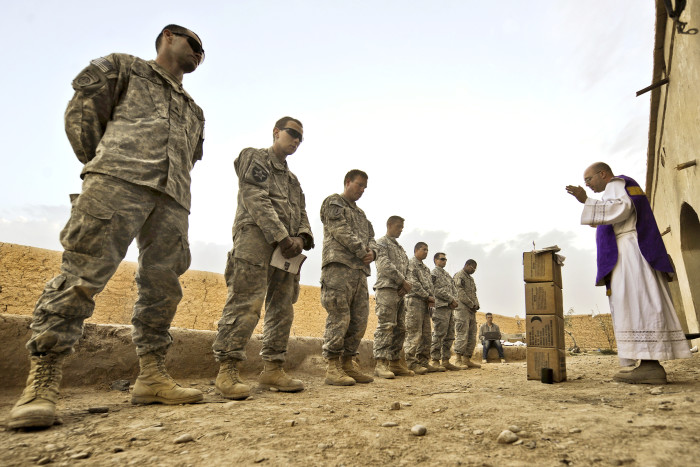
Father Patrick Riffle is a chaplain in the U.S. Navy: «For military chaplains, bringing the Eucharistic sacrifice to men and women in uniform is a true mission of faith». He participated in SEEK is an annual event organized by the Fellowship of Catholic University Students (FOCUS), an organization dedicated to evangelizing and forming young people in the faith. “In the military sphere, we spend a lot of time celebrating Mass in non-traditional places. That’s why, particularly in the Navy and the Marine Corps, we use what we call a field Mass kit like this”, explained the priest as he carefully showed the objects he keeps in his backpack. “First of all, getting to the place. Many times we travel by helicopter, so we use what is called our cranial, which allows us to be safe while we are on board the helicopter”. “Inside the Mass kit we have everything we need to celebrate Mass. We carry a small missal and a stand to place it on. We have the paten, our small chalice, and all the liturgical linens we need”. “We also have some very practical candles that have a small wind protection so they don’t go out”. Chaplains strive to maintain the solemnity of the rite, even when the altar is an ammunition box or an improvised stone in the middle of the field. “Celebrating the Eucharist in the middle of the battlefield reminds us that God does not abandon his children, no matter where they are”.
«Lord, if you will, you can make me clean».
Good reading.