


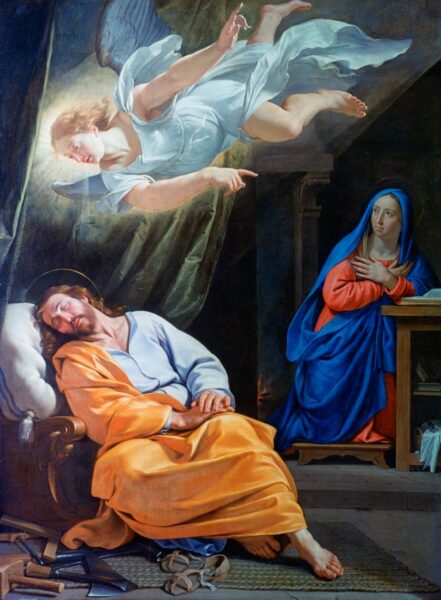
«O Rex Gentium, et desideratus earum, lapisque angularis, qui facis utraque unum: veni, et salva hominem, quem de limo formasti».
Another very intense day. This morning Pope Leo had the greeting to the Roman Curia and then to the employees in the Paul VI Hall. Pope Leo in yesterday’s Angelus addressed the numerous children present in the square for the blessing of the Baby Jesus in the nativity scene. This year, the Virgin Mary is pregnant in the nativity scene in the Paul VI Hall of the Vatican. When Pope Leo XIV prayed before the work, from Costa Rica, «for the protection of life from conception». A «pro-life» nativity scene, but it is also a nativity scene «in progress», because at Christmas, Mary, still pregnant, will be replaced by a figure of the Virgin adoring the Child.
The advance of the message for the 59th World Day of Peace, on January 1, 2026, highlights the pontiff’s intention to take concrete measures to prevent the current panorama from dragging the words of faith toward political conflict, blessing nationalism and religiously justifying violence and armed struggle. Leo XIV is planning an apostolic initiative to recover the universal role of the Church. This expectation coincides with that of the first extraordinary consistory of his pontificate, scheduled for January 7 and 8. After a subtle but discontinuous continuity with Pope Francis, Leo XIV marks the return to a unitary profile, more spiritual and less personalistic than his predecessor. The Consistory of Pope Leo XIII thus promises to be a significant step in defining the face of the new Pontificate: a government of the Church that feeds on sincere dialogue, loyal counsel, and co-responsibility.
We are starting to have analyses of this post-Francis period and today we have the always interesting one by Luigi Bisignani looking ahead to the next consistory. The transition between Bergoglio and Prevost is not a succession: it is a silent caesura, almost surgical in its serenity. There was no real «after Francis». Rather, there was an orderly «filing away» of Francis. As if history had decided to pick up things where Benedict XVI had left them. The signal came soon. In the presence of the now «resurrected» Monsignor Georg Gänswein, a symbolic figure of the Ratzingerian papacy, Pope Leo XIV awarded Maestro Riccardo Muti, at the end of the Christmas Concert, the special «Ratzinger Prize», usually reserved for theologians and philosophers. An eloquent gesture that suggests a failed pontificate.
Bergoglio’s government advanced in fits and starts, forced interventions and sudden personal decisions elevated to the category of magisterium, transforming the Church into a political-emotional laboratory, where gestures mattered more than structure, judgment more than law, and mood more than facts. Sympathy and antipathy often replaced experience, even medical expertise regarding the health of the Pontiff himself. The result is well known: an exhausted Curia, a Vatican financially more opaque than ever, retreating American and German donations, and a disoriented episcopate.
Many prelates have denounced an Italian Church humiliated and marginalized, with bishops—Italians and Argentines appointed directly by Bergoglio—chosen more for proximity than for their culture or ecclesiastical experience, and the Secretariat of State treated like an unwanted guest. Leo XIV is not a vociferous reformer, but a restorer of method. He does not need to contradict Francis: he simply does not need to imitate him. Where Bergoglio improvised, Leo plans. Where the «gaucho» pope often transformed mercy into a weapon of political conflict, the «Yankee» pontiff, less Yankee every day, returns it to the fold of doctrine and forms that—as Justinian taught—are the only guarantee, even for a pope, of the best intentions.
Leo understands the weight of symbols and uses them methodically. During the week, silver: cross and ring, controlled sobriety. But when heads of state enter the scene or Vatican borders are crossed, the silver disappears and it is time for gold, marking the greater solemnity of the Catholic Church. Not a mere aesthetic choice, but the grammar of power. The discontinuity between Francis and Leo is also evident in the eclipse of the magic circle that competed to show such familiarity with the Pontiff that they wanted to address him informally, calling him by his first name, or even Jorge. Meanwhile, discreetly, the Curia has started functioning again: the end of ideological purges, the reduction of «conference prophets», the disappearance of opaque figures—with or without cassock—from the old and new world who, through cooperatives and foundations, plundered the Church’s assets, taking advantage of a tired and ill Pope.
The Pope does not need to say «I am different«. It is enough for him to govern; in fact, he has begun to dismantle, one by one, the useless commissions—from the economic to the doctrinal— inherited from the Bergoglian system. Pope Leo XIV abolished it with a chirograph dated September 29, without explanation, without fuss; there was no need for public trials or purges Urbi et Orbi. The Bergoglian system is being dismantled piece by piece with a subtle, almost imperceptible method. In the Church, transitions are not announced: they are recognized in the details. Today, Francis’s tomb in Santa Maria Maggiore is no longer a destination, but a brief stop on the tour of the basilica. Ecclesia manet, pontifices transeunt.
Interview with Cardinal François-Xavier Bustillo, OFM Conv, Bishop of Ajaccio. ««To Francis of Assisi they said three times: ‘Go, repair my house’. Today we live in a world where distrust has become the norm. We witness increasingly widespread violence in our cities. Individualism, fear, and technological overabundance have broken bonds. Our West, instead of creating connections, pits people against each other and throws them into the arena of perpetual competition». ««In the midst of so much negativity, Christians know that a better world is possible. The parable of the talents tells us that we all have potential, so we need to unite, federate; this cannot be delegated solely to politics and the economy». «Leo XIV stated that faith cannot be reduced to a private matter. I see the Pope living his ministry with simplicity. He is a discreet man, but he knows where to steer Peter’s barque. And on the international geopolitical scene, he has demonstrated unquestionable leadership. He is a Pope who acts by fostering hope and without fear. Is greater unity needed in the Church? Always. Today, being divided means lacking the human, spiritual, and moral maturity to live the faith. The risk is moving from legitimate differences to division, from the innate to the ideological. If we look closely, many frictions concern matters of form, not substance. Leo XIV’s call for unity is not a technical or tactical argument, but the urgent need to live the same faith together».
Paul P. Mariani in First Things: «There is both positive and negative news about the Vatican’s outreach policy toward the People’s Republic of China. The positive news is that the Vatican is engaging with China. The negative news is that the Vatican is engaging with China». Since Xi assumed the presidency in 2013 (the day after Pope Francis’s election), he has tightened his control over all aspects of society. Increasingly draconian regulations have been imposed in the religious sphere, requiring religious leaders to be monitored and indoctrinated by the party, and to report all their finances. The Vatican has been forced to remain silent on any «embarrassing» situation in China, and this silence is considered complicity in the repression of the country’s underground Church.
In Shanghai, the current bishop is Joseph Shen Bin. The good news is that there is no doubt that Catholics know who their bishop is and can function normally; parishes can count on staff and sacraments can be administered. The bad news is that all this comes at a high price; Shen is the communist party’s candidate who brought him to Shanghai and appointed him bishop of the city, without consulting the Vatican, but a few months later, it accepted the fait accompli. Shanghai already had a bishop, Thaddeus Ma Daqin, consecrated in July 2012. Both the Church and the State had given their approval, but he lost the party’s favor minutes after his consecration by announcing his resignation from the Patriotic Catholic Association, a party-controlled entity. Since then, Ma has been under close surveillance and confined to a seminary, and the Vatican was then forced to sideline him. In China, official diocesan documents are signed by the «diocese». The Diocese of Shanghai is just another cog in the party-state machinery, and the same goes for the current bishop. What will be the next step for Pope Leo XIII? So far, he has followed the appeasement policy driven by his predecessor. However, this policy is showing its limits. There could be a change of course after the Pope’s meeting with the cardinals in January. The Church has another card to play; it has survived both the Roman Empire and the Soviet Bloc.
They tell us that everything is going very well in Vatican finances, but we are getting data that it’s not that great. The historic 15th-century palace in the heart of Rome, on Via della Scrofa, which Paul VI chose to house visiting bishops, priests, and cardinals, and where Cardinal Bergoglio resided during his stays in Rome, is about to be sold or rented. Some resident cardinals and bishops have asked Pope Leo XIV for clarifications. The Domus Internationalis Paulus VI seems to have been offered to the highest bidder and is about to be rented for a long period (some speak of 30 years) to be converted into a luxury hotel. The eviction notices have already arrived, demanding that guests vacate their rooms. The official reason is the imminent renovation of the priestly residence due to alleged «security» problems. The decision is not recent: «It was decided with the Holy Father Francis that, for reasons of credibility and image, a five-star hotel could not be built, so in the end it would only be a four-star hotel». Curious that Pope Francis himself condemned on many occasions convents and monasteries that had been transformed into five-star hotels, instead of welcoming the poor and migrants. The matter is already closed, and talk is of a 30-year lease contract with a company that will manage the project; the Holy See will receive 5 million euros annually. Residents have been offered to move to the Domus Santa Marta or to the Domus Traspontina.
War of communion rails in the United States. Official publication of the Archdiocese of Portland, Oregon under Monsignor Sample: «The new communion kneelers [rails] have arrived just in time for Advent and the Christmas season in St. Mary Cathedral, in Portland, Oregon.» In North Carolina episcopal letter, «on the reception of holy communion»: «The norms of the episcopal conference, logically, do not contemplate the use of railings, kneelers, or communion rails for the reception of communion. Doing so visibly contradicts the normative posture on the Holy Communion established by our episcopal conference. And it orders that The use of altar rails, kneelers, and communion rails must not be used for the reception of Communion in public celebrations from January 16, 2026. Temporary or movable accessories used to kneel for receiving communion must be removed before January 16, 2026. With common sense, one might think that it’s better for the bishops to agree a bit before making decisions, however minor they may seem.
We are not living in times of good bishops; there’s no need to explain it much, it’s clearly visible. Someone, someday, will recognize that the appointment process is a disaster and that authentic undesirables are presented to priests and the faithful in the name of God and the Apostolic See. A case, not unique, but striking, that of Ciro Quispe López, 51 years old, former bishop of Juli, Peru. The scandal arose when several women, unknowingly, came into contact and discovered that they were maintaining parallel relationships with the same man, in other words, the harem got out of control. Paola Ugaz, a Peruvian journalist who was able to consult an internal Vatican document related to the investigation, made numerous details public. According to the journalist, many of the women involved—at least 17, as reported—were afraid to expose themselves publicly for fear of the consequences. During the investigation, the Vatican analyzed voice messages, intimate photographs, and videos sent by the bishop; for now, the Vatican has neither apologized for such an inspired appointment. Quispe, appointed bishop by Pope Francis in 2018, and to top it all off, was also investigated for alleged mismanagement of ecclesiastical funds.
Canon law (392) states: «The diocesan bishop is obliged to defend the unity of the universal Church and to promote the common discipline of the Church ; therefore, he must watch to ensure that abuses do not creep into ecclesiastical discipline». Vigilance is part of the government of the diocese, it has a defined perimeter and translates into verifiable duties. Canon 384 is in the same perspective , entrusting the bishop with a special solicitude for priests , so that they live the obligations of their state and receive support in the exercise of their ministry . The relationship between bishop and priest moves within an order that entrusts missions , demands coherence , protects discipline , and requires responsibility . From this derives a concrete task: guide , supervise , and intervene when facts arise that affect the protection of persons and damage the credibility of the institution.
«Oh King of the nations and Desired of the peoples,Cornerstone of the Church, who makes of two peoples one alone:come and save man,whom you formed from the clay of the earth».