


Miércoles de audiencia, en el aula, Roma sigue fresca y de bendición de corderos y otro día en el que no sabemos por dónde empezar. En la memoria litúrgica de Santa Inés se renovó una antigua tradición que entrelaza el martirio, los símbolos y el gobierno de la Iglesia : la bendición de los corderos destinados a proporcionar lana para los palios de los arzobispos metropolitanos. Este rito había sido abandonado por el Papa Francisco en los últimos años. En la Capilla de Urbano VIII del Palacio Apostólico , León XIV bendijo los corderos , continuando una costumbre centenaria directamente vinculada a la figura de la joven mártir romana. El palio es bendecido por el Pontífice el 29 de junio , solemnidad de los santos Pedro y Pablo , y luego impuesto a los metropolitanos . Este año, además, León XIV ha planeado convocar a todos los cardenales al Vaticano en los días inmediatamente anteriores a la solemnidad para un consistorio extraordinario.
Roma es una ciudad donde los símbolos realmente cuentan mucho y no hay lugar más lleno de ellos que el Vaticano. Estos días se ve especial actividad en la última planta del palacio apostólico. Todo apunta a que pronto tendremos al papa León en el apartamento papal, el más clásico de los sitios de la residencia papal. Es un lugar donde cada gesto es público y cada habitación tiene su propio peso institucional.
To the French Catholic doctors.
Message from the Pope, signed by Parolin, to the Federation of French Catholic Media, which celebrates the Days of Saint Francis de Sales in Lourdes until January 23. This year, attention will focus on the challenges of digital technology, the use of social networks, and the minority situation of Catholicism in France. The distinctive seal of Catholics, therefore, is to be «sowers of good words, amplifiers of the voices of those who bravely seek reconciliation, disarming hearts of hatred and fanaticism.» In the face of world polarization, may they be «antennas that capture and transmit the experiences of the vulnerable, the marginalized, the lonely, and those who need to know the joy of feeling loved.» It cites the example of Father Jacques Hamel, servant of God murdered by two young Islamic militants on July 26, 2016, while celebrating Mass in the church of Saint-Étienne in Saint-Étienne-du-Rouvray, near Rouen. A witness whose beatification cause is underway, who believed in the «value of dialogue and mutual and patient encounter.» «He was convinced of the urgency of being close to others, without exception.» The mandate, to conclude, is to be «artisans of a word that embraces, in a communication capable of reconciling what is broken, a balm for the wounds of humanity.»
Parolin and the dramatic situation.
Observatory for Independent Thinking concludes today in Rome the celebrations of its 25th anniversary. The guest of honor was Parolin, who spoke for 90 minutes to an audience of more than 500 students from all over Italy. Some of them raised crucial questions in these times of international tension. «The situation has become dramatic and a cause for great concern.» «We often find it difficult to respond adequately, even though the Holy See has developed guidelines to which we refer in very complex situations.» This year it did not occur to him to appear in Davos, better to position himself in favor of the new winds.
On the situation in Venezuela: «I was apostolic nuncio in Venezuela in Caracas for four years , from 2009 to 2013, although there were already great difficulties and tensions between the episcopate and Chávez.” “Now we are in a situation of enormous uncertainty and it is difficult to predict how things will evolve. The United States has said it wants to achieve democratization to hold new elections, but I am not so sure this will happen. It is urgent to help the population now; there is a serious economic crisis that has brought poverty. 8 million Venezuelans have had to flee, also for economic reasons. We need to foster reconciliation; there is great polarization. We also need spiritual reconciliation.” «I don’t know how Pope Francis developed the concept of a fragmented Third World War , but without a doubt it is the reality. My only doubt is that these phrases become slogans and nothing more; no one thinks about the solution.» On the Middle East, Parolin states: «The goal, as we have been saying for at least ten years, is two States; we have recognized the State of Palestine. In theory, we have it clear; in practice, it is increasingly difficult. The Palestinians must have their rights respected and also a land where they can live.» Regarding the differences he sees between the pontificate of Pope Francis and that of Pope Leo XIV: «Each pope is himself, each pope has his own style and personality; this should not worry us.» But the fundamental thing «is that each pope represents the spirit of his time.»
Trump invites Pope Leo.
Some say yes, others no, others say «we’ll see.» While Israel , with Prime Minister Benjamin Netanyahu , and Russia , with Vladimir Putin, have accepted the invitation from Donald Trump to join the » Peace Board «, the international organization led by the United States and established by the American president with the aim of rebuilding the Gaza Strip. The White House faces negative opinions from Germany , as well as caution from the Vatican. Parolin: «The Pope has received the invitation and we are considering what to do; we are investigating it further.» For Parolin, it is «a question that requires time to answer. I think the request will not be for financial contribution because we cannot do it.» White House correspondents estimate that 35 world leaders , out of a total of approximately 50 invitations, have expressed their approval of the proposal.
The anger of the Vatican employees.
It continues in all media. This is not a new problem in Vatican life, but the magnitude of the data and the very fact that a structured consultation with the staff has been carried out indicate that something is changing. This unease affects not only the organization of work, but also the credibility of an institution that, by its very nature, is called to demonstrate justice, respect for the person, and attention to the most vulnerable, even within its own ranks. The election of Pope Leo XIV fits into this context, marking the beginning of a period of expectations and questioning. Many wonder if the new Pontiff will be able to seize these signals as an opportunity for real change, and not as a mere statistic. Beyond the statistics, the survey revealed a deep demand for dignity, dialogue, and participation among those who live the Vatican daily.
Austen Ivereigh and the lambs.
The criticism of Austen Ivereigh of Pope Leo XIV says a lot about the methods—and the level—of a certain type of journalism that for years has built its career, reputation, and income on the figure of Pope Francis and that today, suddenly without access, tries to remain relevant. This morning Leo XIV received nuns and monks who, according to an ancient and documented tradition, brought lambs that are blessed on the feast of Saint Agnes. These lambs are not killed, mistreated, or displayed as props: they are raised, shorn, and their wool will be used to make the palliums destined for metropolitan archbishops. There is no ethical problem with that rite, simply because Francis was not interested in these things. What mattered to him was not the pallium, but personal fidelity. And when that fidelity was lacking, bishops were dismissed without too many scruples, including canonical right. Ivereigh invokes the «Laudato si’ era» to suggest that Leo XIV’s gesture contradicts Pope Francis’s encyclical. The discomfort is noticeable and Ivereigh is no longer invited, he no longer receives confidential information, his informants—after Francis’s death—have left the Vatican. The season of confidences and authorized biographies is over, and only the attack disguised as ethical concern remains. It is no coincidence that Austen Ivereigh is nicknamed the Mrs. Doubtfire in the Vatican. The problem is not the lambs, the problem is the loss of access to power.
The virgin cardinal.
The Pope has appointed Cardinal Ángel Fernández Artime, pro-prefect of the Dicastery for Institutes of Consecrated Life and Societies of Apostolic Life, as a member of the Cardinals’ Commission of the Institute for the Works of Religion (IOR). The Holy See Press Office announced the appointment today. In the face of lack of work in religious surrounded by two ‘virgo potens’ it seems they are filling his agenda so he doesn’t get too bored. It is not strange that he is known as the ‘virgin’ cardinal, not because of his life, in which we do not enter, God forbid, but because as a cardinal office, what is called office, he has never had one.
The Vatican and Denmark.
The Pope has decided to send Parolin to Denmark to represent him in Copenhagen at the celebration of the 1200 years of the Catholic Church and in an open gesture of support for Greenland’s sovereignty. Parolin, interviewed about Greenland, said that «force solutions cannot be used» and that «it is necessary to return to the spirit of multilateralism that has characterized the postwar period and is being lost.» He added that «it is unacceptable to assert one’s own positions only with force,» an allusion to Trump’s position. This position «will always lead more to conflict and war within the international community.» The mission of Saint Ansgar, 1,200 years ago recalls the missionary action of the Benedictine monk, who is a very popular figure in Denmark. The Benedictine missionary in Denmark and Sweden was born in the year 801 in present-day northern France. In 831 he was elevated to first archbishop of Hamburg and later assumed the archdiocese of Bremen. He died in that city in 865.
Between contradiction and superstition
Joachim Heimerl returns with another of his interesting articles: «Between contradiction and superstition: on the Church and the Popes in our time.» «In Germany, the contradictions inherent in the Church are taken for granted; for example, one considers oneself «Catholic» only if one pays the so-called «church tax.» Otherwise, one is excluded from the Church. Baptism and confirmation no longer count; receiving the sacraments is «forbidden.» In summary: the church tax determines who is «Catholic.» Although this system originated with Hitler, it enjoys general acceptance in Germany. The most loyal, of course, are the bishops, who politically oppose the right and benefit from the church tax imposed by Hitler. A strange way to be credible; however, in Germany this contradiction no longer raises suspicions.»
«Incoherence is not a German peculiarity, but rather the hallmark of the Church of our time; it has become its fundamental form, as demonstrated by the last two Popes; their exaggerated veneration shows how poorly understood the function of the Pope is and the contradictions in which it is entangled. (…) This also includes the popular idea that the Pope is someone chosen by God and, of course, someone whose personal holiness corresponds to the holiness of his office.» «In the last century, the canonization of popes has become so common that no distinction is made, neither among the common faithful nor among most of the clergy. Normally, a pope becomes a saint immediately after his death. While pious men were elevated to the rank of Pope, this was not a problem: official holiness and personal holiness seemed to correspond naturally; no one would ever have thought that a Pope could be contrary to the faith of the Church. With Francis, the situation changed unexpectedly: the theological concept of a heretical pope suddenly took shape, and everything that challenged dogma and superstition became reality. Could a pope proclaim errors, or could he transform them into (new) truths?»
«The Catholic faith was shaken by Francis and only the superstition of the ‘divine’ dimension of his office managed to resolve the contradiction. Official efforts were made to frame the antipope as ‘Catholic’: he was supposed to be understood as a ‘pastoral reformer,’ as a pope of ‘mercy’ who was happy to turn a blind eye, but the truth was the opposite: Francis increasingly presented himself as an irascible despot, as someone who stamped his mark on the Church and indirectly admitted what had long been kept secret: the Church had not been ‘renewed’ after Vatican II, but replaced by a ‘new’ Church, which had abandoned much of what had been Catholic for centuries.»
«It is unlikely that all this will change under the reign of Leo XIV, even though from the beginning he is described as a ‘holy’ Pope, as someone who reconciles the Church internally, as a ‘bridge builder,’ a ‘bearer of hope,’ and other similar nonsense. The message that Francis has truly been a ‘disaster,’ as Cardinal Pell so visionarily expressed, is, of course, implicitly indirect. So far, nothing suggests that Leo is changing the course of his predecessor. The fact that he dresses in papal vestments and behaves better is pure facade.» «No one can predict how long the Church will survive this ambivalent situation. It is taken for granted that it will face a definitive schism. Truth and contradiction finally follow separate paths, and the great task of the popes should have been to avoid it after Vatican II. The Church still suffers this historical failure, but remains silent, to its own ruin.» «Regarding Pope Leo XIV, Cardinal Fernández, and his Marian document, I only have the following words, which seem even more appropriate for an American Pope, with due respect: ‘Shame on you, Holy Father!’
Davos.
Things are heating up. Donald Trump called «green energy» and the Green New Deal the «biggest hoax in history» in his speech at the World Economic Forum in Davos. «Thanks to my electoral victory, the United States avoided the catastrophic energy collapse that hit all European nations that followed the New Green Scam.» He continued to harshly criticize windmills, pointing out their inefficiency. He said that every time a windmill turns, «1,000 dollars are lost.» In his typical ironic tone, the American president began his speech by greeting «many friends and some enemies.» He considers that Europe is on the wrong track due to left-wing policies on energy, public spending, and mass migration: «Certain places in Europe are no longer even recognizable, frankly… I love Europe and want to see it do well, but it is not going in the right direction.» «In recent decades, it has become common in Washington and European capitals that the only way to grow a modern Western economy is through ever-increasing public spending, uncontrolled mass migration, and endless foreign imports.»
Addressing the controversy over Greenland, Trump said that the country is geographically part of North America and is in a «key strategic location between the United States, Russia, and China.» He reiterated his desire to buy Greenland for «reasons of national and international strategic security» and emphasized that only the United States could keep Greenland safe from potential enemies. «We want a piece of ice to protect the world, and they won’t give it to us.» «They [Denmark] have an option: they can say ‘yes’ and we will thank them very much, or they can say ‘no’ and we will remember it.»
Davos and artificial intelligence.
Israeli historian Yuval Noah Harari, atheist and homosexual, made a chilling prediction within a warning at the World Economic Forum (WEF) meeting in Davos, Switzerland: Artificial Intelligence (AI) will soon control not only most of the world’s legal, educational, and health systems, «AI will take over religion.» «This is particularly true in the case of book-based religions, like Islam, Christianity, and Judaism.» «Everything made of words will be controlled by an AI.» «What happens to a religion of the book when the greatest expert on the sacred book is an AI?» He claims that AI: first, is not a «tool,» but an «agent.» It can learn, change, and make decisions on its own. AI «can be a very creative agent» and «AI can lie and manipulate.» The response is not long in coming and there is no doubt that «that Church survived centuries of martyrdom without the Book even being completed. It will also survive any hell in which you and others prefer us to live.» «The Bible accepts that challenge without reservation. Let the game begin!»
The old and the new order.
Canadian Prime Minister Mark Carney doubled down on his intentions to force the country even further toward globalization after telling delegates in Davos that the «old order» backed by the United States «is not coming back.» His speech in Davos was riddled with globalist viewpoints and was, in general, a direct attack on the Trump administration. Carney highlighted how «great powers can afford to act on their own,» claiming they have the «military capacity and influence to dictate terms.» Trump attacked directly Canada and Carney’s comments in his speech to the delegates, pointing out that he was «not so grateful» to the United States for what it had done to protect Canada. Trump claimed that Canada «lives» thanks to the United States and added that «Canada receives many gifts from us.» The similarities between Carney and Trudeau extend to their globalist ties on issues like abortion and the LGBT agenda .
Doctor Newman.
Newman was proclaimed Doctor of the Church by Pope Leo XIV. In Westminster Cathedral , the solemn Vespers of thanksgiving gave liturgical form to a recognition that concerns not only theology, but also the conscience of contemporary man. It is not a late honorary title, but the confirmation of a voice that continues to question the relationship between truth , authority , and moral freedom . To contemporary man, tempted to use conscience as immediate moral justification, Newman reminds him that freedom does not coincide with absolute self-determination. It is, rather, the capacity to recognize a prior truth and let oneself be judged by it. The primacy of conscience, in Newman, does not legitimize subjectivism. It demands men capable of presenting themselves before God, without taking refuge either in blind obedience or in selfish individualism. That is why his voice resonates today with renewed force: not because it simplifies everything, but because it restores weight and seriousness to the moral act.
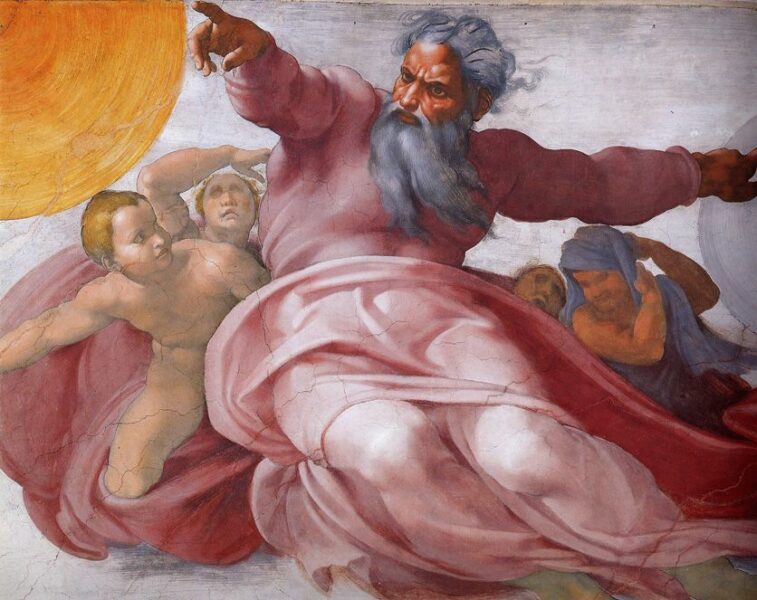
God and the universe.
Ratzinger and Europe.
And we end with a curious, very curious, encounter with an ‘current events’ article signed by Joseph Ratzinger in an Italian newspaper. They publish a homily delivered on May 12, 1979, by Cardinal Ratzinger in Munich Cathedral, where he was then archbishop, on the occasion of Europe Day. Reread almost fifty years later, it will amaze the reader with its profound relevance. And not only that, it is announced that starting today, Il Tempo offers readers several speeches, homilies, and master conferences by Joseph Ratzinger/Benedict XVI. Rereading them in the light of current international geopolitical events, they seem incredibly visionary and unexpectedly timely. What’s more, we believe they are authentic «prophecies.» «Thus Europe was born, the Europe in which we live, the Europe that calls us today, is founded on the union of the Greek spirit and the Christian faith.» «Paul exhorts the Greeks to follow the wisdom of Greece, exhorts them to follow reason and do what is reasonable. Does this mean that the Christian faith is finally declared useless? That faith represents only a preliminary stage until the Enlightenment no longer needs it and reason suffices for itself? By no means, on the contrary. This correlation between faith and reason is reflected in the list of virtues of Saint Paul. Here emerge the true foundations of Europe, those that have given this continent its specific role and its special place in world history.
«We experience the barbarity of unbridled reason today, and Paul could have experienced it in the Greek world of his time. The Acts of the Apostles tell us of the dismay that gripped him when, in Athens, the capital of ancient culture, he discovered an altar inscribed: ‘To an unknown God.’ Where God is unknown, what is crucial remains unknown, and it is precisely here that the need for help is most urgent. Paul intuits it by observing the poverty of the workers in the port of Corinth, the ‘market’ of vice in the big cities, and the desperate perversion that reigns in the courts of the rich. In the first chapters of the Letter to the Romans, he describes this experience with words that remind us of the world of Genet and Pasolini, the desperate inner agitation of modern existence. I still remember when a communist, during the ‘Humanismus Gespräch’ in Salzburg in 1976, shouted at us: ‘Corrupt people of all countries, unite!’ He was referring to the proliferation of drugs, mental illnesses, and suicides in Western society. It would not have been difficult to contrast a long list of phenomena of inner agitation in the East: in both, it is the failure of a reason that only wants to see itself and is necessarily blind.» «The Christian faith, on the other hand, means that reason finds its due in the support of faith, which precisely thus frees it.» «As Christians, we are responsible for ensuring that the moral values spoken of in today’s reading remain as inviolable stars that guide life. This, however, is a form of partisanship to which we do not want to renounce: precisely because we long for the freedom of reason, we manifest against that immoderation of the spirit that leads it to unreason. That is why we fight for the moral values with which the Christian message keeps reason within the orbit of the human.»
«Europe is going through a crisis in its history, its spirit, its identity. The task of the Church is not—and I repeat—to participate in partisan politics. Our task, on the other hand, is to urgently participate in that purification of the spirit and of spirits that allows reason to overcome nostalgia, so that it opens up and calls: ‘Come here and help us!’ This is our prayer in today’s Eucharist. Let us pray to the Spirit of Jesus to cross the sea of our doubts and pride, which separates us from Him, and to illuminate us from within and strengthen us. It is the prayer of Thomas who, doubtful but hopeful, says to Jesus: ‘Lord, we do not know where you are going; how can we know the way?’ (Jn 14:5). And his answer applies to us too: ‘I am the way’: He himself, Jesus Christ, is the true way. We want to know Him and find Him more and more. Only thus can we adequately perform our service in this world and in our time.»
«You are the Son of God!»
Good reading.