


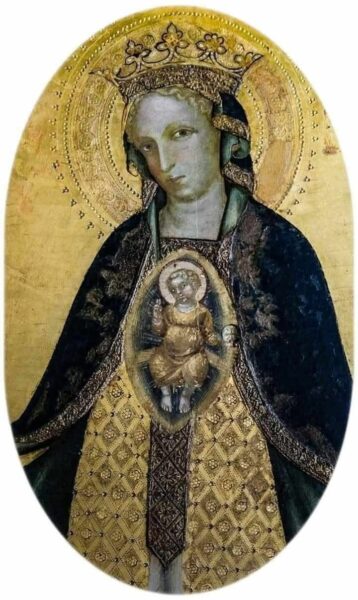
«O Radix Jesse, qui stas in signum populorum, super quem continebunt reges os suum, quem gentes deprecabuntur: veni ad liberandum nos, iam noli tardare».
And after a morning full of audiences, Pope Leo got into his car and headed to the Pinciano neighborhood, a stone’s throw from Villa Borghese, to meet with the Apostolic Nuncio in Italy for lunch. The exchange of Christmas greetings gave him the opportunity to have a broad conversation about the situation of the Italian Church (of which the Pope is Primate), where an important process of merging many small dioceses is underway due to the decrease in priests and even in the faithful. Secularization is beginning to make itself felt in many areas and is already visible. However, other open issues also arise, such as the fact that several important diocesan sees expire in 2026, which requires replacements. Finally, the issue of abuses and how to compensate victims of violence remains unresolved, at least in theory, since the Italian bishops have not been characterized by their transparency and concern in recent years.
The impressive nunciature that the Pope visited, let’s say officially for the Christmas lunch, has a very particular and unique history. It was designed by the architect Busi Vici in 1920 for Isaia Levi, a prominent Turinese industrialist and senator of the Kingdom of Italy. Levi, Jewish, named the beautiful villa after his daughter, Giorgina. After the war, Levi, who had meanwhile converted to Catholicism, bequeathed the property and its grounds to Pius XII in recognition of his help during the racial persecution following the introduction of the 1938 laws by the fascist regime. It was St. John XXIII who decided to turn it into the seat of the nunciature in Italy. The current apostolic nuncio is Petar Rajic, Canadian of Croatian origin, appointed by Pope Francis last March, placing foreign nuncios in the Italian nunciature, deliberately breaking a long tradition.
Last November, Pope Leo, on his trip to Assisi to meet with the Italian Episcopal Conference, spoke of a more open and less limited Church, suggesting more rational and optimized territorial structures, and aspiring to reduce the average age of the episcopate through natural rotation. He asked that everyone respect the retirement age, whose service limit has always been set at 75 years and, if so, he could soon replace several bishops of prestigious sees, such as Assisi, Pompeii, Novara, and Cardinal Cantoni of Como. For 2026, among the dioceses that will become vacant is Milan, the largest in the world, which could affect possible movements at the highest levels of the Curia.
Visit of Leo XIV to the biblical exhibition of Borso d’Este, located in the Chapter Hall of the Senate. He was awaited by the president of the Senate, the secretary general of the Senate, and all the leaders of the Senate groups, along with the minister of Relations with Parliament. He remained about 20 minutes in the Library and was shown to the Pontiff the Borso d’Este Bible , one of the greatest masterpieces of Italian Renaissance art, a work created between 1455 and 1461 by the calligrapher Pietro Paolo Marone and the illuminators Taddeo Crivelli and Franco dei Russi, one of the highest expressions of miniature art. In the Archives Hall he unveiled the veil placed over the image of the Child Jesus in the nativity scene. A pause to listen to the Senate Polyphonic Choir perform «Adeste Fideles».
In this morning’s audiences, Pope Leo XIV received Schneider who has been known for years as one of the most critical voices regarding various approaches of the previous pontificate, especially with regard to the liturgy, doctrine, and the approach to interreligious dialogue. In particular, he has been publicly identified as a representative of the traditionalist camp and as a critic of certain decisions and formulations associated with Pope Francis. Institutional contacts have not been lacking and in an audience with Francis in 2025 , Schneider himself conveyed a cordial tone and the request to pray for the Pope. We may be witnessing «the image of reconciliation «, the sign that the new pontificate intends to keep channels open even with polarized interlocutors . We do not believe that the audience equates to an endorsement of Schneider’s positions, it indicates a governmental priority: to return the debate to institutional limits , moving it away from the permanent struggle between «factions». We are facing the will to recompose the internal fabric of the Church not through media operations , but with a line of government made of meetings , in which direct dialogue becomes central , even when it is uncomfortable and complex.
«The peace of the risen Jesus is disarmed» describes a path that Leo XIV is following above all within the Church . The Pope is convinced that, before calling the world to peace, the Church must recover its own internal peace . This is not a governance strategy: it is a matter of credibility . In recent years, in fact, extremist positions have hardened on both fronts , to the point of making the ecclesial air heavy , sometimes unbreathable: this polarization has produced an unbearable climate , a permanent conflict disguised as zeal, an identity militancy confused with faith.
The appointment announced today for New York is not just a change in a major American diocese , but a sign of his governance style. New York has national significance and covers three districts of the city of New York (including Manhattan and the Bronx ) and several counties north of the city; pastorally, it serves approximately 2.5 million souls in nearly 300 parishes. It is the desire to cool internal tensions , cut the logic of factions , and return the ecclesial debate to the terrain of unity and credibility . The Holy See has announced that the Pope has accepted the resignation of Cardinal Timothy M. Dolan from the pastoral care of the Metropolitan Archdiocese of New York and has appointed His Excellency Msgr. Ronald A. Hicks as Metropolitan Archbishop , transferring him from the Diocese of Joliet (Illinois). The profile of the new archbishop is that of a pastor who grew up in Chicago, with a solid education and no improvised governance experience: born in 1967 , philosophy studies at Loyola University , theological training at Saint Mary of the Lake University/Mundelein Seminary , a significant step in the charitable work Nuestros Pequeños Hermanos between Mexico and El Salvador , then roles in formation and, above all, a long path of responsibility up to the role of Vicar General.
This appointment must be read in parallel with another choice that directly impacts the governance of the universal Church: the designation of Msgr. Filippo Iannone for Bishops. In recent years, men «friends of friends» have been preferred for promotion, coming from environments close to ideology and profiles built to please the Pope of the moment, with a curriculum tailored to what would fascinate him most. It is enough to observe how pleasing profiles have been created full of pastoral roles displayed as seals of authenticity: parish priests for a few months , directors of Caritas for a few months, prison chaplains for a few months . A few months, sometimes even a few weeks , just enough time to craft a presentable profile and be able to say, serenely: «He is a man with the smell of sheep».
The result? A permanent representation , a staging that replaces discernment with narrative and competence with the ability to dress in the appropriate attire at the right moment. The results have been seen, and the real parish priests are paying the consequences, having teenage bishops at the helm of their dioceses who dedicate themselves to sowing discord among priests as the only form of governance. The Pope has repeatedly insisted on the need to break the logic of division and polarization , calling for «agents of communion» capable of recomposing what divides them: not «dividing the world into irreconcilable factions», not letting hatred and lies dictate memory and affiliation, because «within the Church… we cannot be divided».Empty «neutrality» does not exist and every appointment indicates a direction. The direction that emerges is neither “traditionalist” nor “progressive”, but more radical: communion as the priority of governance. Everything points to placing people in strategic positions who, by their biography and style, can reduce conflict and facilitate the patient work of recomposition. Problems cannot be avoided, but the truth is that a different atmosphere is being breathed in the Church that we hope will not be disappointed.
Pacifying Germany will not be easy. Last week, the German bishop Peter Kohlgraf of Mainz rejected claims that he and other members of his country’s episcopate have ceased to be Catholic, insisting that such accusations misinterpret both his position and the nature of current Catholic identity. During the feast of the Immaculate Conception, Bishop Kohlgraf said he repeatedly encounters claims that German bishops are no longer Catholic. Arguing that Catholic identity should not be defined primarily in terms of boundaries and exclusion, the bishop stated that he rejected Catholicism defined as «an immutable truth that must be proclaimed at all times, regardless of current problems and events». «For me, being Catholic also means taking into account the possibility of being wrong”. The bishop did not directly address specific criticisms of the German Synodal Way. Nor did he refer to Rome’s repeated interventions, warning that national synodal bodies have no authority to alter teachings considered irreformable.
Since its launch in 2019, the Synodal Way has approved a series of resolutions demanding radical changes in Church doctrine and governance. Among the most controversial are texts supporting blessings for same-sex couples, the ordination of women, a revision of sexual morality, and the creation of a permanent synodal council of bishops and laity. The resolution stated that «same-sex couples who wish to risk an unbreakable common life should be able to see themselves under God’s blessing». The synodal documents express recognition of «different sexual orientations and gender identities» and demand a reevaluation of homosexuality in Catholic doctrine. Bishop Georg Bätzing, president of the German Episcopal Conference, has openly criticized the Vatican’s stance, calling it outdated and not reflective of a freedom-loving society. The future of the German Synodal Way remains uncertain and the movement seems to be fading, especially in terms of its public presence. What is evident is that the movement has directly challenged Church doctrine, and in doing so, could undoubtedly be considered heterodox.
The first meeting, the «synodal conference», is already scheduled for November 6 and 7, 2026 in Stuttgart. There are even dates for a second meeting, April 16 and 17, 2027 in Würzburg. But the new national synodal body currently exists only on paper and cannot be established without Vatican approval. Pope Leo’s response to a direct question about whether he would approve the synodal conference was evasive. Does «We’ll see» mean «more than likely» or «probably not»? Observers in Germany are divided on whether the Vatican will give the green light. Bishop Klaus Krämer of Rottenburg-Stuttgart, for example, has said that he takes it for granted that Rome will approve the body. However, canon lawyer Heribert Hallermann has argued that the statutes are too plagued with ambiguities to satisfy Rome. After the boycott by the four bishops, the interim synodal committee contained few dissenting voices, as seen in its unanimous vote to approve the synodal conference statutes. Given his apparent desire to pacify the Church, it is unlikely that Pope Leo XIV will opt for this radical option. It is more likely that he will choose a less resistant path, approving the synodal conference statutes, but with small adjustments, and perhaps not as quickly as its creators would like.
There is not a very good atmosphere in southern Italy and the weapons are raised in the hospital of Padre Pio owned by the Vatican, actually by its Bank and with direction set by the Secretariat of State. The workers’ banner was unfurled while the general director was preparing to begin his speech. Then, shouts, whistles, and protest applause from doctors and nurses were heard: a persistent call for the managers to resign from their positions at the helm of the «Casa Sollievo della Sofferenza». The protest erupted during the Christmas greetings ceremony. Perhaps almost inevitable after days of tension at the San Giovanni Rotondo hospital: the healthcare staff is restless over the management’s decision to abandon the national public health contract and switch to one for private residences. This measure has been harshly criticized by the unions, who claim it reduces employees’ rights and endangers the services provided. A strike was called for January 9, while next Monday there will be a torch procession in the city with the participation of residents. A demonstration is also being organized at the Vatican to draw the Holy See’s attention, the owner of the hospital.
God’s representative on Earth has ended up on Vogue’s best-dressed list, among a rapper and an independent actress. The wonderful thing is the tone and Vogue explains that the Pontiff has «broken with Francis’s deliberately humble tastes». The winning look —and here we must pause for a moment to reflect on the very concept of «winning look» applied to a Pope— is the one he wore in his first appearance from the balcony. Red, gold, silk. Things that would make Donatella Versace cross herself and she probably did upon seeing that embroidered stole. Vogue describes it as «a perfect balance between authority and iconic power». Perhaps in a few years we will have popes with recognized stylists, Vatican collections, limited-edition vestments. Eternity, once upon a time, did not need to appear in Vogue to be taken seriously.
And we end with an article that introduces us to the beauty of the great men of history. On December 12, in the Vatican, in the presence of Leo XIV, Maestro Riccardo Muti conducted the Coronation Mass of Charles X by Luigi Cherubini , performed by the Luigi Cherubini Youth Orchestra and the “Guido Chigi Saracini” Choir of Siena Cathedral. The choice of this mass, as a musical homage to Leo XIV, also seems to be an event rich in symbolic allusions. Luigi Cherubini (1760-1842), a composer very dear to Riccardo Muti, was one of the central figures of European music between the late 18th and early 19th centuries. Born in Florence, he spent much of his life in France, where he lived through some of the most dramatic periods of modern history: the French Revolution, the Napoleonic era, and the monarchical Restoration after 1814. Composer of important operatic and sacred works, he became director of the Paris Conservatory, exerting a decisive influence on European musical education.
The Coronation Mass of Charles X represents one of the peaks of his sacred production: a work conceived for a rite in which music, theology, and sacred politics intertwined. The mass was composed for the coronation of Charles X of France, celebrated on May 29, 1825, in Reims Cathedral. Charles X (1757-1836), already Count of Artois, was the brother of Louis XVI, guillotined on January 21, 1793, and of Louis XVIII, who ascended the throne in 1814 after Napoleon’s fall, but died without issue in September 1824. Charles X reigned only six years and, after the July Revolution of 1830 and his abdication, lived in exile with great dignity, interpreting it as a trial permitted by Providence.
Charles X firmly believed in the principle of monarchy and wished to be crowned according to the ancient ritual, codified by Charles V in 1365, but whose origins dated back to the pontificate of Egbert in the 8th century. For over eight hundred years, this rite had undergone no substantial changes, and Charles X wanted to revive it in its entirety. During the ceremony, the king insisted on kneeling personally in the most solemn moments, despite his age and physical limitations, declaring that sacred power could not be received standing. The central moment of the coronation was the consecration with the holy oil, traditionally kept in the famous Holy Ampulla. According to the history of Hincmar of Reims, a dove brought this ampulla from heaven to St. Remigius, who with the oil it contained anointed Clovis, the first Christian king of the Franks. From then on, the king of France was considered almost a vicar of Christ, invested with a providential mission. The royal consecration expressed the sacred origin of temporal power.
During the French Revolution, on October 7, 1792, a member of the Convention, the Protestant pastor Philippe Rühl, solemnly broke the Holy Ampulla in Reims square, a public gesture of rejection of the monarchy’s sacrality. However, according to an official record of the time, the day before, a portion of the chrism had been extracted and preserved with a gold needle, which was later used for the consecration of Charles X. The coronation of Charles X, celebrated at eight in the morning on May 29, 1825, was a gesture by the sovereign to solemnly affirm the return of the sacred monarchy after the outbreak of the Revolution. Paris, the capital of the Revolution, remained on the sidelines of the event, while Reims, the traditional seat of French sovereign coronations, was chosen. It was, therefore, a deeply counter-revolutionary gesture. The king took the ritual oath, received the spurs and sword, symbols of power, and was anointed with the holy chrism by the archbishop, Monsignor de Latil. Then, the fleur-de-lis cloak, the ring, the scepter, the hand of justice, and finally, the imposition of the crown were presented. Cherubini’s music played a central role, accompanying the key moments of the sovereign’s coronation. The Coronation Mass of Charles X, officiated by Cherubini in the Vatican before the Holy Father, thus evoked the sacramental conception of power, proper to Christian civilization, acquiring the significance of a symbolic reminder of a permanent truth: that of Jesus Christ, King of society and history. It does not seem coincidental that this event coincided with the centenary of the encyclical Quas primas of Pius XI (1925), in which the Pontiff clearly affirmed the biblical, theological, and spiritual foundation of Christ’s social kingship, the perennial ideal of every true Catholic.
«O Root of Jesse, who stands as a standard for the peoples; the lips of kings will refrain from mentioning you while the nations invoke your name: come and redeem us. Delay no longer».
«…to prepare for the Lord a perfect people».
Good reading.