


The Pope called for amnesties and pardons during the Mass for the Jubilee of Prisoners, echoing the requests of Pope Francis. He urged offering every person the opportunity to start anew, denouncing the difficulties of the prison system and promoting restorative and inclusive justice. Leo XIV strongly reiterated the desire expressed by Pope Francis in the Bull Spes non confundit to grant «forms of amnesty or remission of sentences intended to help people regain confidence in themselves and in society, and to offer everyone real opportunities for reintegration». The Pontiff recalled that the biblical Jubilee was «a year of grace in which, in many ways, everyone was offered the opportunity to start anew». «As the end of the Jubilee Year approaches, we must recognize that there is still much to be done in the prison system». He did not forget to mention the structural problems of the prison world: “We think of overcrowding, the still insufficient commitment to ensure stable compensatory education programs, and job opportunities”.
The «Pet Carpet» association has obtained permission from the Holy See, for the first time in its history, to sponsor an event dedicated to animal caregivers on the occasion of the Jubilee. On December 13, a six-legged walk was held in Villa Borghese and on Sunday the 14th they participated in the Holy Mass at St. Peter’s with the Pope followed by the Jubilee pilgrimage. The president of Pet Carpet stated “how fundamental the figure of volunteers, healthcare personnel, volunteer doctors, and all those who work on the front lines is”.
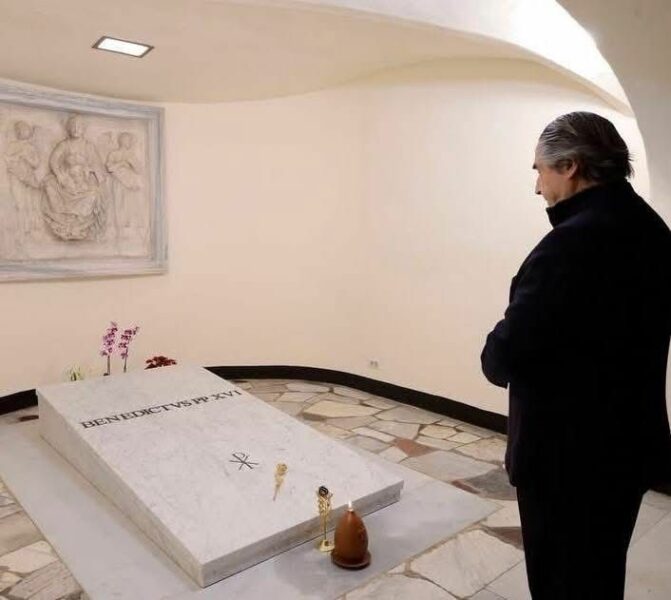
Luis Badilla rejoices at the «public» return of the Pope to sacred music after Francis despised it for 13 years. Pope Leo: «It seems especially appropriate to award the Ratzinger Prize to those who have preserved what Benedict XVI always considered the essence of art: the possibility of making a spark of God’s presence resound through beauty». Highly recommended is the full text of the Pope’s speech and the interview with Riccardo Muti on Vatican.va. In our image, Muti’s visit to the tomb of his admired Benedict XVI, for whom he does not skimp on praise.
Pope Leo XIV is among the best dressed of 2025 according to ‘Vogue’: during his first seven months of pontificate he has shown a taste for dressing in a more traditional and solemn way. It is true that coming from where we come from, it is not difficult to surpass it. From the first moment he chose a tailor from the house, «I Sarti del Borgo” very discreet and habitual in the Vatican world for making the colorful uniforms of the Pontifical Swiss Guard. They tell us that we will have news and in the right direction, this Christmas. It is said that «the habit does not make the monk», but we know that habits and customs, repetitive and conscious actions (like those of a monk), are what truly shape our character and transform us from within, suggesting that we can improve our lives through small daily practices, like living with presence, compassion, and attention to the everyday, beyond clothing or title.
Many of our bishops get distracted more often than desired, things of these turbulent times where even the Vatican is immersed in confusion. Thank God, they are times when there are many sensible parish priests who are a reference for Catholic faithful who want to remain faithful to the faith of their elders. Among the parish priests we also have the distracted ones and in strong times they usually manifest themselves in their splendor. Don Vitaliano Della Sala, resident in Capocastello, near Avellino, proposes this year a nativity scene with a «Baby Jesus Girl». He announces: «It would be a good idea to dismember it to make it resemble those children victims of massacres around the world». ¿The objective? «To provoke debate», as he explains in an interview with a local television network. I thought of putting a woman Jesus in the manger because we need to start a debate on the role of women. We need women priests. God also incarnates in women. I am not against the nativity scene, but I reinterpret it». Don Vitaliano Della Sala is known for his rejection of tradition. A few years ago, he created a nativity scene with two mothers. What will his bishop think? Well, as is usual, he doesn’t think and if he thinks he doesn’t say it. No comment from the diocese of Avellino. In recent times the Avelino priest would be a candidate for cardinal, we’ll see if he still is.
The so-called Supreme Court of the Vatican, civilly speaking, is preparing to decide on the recusal of the Promoter of Justice, Alessandro Diddi, in the controversial appeal of the London trial. It will meet on January 9 to decide whether to recuse the Promoter of Justice, Alessandro Diddi, and exclude him from the Becciu process appeal. In practice, the thousands of messages exchanged between Chaouqui and Ciferri carry great weight, as both, in the midst of the complexities of this convoluted matter, would have inspired, at different levels, the memos drafted by Perlasca, the main accuser of Cardinal Becciu. On January 9, the Cassation panel will include Cardinals Kevin Farrell as president, Matteo Zuppi and Angel Artime, none of them from the legal world, along with two appointed judges, professors Chiara Minelli and Patrizia Piccialli. Leo XIV made it known that he had no intention of interfering, leaving the task to the appeal judges and defense lawyers to reach a conclusion. The use of the verb «interfere» chosen by the pontiff was to emphasize that this time only Canon Law would speak. Practically the opposite of what happened in the first instance due to the massive and repeated interventionism of Pope Francis who even signed, while the investigations were open, four decrees (initially kept secret) to grant the Promoter of Justice total carte blanche regarding interceptions, precautionary measures, and freedom to examine seized material. John Allen recently highlighted in Crux how this «disaster» is plagued by «procedural irregularities» to which other strange elements have been added. If that weren’t enough, the president of the Vatican’s first instance tribunal, Giuseppe Pignatone, is being investigated in Sicily for alleged ties to the mafia. «The trial in the London Palace, which was supposed to represent a turning point under the pontificate of Pope Francis, in the name of greater transparency and accountability, has become what comes closest to a judicial farce».
And we end with an interesting seminar organized by sociologists of religion at the University of Padua, with a dynamic dialogue between historians, jurists, theologians, and sociologists, on the anniversary of the Declaration on Religious Freedom, Dignitatis Humanae. On one hand, the issue of the relationship between religions and States; on the other, the strength of the principle of freedom of conscience in the Catholic Church. Perhaps the most intense analysis in these 60 years has been dedicated to the institutional impact of that principle. But also its internal effect, that is, the consequences that freedom of conscience introduces in the way of thinking about doctrine and in the exercise of theological service. Dignitatis Humanae is the conciliar document that allows the Catholic Church to move from a society of honor to a society of dignity. Not only the doctrine, but also the believers themselves embrace freedom of conscience as a constitutive element of their faith. This also changes the way those who call themselves theologians can offer syntheses of wisdom and light to the lives of men and women.
If the provisions of the 1983 Code are examined, comparing them with those of the 1917 Code, it is observed with consternation that canon 752 imposes a limitation on the theologian’s freedom of research, which has increased rather than decreased. The due obedience extends to the entire magisterium (both irreformable and reformable), one wonders how it would have been possible, with these 1983 norms, to depart from the positions of the «authentic» but «reformable» magisterium of the popes of the 19th century regarding the issue of «freedom of conscience». The 1983 Code, in a certain sense, would make impossible today what was done between 1962 and 1965. The institutional demand for silence, for self-censorship, has increased rather than decreased, extending this obligation not only to the infallible magisterium, but to the entire ordinary magisterium. It is evident that, without spaces for effective and open debate, the development of a doctrine updated to the new established condition remains difficult.
«By what authority are you doing these things? And who gave you this authority?»
Good reading.