


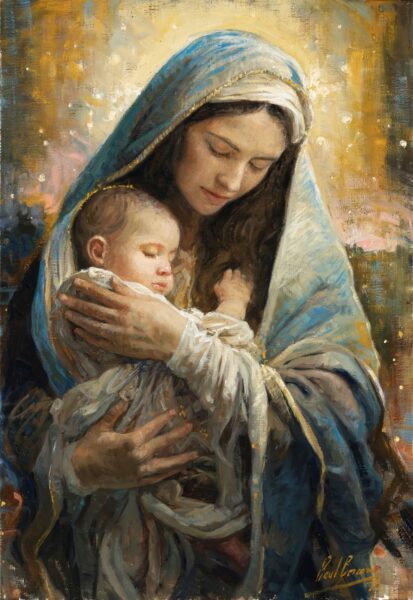
«Peace be with you!» thus began in 2025 the pontificate of Leo XIV on May 8, 2025.
Leo presided over the celebration of the First Vespers, with the traditional Te Deum of thanksgiving for the past year, and then descended to the square to see the nativity scene and greet the faithful. In the morning, he held his last general audience of 2025: after a tour in the popemobile, he recalled the important events that marked the year 2025, such as the death of Pope Francis and the wars that continue to shake us, but also the pilgrimage of so many faithful during the Holy Year.
After celebrating the First Vespers in the Vatican Basilica with the Te Deum hymn for the past year, Leo XIV went to St. Peter’s Square to visit the nativity scene installed under the obelisk, stopped for a few minutes in front of the nativity scene and then approached the Child Jesus to pay homage and give his blessing. Before leaving the square, Leo approached the faithful gathered there, shook their hands, and imparted blessings to them. According to data from the Prefecture of the Pontifical Household, a total of 1,069,000 faithful attended the 36 general and jubilee audiences of Pope Leo XIV, 29,694 per audience. In January and February, 60,500 people attended the eight general and jubilee audiences of Pope Francis, 7,562 per audience on average.
Highly recommended to start the year is the article from The Wanderer Colors, Grays and Where to Park Tucho. «A few weeks ago we wondered if Pope Leo could be described as a «gray man.» On one hand, we see that it is a pontificate of colors, and by that I mean the constant restoration we are observing of small traditions that had been lost during the pontificate of Bergoglio, or even before.» «Some will stupidly say that it is an ‘assault on intelligence’ to focus on those changes. Others will say that they are merely cosmetic changes, and they are right. But the fact is that traditions (with a lowercase ‘t’) are always cosmetic, but that does not mean they are unimportant. In fact, it is they that reveal truths and mysteries, just as accidents reveal the substance.»
«The recovery of these beautiful traditions so characteristic of our Church has not been accompanied by other gestures that would have greater specific weight in the life of the Church. If we stop at the speeches, homilies, and other papal addresses, it seems we are listening to John Paul II, with all the good and predictable aspects of this similarity, although Pope Leo is certainly far removed from Bergoglian platitudes.» «The crucial fact of episcopal appointments has also left the colors and anchored itself in the grays. The two most relevant episcopal appointments of Leo XIV (New York and Westminster) accentuate the grayish tones. And it will accentuate them further with the appointment of the next archbishop of Lima, which will possibly take place before the end of the year.»
«What are the characteristics of the chosen candidates? Precisely that of being, «gray men,» and by that I mean men of Catholic faith with centrist profiles, more or less leaning to the right or left, but who will not provoke waves of protests or anger in either of the two sectors into which Pope Francis left the Church deeply divided, and who, moreover, guarantee that they will not generate conflicts.» It gives us a positive view of the fact. «It is possible that for the times we live in, the tones of grays are precisely the appropriate ones to maintain unity, without capitulating in the faith, which is the munus of the Successor of Peter. Because if the tones were sharper, like red or blue, we would inevitably face a schism.» Leo XIV received a Church in a catastrophic state, which in the last ten years had been managed through arbitrariness and whims, with countries completely decimated like Argentina or Spain, and with characters who are very difficult to remove from their positions.
It deals with what he calls «the big problem of Cardinal Tucho Fernández.» «In the Vatican it is already public knowledge that the Pope does not want him, and does not want him even a little bit. And Tucho knows that and that is why he has put his entire “Brancaleone army” on a war footing to defend him.» «In other times, the problem of an inconvenient cardinal was easily solved. Leo X, namesake of the current pontiff, ordered the strangling of Cardinal Petrucci in 1517 and Francis ordered the deposition of Cardinal Burke and sent him to the storeroom of the Order of Malta in 2014. Leo XIV is too institutional for such drastic solutions and does not know where to park Tucho. That is the reason why he has not yet exonerated him from his position as prefect.» «Wouldn’t it be more dignified for him to retire to some religious house on the peripheries and continue writing self-help books?»
The Lemkin Institute for Genocide Prevention, in a statement dated December 28, 2025 alerted about the arrests and intimidations of the clergy of the Armenian Apostolic Church, describing them as «a dangerous challenge to Armenia’s democratic institutions.» The Institute warns that attacks on religious leaders reflect historical patterns of identity erasure, noting that «genocide operates not only through physical annihilation, but also through cultural and spiritual destruction.» The Institute urges Armenian authorities to cease politically motivated actions against the Church and invites international observers to closely follow the development of events. Archbishop Ajapahyan has been a political prisoner since June 2025 declared guilty and sentenced to two years in prison for alleged public statements critical of the government, which the prosecution described as calls to subvert the constitutional order. The sentence was criticized by representatives of the Armenian Apostolic Church and opposition figures, describing it as politically motivated.
Tensions between the Armenian government and the Armenian Apostolic Church have been exacerbated by the 2023 educational reform, which eliminated Armenian Church History as an independent mandatory subject, incorporating it into broader curricula. The Armenian Apostolic Church has been the spiritual, cultural, and historical foundation of the Armenian people for centuries. Since the 4th century, when Armenia became the first nation to adopt Christianity as its official religion, the Church has been the main guardian of Armenian continuity, preserving the language, culture, and memory through centuries of foreign domination.
On the feast of the Immaculate Conception, December 8, 1965, Paul VI closed the Second Vatican Council. «Upon closing the Ecumenical Council, we celebrate the Most Holy Mary, Mother of Christ, and therefore, as we said on another occasion, Mother of God and our spiritual Mother. Most Holy Mary, let us say immaculate! That is, innocent, that is, stupendous, that is, perfect; that is, the Woman, the true Woman, ideal and real at the same time; the creature in whom the image of God is reflected with absolute clarity, without any disturbance, as happens, on the contrary, in every human creature.» But 60 years later, what remains of the life of the Church in the contemporary world?
«Mary treasured all these things, pondering them in her heart.»
Good reading.