


We start the week and January is passing. It is a widespread conviction that the pontificate of Prevost begins now. With the Holy Door closed and the multitude of jubilee events now far away, Leo XIV can dedicate himself to the main objectives of his government: revitalizing the Curia and closing the gaps created during the long civil war unleashed in the turbulent and failed pontificate of Pope Francis. Ensuring that Catholicism maintains its appeal (Benedict XIV) in a world undergoing rapid technological, social, and cultural transformation.
Ensuring an Attractive Catholicism.
In recent months, Leo has made several decisions. He appointed Bishop Thibault Verny , a rigorous figure, as head of the Vatican Commission on Abuses, previously in charge of the same body in France. He chose Archbishop Filippo Iannone, with solid legal and management experience, as prefect of the Dicastery for Bishops, expressing his desire to proceed with utmost care in the appointment of future bishops. He appointed Sister Tiziana Merletti as secretary of the Dicastery for Religious (Institutes of Consecrated Life), continuing here the line of Francis in appointing women to high positions in the Roman Curia. Now is the beginning of the phase in which Prevost will begin to choose his team at the head of the curia .
Issues related to the «Synod and synodality» , terms certainly difficult to understand for the man on the street. We will see if Pope Leo bases his pontificate on this project, destined to culminate in 2028 (as Francis hoped) in a World Ecclesial Assembly. What does seem complicated now is accusing Pope Leo (as happened in the Bergoglio era) of proceeding «stumbling» and making decisions alone.
The general assembly of cardinals from around the world for June 27 and 28, is likely to be more refined. On this occasion, the method used in recent synods was followed. This is the first criticism that arises from the Catholic world, along with the request that the working group documents be made public. «Synod» is another Greek word meaning to walk together, and there is a growing demand among Catholic laity to «know together» what is debated at the highest level.
Pope Leo XIV and Venezuela.
Today we have a lot about Venezuela, we are interested in the role of the Holy See and Pope Leo XIV in this situation, that’s where we focus.
In the Angelus of January 4, 2026, Leo XIV looked toward Venezuela, with deep concern for a nation in collapse. While Venezuelans awoke to a new chapter in their turbulent history, from the windows of the Apostolic Palace, the Pope raised his message: neither revenge nor chaos, but justice, peace, and constitutional legality. Leo XIV proclaimed that nothing is acceptable except what serves the good of its children, with full respect for the constitutional order and human rights. A few days later, María Corina Machado, a prominent figure in the Venezuelan opposition, shaking the hand of Pope Leo XIV in the austere silence of the Vatican Library, had arrived at the Vatican almost in secret, dressed in black and with a rosary around her neck. For the first time a Pope openly welcomed the representative of Venezuela’s democratic aspirations, just days after the fall of the regime. The Pope made no public statements about the audience nor pronounced on institutional agreements or transitional leadership. The importance of the gesture lies fundamentally in its moral dimension. The message sent by receiving Machado is clear: the Church is with the people, with their rights and with their suffering. The words of Francis —«dictatorships end badly, sooner or later»— resonate today in the attitude of Leo XIV. While Francis said them with bitterness, after experiencing the tensions firsthand, he received Nicolás Maduro in the Vatican at least twice in 2016 and 2017.
The Holy See and Venezuela.
The Vatican Secretary of State, Pietro Parolin, confirmed that the Holy See attempted to negotiate a peaceful exit for Nicolas Maduro from Venezuela, including discussions on possible exile in Russia, but the initiative failed. Parolin admitted to having held discreet conversations with Maduro and other members of the Venezuelan regime, but the plan clashed with reality. «We tried what was also published in some newspapers». Parolin gave no further details, but his confirmation left little doubt. The Vatican offered Maduro, through the U.S. ambassador to the Holy See, Brian Burch , on Christmas Eve «to go enjoy his money», but he refused thinking that the United States would not intervene. Parolin explained that the Holy See «has always supported a peaceful solution», but encountered a fait accompli, a situation that had gotten out of hand. The United States arrested Maduro and any possibility of negotiation was dashed.
Parolin described the current situation in the Caribbean country as one of «great uncertainty «. He expressed his hope that the situation «evolves toward stability» and an economic recovery that seems distant: «People are suffering». He went further, stating that Venezuela now needs a «democratization of the country «.
Spadaro: Francis Already Said It.
Spadaro continues working in the Vatican in the position created halfway by Pope Francis, very given to paying favors to friends with the faithful’s money. He doesn’t know how to enter the game in the new balances and today he pontificates about Venezuela. «Pope Leo XIII has addressed the issue directly. His stance coincides with that of Pope Francis, who repeatedly urged, even in meetings with Maduro, political and civil leaders to seek a path of peace and dialogue, emphasizing that «dictatorships are useless and end badly»». «The Church does not take sides in the controversy, but calls on the international community not to forget that the deepest legitimacy of any political order lies in the free and authentic will of the peoples and in respect for their dignity». He has no choice but to recognize that «the meeting with María Corina Machado, Venezuelan opposition leader and Nobel Peace Prize winner, is a moral recognition of the responsibility of those who raise their voice for a wounded people». About time.
Leo XIV at the Bernabéu.
Among this year’s plans is a trip to Spain by Pope Leo XIV after the distant visits of John Paul II and Benedict XVI, because Francis never came. It seems he will be in Spain between June 6 and 12 and one of the central events of his Apostolic Visit to Spain will be a prayer vigil at the Santiago Bernabéu Stadium. Leo XIV could have an event very similar to one that in 1987 Pope John Paul II in 1982 had a similar event at the same stadium. It is, without a doubt, a spectacular space but which will turn out to be very small for what these encounters are, in Madrid we have some priests who are capable of filling similar spaces, Pope Leo, in what seems to be a brief visit, deserves something more.
Between Synods and Consistories.
Luis Badilla analyzes the recent consistory. «In his speech to the College of Cardinals at the end of the Extraordinary Consistory, Pope Leo XIV reiterated what he had already said: in October 2028 the World Ecclesial Assembly announced by Pope Francis for March 15, 2025, will be held». The Pope: «Therefore, it would be important that our usual way of working together be an opportunity for formation and growth for those of us who collaborate, at all levels, from the parish to the Roman Curia. Pastoral visits are an example of how one can habitually grow in a synodal style; and it is also necessary to revitalize all organs of participation. But all this is connected with the process of implementing the Synod, which continues and will have a fundamental stage in the Ecclesial Assembly planned for 2028. I encourage you to be leaven on this path. It is a path for the mission of the Church, a path in service of proclaiming the Gospel of Christ».
«The General Secretariat of the Synod of Bishops has been announcing for months that additional texts will be added to the previous ones, which will form part of the guidelines for implementing the synodal conclusions from last October. This bureaucratic, cumbersome, and sometimes excessive structure is a method and style that, unfortunately, was partially reflected in the Holy See’s media coverage of the Extraordinary Consistory. Many within the Church, including members of the Catholic hierarchy, have complained about this contamination. Therefore, it is very likely that several organizational changes will be introduced in the Extraordinary Consistory next June».
«What the Pontiff describes as a «simple method, but not necessarily easy» has to do with the abundance of rules, gestures, and furniture that supposedly demonstrate the synodal nature. Symbols of this approach are round tables, instead of armchairs, because they indicate face-to-face dialogue. Everything is horizontal and nothing vertical, to foster relationships based on listening and not on institutionalized hierarchy». «Recently, numerous bishops and cardinals have earned a reputation as passionate travelers, easier to find at airports than in the episcopal residence».
One Hundred Years After the Cristero War, Persecution Continues.
One hundred years ago in Mexico, the Cristeros –characterized by their cry of “Long Live Christ the King!”– rose up against the government that had fiercely persecuted the Church and forced the Mexican episcopate to take a dramatic and exceptional measure, the suspension of public worship, an event that effectively triggered the Cristiada. The pope Pius XI dedicated three encyclicals to the matter. The Cristero revolt also produced many martyrs, most of whom are still unknown. It is hoped that, after the silence that has reigned on the matter for several decades, this centenary will provide the opportunity for an appropriate, deep, and passionate reflection.
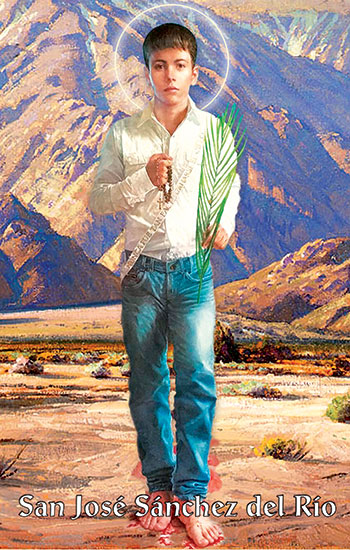
A true symbol is the figure of the child martyr and standard-bearer of the Cristero army, José Sánchez del Río (1913-1928), tortured and murdered by the Mexican federal army after being captured, and finally canonized ten years ago, on October 16, 2016. Leo XIV in his speech to the Diplomatic Corps on January 9 recalled that the persecution of Christians continues, even more so, it has increased and spread. Today there no longer exists only the ideological persecution of the 20th century (communism, national socialism, and laicism), but to these ideologies has been added persecution by radical Islamism, after the Shiite revolution in Iran in 1979, which later spread also to the Sunni world, and, in general, by forms of authoritarian and fundamentalist nationalism, which persecute or in any case discriminate against religions other than their own. The website of the pontifical foundation Aid to the Church in Need indicates that, in the last year, thirteen Christians were killed every day, one every two hours, for a total of 4,849 in 2025. The previous year, only 4,476 were killed.
«No one pours new wine into old wineskins…»
Good reading.