


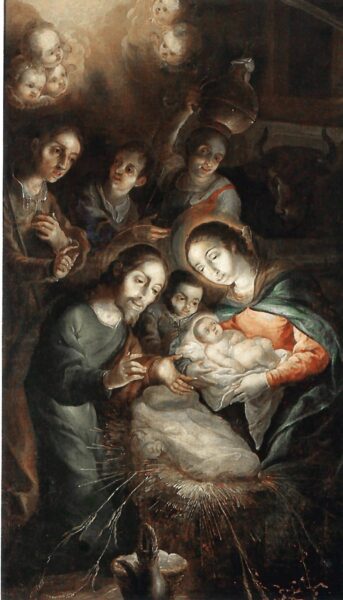
Y celebrated Saint Stephen today we do it with Saint John, the evangelist.
During the Angelus of the feast of Saint Stephen, Pope Leo XIV recalled the example of the first martyr of Christianity, who placed peace and the poor before fear and selfishness. «If in the conditions of “uncertainty” and “suffering” of the current world joy “would seem impossible”, those who today “believe in peace” and choose “the unarmed path of Jesus and the martyrs” are often “ridiculed, excluded from public discourse and not infrequently accused of favoring adversaries and enemies ”. Christian joy is not a superficial feeling: it is «motivated by the tenacity of those who already live in fraternity», of those who recognize «even in their adversaries, the indelible dignity of sons and daughters of God».
Yesterday, Pope Leo had lunch with his Augustinian brothers at the General Curia: «I have had to give up many things, but I will not give up being Augustinian». In recent months, he has frequently dined with his brothers in the Pontifical Sacristy and received his Augustinian friends in his apartment located in the former complex of the Holy Office. Communal life, and especially shared meals, both in communities and in missions spread throughout the world, are very important for the members of the order founded by Saint Augustine. He knows very well the few meters that separate his residence from the Augustinians’ General Curia.
Mario Proietti comments on the second Urbi et Orbi message of Pope Leo XIV . «It begins with Christ before the world, with sin before crises, with the human heart before structures. The poverty of Jesus, laid in a manger and rejected, reveals itself as a precise theological choice, more than a simple poetic detail. The Incarnation is the criterion that runs through the entire life of the Son of God, inextricably linking the cave of Bethlehem with the wood of the Cross». «The Urbi et Orbi message of Leo XIV calls for truth, not consensus. It points to an ancient but always new path of conversion, responsibility, and concrete charity. It is Christmas that restores order first in us and only afterward in the world, bringing that silent peace that is born when the heart stops fleeing and finally accepts its salvation»
In recent years, formality had become suspicious, and touching it meant exposing oneself to immediate ideological interpretations. The pontificate of Francis has deeply affected the ecclesial imaginary, creating a climate in which any resurgence of symbolism seemed a distancing or an implicit correction. Formality was perceived as an alternative to evangelical simplicity, a fragile but widespread opposition. Something different is happening here. We are not witnessing a denial of the past or a retrospective critique, but rather an integration. Simplicity and closeness remain, returning to a stable, recognizable, and institutional form. The Church does not live in absolute phases; it lives in continuities that consolidate. Other small signs, such as the restoration of the mozzetta and the stole, the return to Castel Gandolfo, and the use of the apostolic apartment, are inscribed in this context. Together, these details point to a clear direction: not a withdrawal, but a rebalancing.
The mozzetta and the stole make their ministry clear without adding artificial solemnity. Castel Gandolfo represents the recognition that even the Pope needs places capable of transmitting permanence. The apostolic apartment is not distance, it is a seat. The distinction between the person and the office has always protected both. The power of these gestures lies in their rhythm. There are no accelerations, justifications, or accompanying speeches. The signs are allowed to speak, deactivating polarization and making any attempt to involve them in an ideological battle useless. There is nothing to defend or attack; there is a stance that becomes habitable again. Even if these gestures do not become permanent, they have already broken a taboo and returned a language that was previously considered unspeakable. The Church does not need to constantly reinvent itself to be alive; it needs to remain firm.
The Catholic Church is facing one of the most complicated periods in its history, confronting a series of important challenges, beyond the decline in vocations and spirituality. In the pontificate of Pope Francis, everything has become even more complicated and little, rather nothing, has been resolved. The Vatican is trying to calm the waters at the beginning of this new pontificate, but there is an aspect that is causing great internal discomfort and many headaches. Under the papacy of Francis, there has been an increasing recourse to external consultants, such as Deloitte, for internal management and organizational strategy. This phenomenon raises fundamental questions about the true autonomy of the Church and its long-term implications with the loss of internal control that can leave the Vatican in a vulnerable situation. Who guarantees that these external consultancies are truly aligned with Christian values and act in the best interest of the Church? The Church could run the risk of appearing more like a commercial entity than a religious institution. What message does this send to the faithful when the preparation of sacred celebrations is in the hands of companies that may not share the same spiritual vision?
According to a report from the Pew Research Center, religious practices are declining worldwide, and young people in particular show a growing disconnection from the Church. How can the Church regain trust if its key decisions are influenced by external advisors? What internal resources can be leveraged to reduce dependence on external consultants? How can the Church ensure that its leaders are prepared to face future challenges? What technological tools can be used to strengthen community and spirituality without compromising fundamental values? The challenge facing the Vatican today is not just a matter of management, but of identity. The Church must find a balance between modernization and spiritual authenticity.
International Boniface VIII Award to Cardinal Agostino Marchetto , Deacon of Santa Maria Goretti, who was unable to collect the award on December 13 in Anagni due to health reasons, and has received it at his home. Cardinal Agostino Marchetto, emeritus secretary of the Pontifical Council for Migrants and Itinerants, receives the International Boniface VIII Award for his exceptional dedication and service to the Catholic Church, particularly in the field of migrant pastoral care».
It is Christmas but the persecutions do not cease and today we remember Nicaragua. In Nicaragua, the Catholic Church lives another Christmas under persecution: masses monitored, processions prohibited, priests exiled, and Bibles banned. The Ortega regime and his wife continue to repress religious freedom, but faith remains alive and the martyred Church resists and continues to hope, even in the most difficult trials and remains alive, as demonstrated, for example, by the recent ordination of eight priests in the Managua cathedral. The Church of Venezuela lived another Christmas yesterday behind closed doors, unable to express its joy and faith outside its churches, in the streets, in the squares, or with visible posters. Israel González Espinoza , Nicaraguan journalist exiled in Spain: «The level of religious persecution waged by the Ortega regime borders on paranoia. Not only are books and newspapers prohibited, but now even the Bible is banned in the country, as if it were a ‘subversive’ reading. In reality, if one reads the Sacred Scriptures carefully, one can see that the word of God is always enlightening and liberating». Patricia Molina in her report, «Nicaragua: A Persecuted Church»: «The Ortega-Murillo dictatorship continues to persecute everything that affects religious freedom in Nicaragua».
The first consistory of Leo XIV will be a consistory of debate, not one of creating new cardinals. The topics of this debate, which will be detailed in three sessions, are four and are described in a letter from Leo XIV to the cardinals dated December 12: a deeper study of the Exhortation Evangelii Gaudium , the study of the Apostolic Constitution Praedicate Evangelium , synodality, and the question of liturgy. Highly recommended reading of the book by Christopher Altieri, an American Vatican correspondent with a European soul. «Leo XIV: The New Pope and Catholic Reform». It offers a vision of the future of the pontificate and represents a retrospective look at the pontificate of Pope Francis. Altieri studies and pays enviable attention to the work of his colleagues. He not only meticulously selects his sources, but also his readings. He strives to describe the Church from the Church’s perspective, which is undoubtedly an advantage in his work. He knows that everything that happens in the Vatican has meaning. He also knows that there is a risk of overinterpreting everything and that, therefore, balance and a lot of common sense are required to narrate something without attributing a greater meaning to it than it really has. Anyone who has been to the Vatican knows that many of the things seen are far from being a conspiracy, they simply happen.
This approach is probably the best guide for addressing what will be a decisive moment in the pontificate of Leo XIV, a necessary transition from the Holy Year convened by Pope Francis to the beginning of Pope Provost’s pontificate. This approach is necessary to understand that today we also need new terms to understand this Pope, the first who did not live Vatican II as a priest and, therefore, immune to many of the ideological debates and ideological origins that followed the Council. And who said we can’t look forward without losing the virtues of the past?
Good reading