


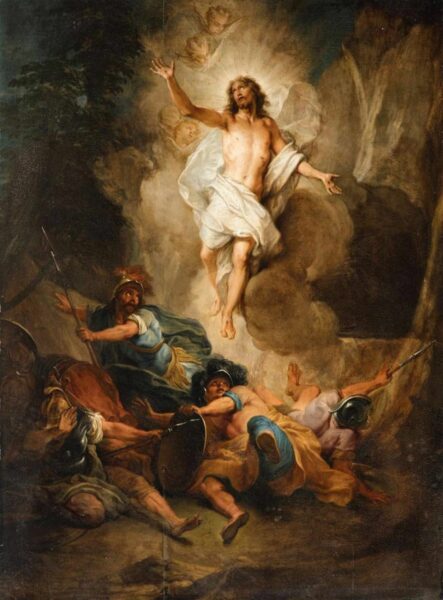
Celebrated the Easter Vigil, solemn Mass in the square this morning and Urbi et Orbi blessing. Security measures are very noticeable; the sectors of the square have been lightened, fewer chairs and more spaced out, crowds have been prevented, the Vatican surroundings very controlled, much more than usual which is no small thing. Attendance more than worthy but very dispersed, stretched along Via della Conciliazione, the Pope has been generous in the usual procession after the blessing. Today is a day that has surprised us with the amount of information despite it being a vacation period and especially sensitive days for religious information. There is information and we report it.
«Christ is risen! Happy Easter!».
The solemn Pontifical Mass of Easter Sunday, presided over this morning in St. Peter’s Square, León XIV ascended to the central loggia of the Vatican Basilica at 12 noon for the traditional Message and Urbi et Orbi Blessing, addressed to the city of Rome and the entire world. A discourse marked by the theme of peace, interpreted in the context of the Paschal Mystery of Christ’s death and resurrection. «Christ is risen! Happy Easter!». The Easter is the victory of life over death, of light over darkness and of love over hatred, but this victory does not arise from a logic of power. It arises, instead, from Christ’s sacrifice, from obedience to the Father, from total self-giving. The Pope explained that the power of the resurrection coincides with God himself, with his faithful and creative love, capable of forgiving and redeeming. The most significant passage of the message refers precisely to the way in which Christ triumphs. For the Pope, peace is not a simple balance between opposing interests, but the fruit of relationships transformed by love, respectful relationships between individuals, families, social groups and nations, oriented toward the common good.
«Whoever takes up arms, let him lay them down!». Another important point of León XIV’s third Urbi et Orbi Message was the denunciation of habituation to violence. León XIV observed that we become accustomed to conflict, we resign ourselves to death, we become insensitive to divisions and even to the economic and social consequences of war. In this context, he reiterated the expression «globalization of indifference», also recalling the words pronounced a year earlier by Pope Francis. The message concluded with an invitation to join the prayer vigil for peace that León XIV will celebrate in St. Peter’s Basilica on Saturday, April 11.
The theme of war and the need to seek paths of peace was also the central axis of the homily at the Easter Mass celebrated in St. Peter’s Square, just as the call to lay down arms and set aside all hatred echoed during the Paschal Triduum, from the Mass of the Lord’s Supper on Holy Thursday to the Way of the Cross on Good Friday at the Colosseum. «Death is always lurking. We see it present in injustice, in partisan selfishness, in the oppression of the poor, in the lack of attention to the most vulnerable. We see it in violence, in the wounds of the world, in the cry of pain that arises everywhere before the abuses that crush the weakest, before the idolatry of profit that plunders the earth’s resources, before the violence of war that kills and destroys».
«This is a message that is not always easy to accept, a promise that costs us to assume, because the power of death always threatens us, from within and from without. In our interior, when the weight of our sins prevents us from taking flight, when disappointments or the loneliness we experience undermine our hopes, when worries or resentments suffocate the joy of living, when we experience sadness or fatigue, when we feel betrayed or rejected, when we have to deal with our weakness, with suffering, with the work of every day, then we feel as if we have ended up in a tunnel from which we cannot see the exit».
Easter Vigil.
With the invitation not to be afraid to move the stones that enclose us in our tombs and that seem immovable. «Thus, dear brothers and sisters, the deacon, at the beginning of this celebration, praised the light of the Risen Christ, symbolized in the Paschal Candle. From this single Candle we have all lit our candles and, carrying each one a flame drawn from the same fire, we have illuminated this great basilica. It is the sign of the paschal light, which unites us in the Church as lamps for the world. To the deacon’s announcement we responded “Amen”, affirming our commitment to embrace this mission, and soon we will repeat our “yes” by renewing our baptismal promises».
God does not abandon his creatures: «Is there greater charity? Greater generosity? The Risen One is the same Creator of the universe who, just as in the dawn of history he gave us existence from nothing, so on the cross, to show us his unlimited love, gave us life. The «holy mystery of this night», therefore, has its roots there where the first failure of humanity occurred, and extends through the centuries as a path of reconciliation and grace. «In all these moments of the history of salvation, we have seen how God, in the face of the hardness of sin that divides and kills, responds with the power of love that unites and restores life. We have recalled them together, interspersing the narration with psalms and prayers, to remind ourselves that, for Christ’s Easter, consecrated in Baptism to the Father’s love, united in the communion of saints, made by grace living stones for the construction of his Kingdom». «This is sin: a very heavy barrier that isolates us and separates us from God, trying to kill his words of hope in us. However, Mary Magdalene and the other Mary were not intimidated. They went to the tomb and, thanks to their faith and love, were the first witnesses of the Resurrection».
«Even in our days there are no lack of tombs to open, and often the stones that close them are so heavy and so well guarded that they seem immovable. Some oppress man in the heart, like distrust, fear, selfishness, resentment; others, consequence of these internal ones, break the bonds that unite us, like war, injustice, isolation between peoples and nations. Let us not allow them to paralyze us!». «…and in this Holy Night, let us make his commitment our own, so that everywhere and always, in the world, the paschal gifts of harmony and peace may grow and flourish”. The tradition of the evening vigil is also resumed, after the two previous pontiffs advanced the start of the Mass to the afternoon and during the Mass, Pope León XIV baptized ten adults: five from the Diocese of Rome, two from Portugal, two from Great Britain and one from Korea.
The cross of Easter Sunday of León XIV.
On Easter Sunday there is a cross that belongs not only to the rite of Good Friday, but to every day of this new pontificate of León XIV, marked by the wars ravaging the world, beginning in the Holy Land. The Pope has once again carried it in the Way of the Cross, a tradition revived by Paul VI in 1964 after a trip to the Holy Land, and the gesture is not only a remembrance, but a concrete sign. It is a silent cross, made of decisions, pressures and accumulated tensions, and of a Curia that still bears the imprint of its predecessor. Amid reformist demands for change and calls for tradition for continuity, León XIV adopts a sober and reflective style, marking a quiet break with Pope Francis. A pontificate is not measured by the brevity of its beginnings, but by the long term of the Church, where decisions mature through discernment and bear fruit beyond the immediate future. The latest appointments confirm this, applause for Paolo Rudelli, 53 years old, from Bergamo, a child prodigy of Vatican diplomacy, former nuncio in Colombia, appointed to the strategic position of Substitute for General Affairs of the Secretariat of State, where he succeeds the much-commented Venezuelan Edgar Peña Parra, 65 years old, appointed in 2018 —in replacement of Angelo Becciu— and now destined for the nunciature in Italy.
Peña Parra leaves behind an endless controversy. In the Sacred Palaces, they call him «Maracaibo» for the carelessness he showed in his «South American» handling of the thorniest case: that of the London building, a transaction initiated by Becciu and which, under his direction, ended in a financial disaster. Edgar himself, in his farewell message and in a television interview, called it his «via crucis». Perhaps because he never recovered from the most embarrassing episode: in London, before the High Court of Justice in July 2024, presided over by Judge Robin Knowles, during several hearings, sweaty and visibly anguished, with an imposing bodyguard at his side and apparently mascaraed eyelashes, he admitted to having knowledge of false invoices paid by his office and having negligently opened the door to accredited investors. The astonished English judge witnessed that painful calvary. On the first day, Peña Parra responded in English thinking he dominated the situation. Later, he preferred to have an interpreter nearby, perhaps to delay his responses, unable to get out of the predicament he had gotten himself into. The situation became clearly evident during the trial in the Vatican, where the gendarmerie and witnesses, under the direction of the Secretariat of State, ended up trying to confuse everything. This is a «mess» that Prevost is trying to solve, as was evident even during the debate in the General Congregations, when the Secretary of State unexpectedly showed an unofficial document from Bergoglio, and more than doubtful, that, surprisingly, requested Becciu’s resignation from the Conclave.
The Substitute’s Office seems to have had a report six months before the formal start of the Vatican investigation, which also contained information on the illicit access of Pasquale Striano, the financier investigated in the «Dossieropoli» case, at the center of a myriad of intrigues that involved numerous people subsequently implicated in the Becciu process. Among the investigated were politicians, businessmen and public figures. The matter is delicate and may result in the invalidity of the entire trial due to a serious violation of the right to defense, a sacred right that Prevost himself has solemnly reaffirmed on two public occasions.
During Francis’s pontificate, Peña Parra was, in fact, the most powerful man in the Curia. The Substitute met daily with the Pope, handing him documents and revoking decisions. However, in the opinion of many, Francis devoted only a few minutes to these meetings, often limiting himself to a simple «Okay, do it». In this space, the Substitute’s power was consolidated through gestures, decisions and files, even without the absolute control of the pontiff, which generated tensions and contradictions, with measures that were sometimes denied or revoked by the Pope himself. This also resulted in difficult years for the Secretary of State Pietro Parolin, formally superior but too often forced to submit to decisions taken in other spheres. It is no coincidence that, after the conclave, the intention to rebalance this dynamic was evident. The transfer of Peña Parra to the nunciature in Italy seemed immediately anomalous with a delay in its approval much beyond the usual deadline between Italy and the Holy See.
According to rumors coming from the third loggia of the Apostolic Palace, shadows hang over the operational methods and relationships developed during those years: contacts with the Court and circles within the Vatican gendarmerie, conversations with intelligence agencies and links with sectors of the Guardia di Finanza, in a network of connections that has never been fully clarified. These factors generate doubts among several officials, from both sides, about his suitability to represent the Holy See in Italy. Peña Parra is the first post-war Substitute not to receive the cardinalate and one of the few who was dismissed to be assigned to a nunciature. A fundamental question persists: this appointment risks exposing the Italian government to evident embarrassment, forcing it to immediately monitor the new nuncio’s relations with the most sensitive state institutions. Even in the darkest corners of the Sacred Palaces, where power sometimes takes on less evangelical forms than one would wish, the cross remains there, silent. Waiting for someone to really take charge.
The deep disappointment of Mater Populi Fidelis.
Edward Pentin in the National Catholic Register , it is reported that the Theological Commission of the International Marian Association (IMA) , made up of cardinals, bishops and more than forty renowned theologians and mariologists (among them Scott Hahn, Mark Miravalle and Michael Sirilla), sent an open letter on March 19, 2026 , Solemnity of St. Joseph, to Cardinal Víctor Manuel Fernández , Prefect of the Dicastery for the Doctrine of the Faith (DDF). The letter, made public on the feast of the Annunciation, expresses «deep disappointment» over the persistent silence of the Vatican in the face of the detailed criticisms directed at the doctrinal note Mater Populi Fidelis , published on November 4, 2025 .
It considers that the titles of «Co-redemptrix» and certain uses of «Mediatrix of all graces» are theologically and pastorally ambiguous, discouraging their use in official documents, teaching and liturgy, without denying the truths they intend to express. The mariologists fear that this approach adopts a minimalist view of Mary’s role, which could weaken popular devotion and close the door to possible new Marian dogmas after decades of study. In its 23-page commentary, published on December 8, 2025 (Feast of the Immaculate Conception), the Commission identified numerous omissions , minimizations and, in some cases, flagrant contradictions with pre-conciliar and post-conciliar Marian teachings, including those of the Second Vatican Council. Consequently, they requested clarifications and corrections to ensure a hermeneutic of continuity in the Marian Magisterium. The theologians recall previous interventions by the Holy Office (now DDF) that required corrections, such as the Instruction on Slavery of 1866, later annulled by Leo XIII and condemned as intrinsically evil by St. John Paul II in Veritatis Splendor.
They welcomed the informal clarifications that Cardinal Fernández issued on November 27, 2025 to journalist Diane Montagna, according to which the title of Co-redemptrix is not «always inappropriate», but should only be excluded from official documents and liturgical texts. However, they regret that said clarifications were kept on an informal level and that the note still «substantially omits» the redemptive value of Mary’s active and singular cooperation, constituting a doctrinal setback and an «unnecessary prohibition» of the legitimate title of Co-redemptrix. At the moment Cardinal Fernández has not yet responded to the requests and we fear that he never will.
The return to faith of Generation Z.
It is not the Gospel that is attractive, but what it conveys: discipline , rules , structure . Exactly what —as explained by Antony Gross , with 48.5 million followers on TikTok— young people need today, who live a chaotic and precarious daily life. They need rituals, certainties and a sense of community: and that is what the influencer tries to provide to his «followers», who can not only watch his videos, but also meet him in person at the numerous pizza gatherings he organizes. The videos show dozens of girls and boys spending the night together: nothing unknown to anyone who has attended the oratory, but for New York this is something new. Only after the pizza and the fellowship does the group head to the church to attend Mass . The sequence is not random: first the relationship, then the ritual. First the community, then the ritual.
Antony said: «I hope this series inspires more people who normally wouldn’t go to Mass to try it». And judging by his videos, he seems to be achieving his goal. Although he doesn’t want to be labeled as a » Catholic influencer «, like many others, he reviews churches, just as others review cafes or bars. «I like to show churches and help people find new places to go». Antony’s church in New York, St. Joseph’s, recently experienced an almost 20% increase in attendance.
According to the Osv News website , the American Generation Z attends church an average of 1.9 times a month , or about 23 times a year. This figure is much higher than that of previous generations, who attend Mass only 17 times a year. Approximately between 15% and 21% of people born between 1997 and 2012 (13 to 29 years old today) identify as Catholic.