


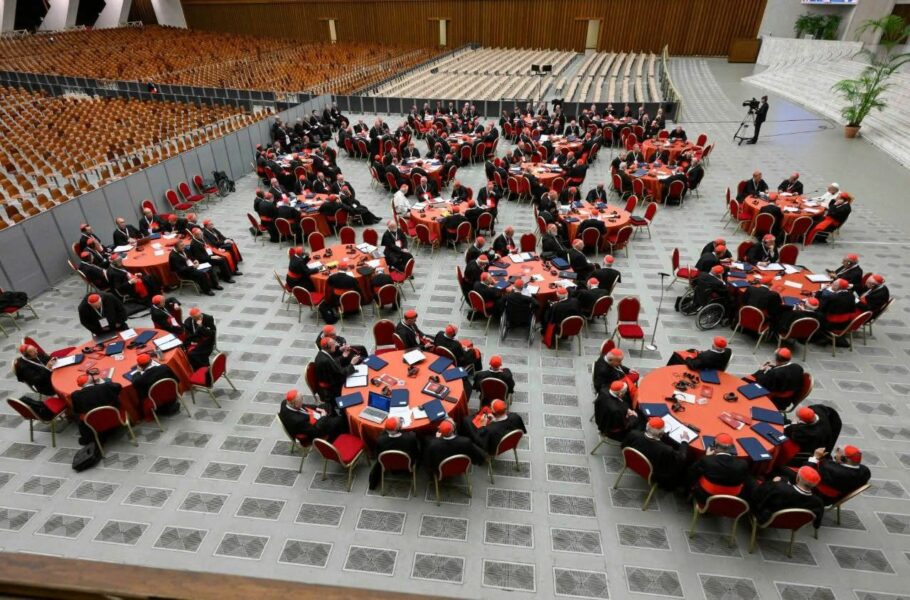
In Rome it’s cold, it’s not usual for us to have sub-zero temperatures, these days, slightly below zero, but there are; and the days are not ones to set off fireworks. The Jubilee of Hope closes with figures higher than the Jubilee of Mercy: in 2015-2016 there were 22 million, while in the Holy Year just concluded they exceeded 33 million from 185 different countries. The final act took place yesterday in St. Peter’s Basilica with the rite of closing the Holy Door. For the occasion, the Pope wore a new staff with his episcopal motto, «In Illo uno unum»; the Door will be bricked up in about ten days. Yesterday the first Extraordinary Consistory was inaugurated in the Synod Hall presided over by Pope Leo XIV. The image corresponds to the meetings by languages, it’s not the most beautiful thing we’ve found, it’s what we have.
First audience of the year on Vatican II.
In the Paul VI Hall in the morning the Pope inaugurated, in the usual Wednesday audience, the cycle of catechesis on the Council. When Pope St. John XXIII inaugurated the Council on October 11, 1962, he described it as the dawn of a day of light for the entire Church. The Pope recalled this, who today, in the Paul VI Hall, inaugurated a new series of catechesis on the Council through its documents. «The work of the numerous Fathers convened, coming from Churches from all continents, effectively paved the way for a new ecclesial era». «After a rich biblical, theological, and liturgical reflection that spanned the 20th century, the Second Vatican Council rediscovered the face of God as Father who, in Christ, calls us to be his children; it contemplated the Church in the light of Christ, light of the people, as a mystery of communion and sacrament of unity between God and his people; it initiated a profound liturgical reform, centering the mystery of salvation and the active and conscious participation of all the people of God». For the Pope the Council «has helped us to open ourselves to the world and to welcome the changes and challenges of the modern era in dialogue and co-responsibility, as a Church that wants to open its arms to humanity, echo the hopes and anxieties of peoples, and collaborate in building a more just and more fraternal society».
The consistory begins.
In the opening words of the consistory the Pope made it clear that it was not a «framework» event, but a time deliberately structured for listening. There are currently 245 cardinals, divided almost equally between those under 80 who voted in the conclave that elected Leo and those over. It is not something indifferent and a high-ranking cardinal occupied a prominent place in Leo’s private audience agenda on Wednesday: Cardinal Joseph Zen , emeritus archbishop of Hong Kong. Zen, who will turn 94 next week, was a staunch conservative critic of Francis, especially for his approach to China, and complained for years that Pope Francis did not receive him in private audience. The number of attendees is significant: 190 cardinals. In the ordinary form at least the cardinals present in the City are convened and in the extraordinary in which the convocation affects the entire College. We do not have the official list of attendees, there are absences, we will comment on them, among the absences that of Cardinal Leopoldo José Brenes Solórzano , metropolitan archbishop of Managua, who declared he had not been invited, which is evidently false. It seems he doesn’t realize what’s going on with his Ortega and wife, it’s not strange that he doesn’t realize this either.
Timothy Radcliffe pontificating.
Cardinal Timothy Peter Joseph Radcliffe OP, – the one who confesses that he introduced his love affairs to his community, we won’t have anything better to teach – inaugurated the session with a meditation capable of preparing the assembly for a ‘synodal listening’. «We gather in this Consistory to offer our assistance to the Holy Father in the exercise of his ministry in service to the universal Church. But how can we do this?». The cardinal broadened his gaze to the present, describing it as a time of «terrible storms»: an escalation of violence, from armed crime to war; a growing gap between rich and poor; the erosion of the global order established after the last world war; the emergence of artificial intelligence, whose effects we still do not know. «If we are not already worried, we should be.» Radcliffe acknowledged the most common temptation: to feel alone, exhausted, worn out.
Intervention of Leo XIV.
The intervention of Leo XIV chose an elevated but extremely direct tone, clarifying from the beginning that the heart of these days would not be the drafting of documents, but a genuine exercise of communion and discernment. The Pope reinterpreted the great pontificates of the second half of the 20th century as a coherent development of the conciliar vision, up to the synthesis offered by Benedict XVI and Francis in the category of attraction. «It is not the Church that attracts, the Pope reiterated, but Christ himself ; and if a Christian community is credible, it is only because it allows the sap that flows from the Heart of the Savior to pass through, without obscuring it.» Leo XIV clearly affirmed that unity has an intrinsic attractive force , while division produces dispersion and sterility.
The cardinals.
Once the themes were chosen, the cardinals gathered around a circular table, divided into 20 groups by language, with interventions of about three minutes each to ensure everyone had the opportunity to contribute. The first part of the meeting was presided over by Cardinal Ángel Fernández Artime; tomorrow morning, Cardinal Tolentino; and in the afternoon, Cardinal Tagle. The opening began with the singing of the Veni Creator, the reading of a passage from chapter 6 of the Gospel of Mark, and two minutes of silence. Then, Cardinal Giovanni Battista Re, dean of the College of Cardinals, greeted with «a bit of his usual show.»
From 16:20 to 18:00, the cardinals moved to the Paul VI Hall for group work, in which Leo XIV did not participate: the Pope chose not to intervene in the discussions, reserving the right to listen and returned for the final reports. Only the secretaries of the first nine groups—composed of cardinals from local Churches—were able to present a three-minute summary of the debate and the reasons that led to the selection of the two themes. The secretaries of the other eleven groups only communicated the titles of the preferences expressed. The Pope’s farewell: «I feel the need to count on you. You have called this servant to this mission; it is important that we discern together.» «Is there life in the Church? I believe so,»
The consistory continued with the usual dinners, several cardinals gathered with a curial archbishop and a bishop present in Rome. They recalled with enthusiasm the day, also focusing on the work done in the groups in the Paul VI Hall: they recounted how the Pope sat at one of the tables with them, participating directly in the discussions. They were enthusiastic about the words of the preacher and what was proposed in the groups. They commented on a joyful, serene, and relaxed atmosphere. «Seeing the Paul VI Hall again populated by ‘bishops’ and not by others is a beautiful spectacle» alluding to the last setting of the Synod on Synodality.
Emanations from Timothy Radcliffe.
 Barron and synodality.
Synodality, a Rousseau thing.
Professor William A. Thomas, theologian and former classmate of Pope Leo XIV and Cardinal Mario Grech exposes the ideological crisis underlying the Synod on Synodality. After speaking of the disastrous pontificate of Pope Francis, he argues that the entire synodal project is «devoid of Christology» and lacks foundation in Scripture, Apostolic Tradition, or the Church Fathers. “I told Grech: ‘You can’t promote this, because it lacks Christology’.» “As Pope Leo himself said, there is no model for this, so it is a very ambiguous and confusing movement within the Church, lacking apostolicity. It does not go back to the Fathers. There is no place in Scripture where Jesus speaks of synodality or the synodal Church.” “The synodal Church is the Church of England. It is not the Catholic Church, which is the one true Church on earth.” “When I read a copy of the final (synodal) document in Spanish, I began to see that the philosophy that sustained it was based on that of Jean-Jacques Rousseau, father of sentimentalism, who wrote a book called The Social Contract . Synodality is almost page by page from The Social Contract by Rousseau, who completely dismantles the notion of Christianity in Europe and prepares Europe for the bloody revolution we had in France.” Sentimentalism is about feelings and emotions. Someone says: «Oh, this is sinful, this is wrong, this is mortal, this will destroy your soul», and so on,” he said. «But nowadays you can’t say that, because you would hurt people, you would hurt their feelings… so everything goes». I told Cardinal Grech that «this is going nowhere, no bishop with guts can accept this and it must be stopped.» “What the Church needs is a movement of renewal, a rebirth through catechesis, a rebirth through faith in Jesus Christ as Redeemer of the world, a rebirth in authentic Marian devotion, a rebirth in sacramental life.” “It does not need something… that distracts and diverts the divine toward this human sentimentalism of listening to each other, encouraging each other. That is not what Christ had foreseen.” “The mandate is to go to the whole world and preach the Good News, proclaim the Good News that the Redeemer of the world, in fact, redeemed with his passion, death, and resurrection.”
Sarah and sacred music.
We end with the pleasant news that some talks by Cardinal Sarah given at Princeton University last November are being published. He focused on the publication of his new book, «The Song of the Lamb: Sacred Music and Heavenly Liturgy», co-written with ecclesiastical musician Peter Carter, director of sacred music at the Aquinas Institute at Princeton University. «The cardinal stated that the Church’s liturgy has been instrumentalized too often and politicized in recent decades. He assured that it was a mistake for Church leaders to pursue and exclude those who denounced liturgical abuses.» He recalled the harmonization that Pope Benedict XVI made between the Novus Ordo Missae and the traditional Latin Mass and his emphasis that “what previous generations considered sacred remains sacred and great for us too.” The liturgy «is not something that you or I can invent or change, even if we think we are experts or even bishops», «We must be humble before the sacred liturgy, as it has been transmitted to us in the Tradition of the Church.» Quoting Pope Benedict, he said: “Regarding the liturgy, we cannot say that one song is as good as another.” He explained that sacred music “has an objectivity” rooted in the Church’s liturgical tradition. “That is, what is sung in the liturgy can truly be said to be ‘The Song of the Lamb’, praising and giving glory to Almighty God and supplicating him for the needs of his people.» Sacred music “is not a ‘nice’ addition to the liturgy; it is an essential component of it.”
We don’t want to go on much longer, but we don’t want to fail to mention an interesting publication by F. Antonioli and L. Verrani, in Lo Scisma emergenti , they have given their research the title, which speaks not so much of schisms, but rather of «conflicts, lacerations and silences in the Church of the Third Millennium», as the subtitle reads.
«Today this Scripture has been fulfilled in your hearing.»
Good reading.