


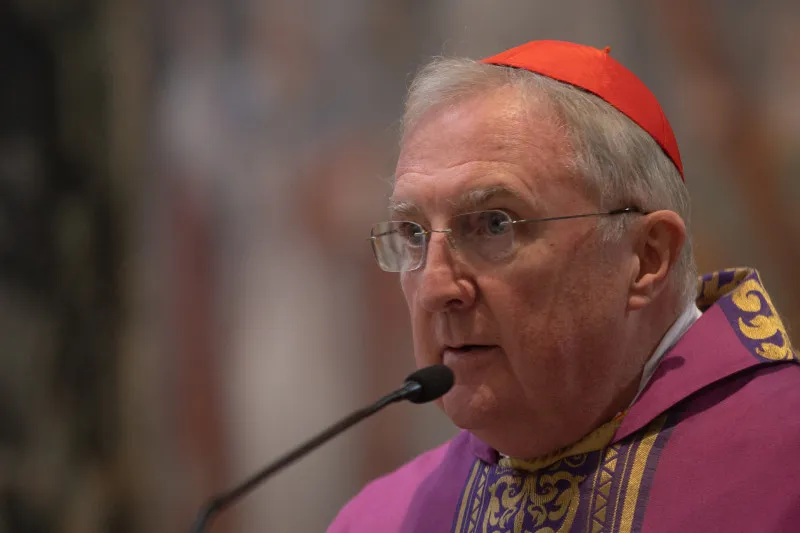
Who is Cardinal Roche.
Very much in agreement with Specola.
And with the bit about zascandil.
Arthur Roche the Meddler.
Serious, as in truly serious, this character has never been. Arthur Roche has spent years causing the kind of damage that only a curial official can do well: disguising coercion with the language of pastoral concern, disguising rupture with the language of continuity, and then being scandalized when Catholics notice that the disguise is slipping from their hands. In his new interview with OSV, he claims that liturgical debates must be viewed from the perspective of unity, not personal preferences; he reiterates that the ancient rite was being used against the reform of the Second Vatican Council; he describes the Traditional Mass as a concession that is still only available «by papal authority»; and then, with a mix of arrogance and paranoia, he asks why there is «all this fuss» and says that «clearly something more is at play».
He even admits that silence, music, and reverence are part of the appeal of the ancient rite, and that this calls the Novus Ordo into question. That last confession is key. Instead of fighting against an imaginary cult of nostalgia, Roche is confronted with the obvious. People are drawn to a liturgy that feels sacred, sounds sacred, and behaves as if God is present. He knows it. He says it. Then, he turns around and treats those who desire that kind of worship as a political problem that must be controlled. The insult comes wrapped in a mocking smile. They come because the church is silent, the music is solemn, and the rite is reverent. But his response is not repentance for the desert that replaced it, but another lesson on unity.
What is truly revealing about Roche is not simply that he wants restrictions—many bishops want them. What is revealing is that he already made it clear in 2023, when his statements to the BBC were widely disseminated, claiming that «the Church’s theology has changed». In practice, he admitted what post-conciliar settlement defenders had denied for decades: the old Mass and the new liturgical order not only differ in language, calendar, or emphasis, but in the theological understanding that the rite itself conveys. That’s why Roche deserves special contempt. For years, traditionalist Catholics were told that their objections were hysterical, that the new rite was nothing more than the old faith in updated ceremonial garb, that continuity was evident to any honest observer. Then Roche, perhaps too obtuse to understand the implications of his own frankness, let the truth slip.
There was a change, the reform embodied it, and the inherited Roman rite remains there as irrefutable proof against the official fairy tale. And once he admitted it, the entire anti-traditional campaign took on a new dimension. It stopped looking like a simple cleanup and started looking exactly like what it is: an attempt to suppress a liturgical witness that reminds too many things. Roche now quotes St. Paul on the importance of receiving what has been given to us and warns against controlling the liturgy according to personal preferences. The traditional Roman rite was not the product of an amateur committee, a post-war workshop, or a culture of pastoral management intoxicated by options, experts, and explanatory prefaces. So no, Roche is not defending unity. He is defending the terms of the settlement. He wants a single liturgical regime, an official memory, a permitted interpretation of the council, and a clear direction. He wants Catholics who still remember what the Roman rite was like before the arrival of the experts to stop reminding everyone that the revolution had a before. That’s why his condescension is so exasperating. He presents himself as the sober guardian of ecclesial order, when in reality he is one of the main ones responsible for showing that the struggle was never about tastes.