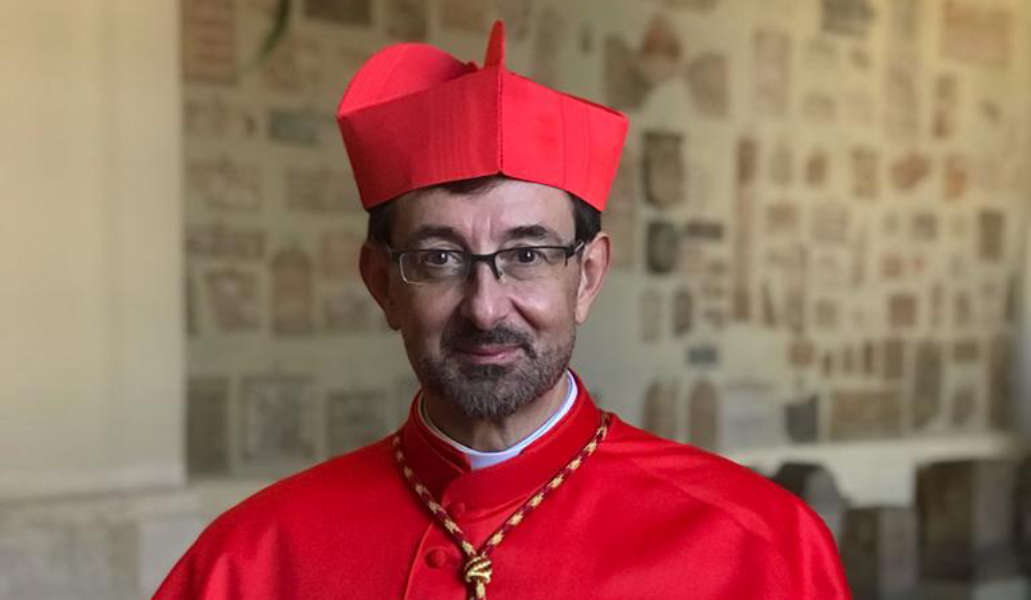
His figure is becoming terribly damaged and it is even possible that he is incapacitated to govern Madrid.
And his main problem is His Insignificance.
What an immense mistake to appoint him archbishop of Madrid and create him cardinal. And as it seems, he is incapable of assuming the charge with dignity. The worst is not that he doesn’t know, which he doesn’t, but that could be mitigated by learning. What has no remedy is that he cannot, due to his incapacity being so great.
Is the trip to Spain postponed ‘sine die’?
Possibilities have been discussed, but until now, no date has been set for a possible trip by Pope Leo XIV to Spain. There have been many years of absence of a pontiff in Spanish territory and due to the inheritance of Pope Francis, his presence or absence does not create special enthusiasms. In Spain we have a tense ecclesiastical context, marked by serious internal divisions.
In Madrid, Cardinal Cobo does not quite fit in, and the more time passes, the more the error of his appointment in a diocese that, like it or not, is a reference for the rest of Spain becomes evident. One of his latest and solemn blunders is the one regarding the thorny issue of the Valley of the Fallen. This trip was announced under unusual circumstances: a few weeks ago, Pope Leo XIV personally informed Cardinal José Cobo, Archbishop of Madrid, of his intention to visit Spain at the end of this year. This decision was a surprise: traditionally, a papal visit is prepared after a long diplomatic and pastoral process. In this case, the Pope expressed his wishes even before the official invitation was formally extended. But, according to Spanish protocol, said invitation must be signed by the King and the President of the Government. It seems that the King gave his approval quickly, but the President of the Government, Pedro Sánchez, took time to do so, which explains why the travel dates have not yet been confirmed.
At the epicenter of the tensions is the Valley of the Fallen, located near Madrid. It is not merely a historical monument, but above all a consecrated Catholic basilica, carved into the rock and under the direct authority of the Holy See. It is crowned by a monumental cross and historically entrusted to a Benedictine community. The place houses the remains of more than 33,000 victims of the Spanish Civil War and was conceived as a place of prayer and national reconciliation, although this intention is now questioned and exploited in the contemporary political debate. For several years, the Spanish government has sought to transform the meaning of the Valley of the Fallen. The stated objective is to turn it into a place of civic memory marginalizing the religious dimension of the place.
This development poses a serious canonical problem: as a papal basilica, the place is not under the exclusive authority of civil powers or the local archbishop. Any substantial modification should require the approval of the Holy See.
What is curious is that Cardinal José Cobo, despite alleging in the recent press conference of San Francisco de Sales before friendly media that he had nothing to do with the issue, accepted and signed agreements that fit the government’s demands, despite lacking the necessary authority to do so. This decision is perceived by many faithful and priests as a grave concession, even a symbolic profanation, of the sacred nature of the place and the enormous number of relics of canonized and beatified individuals found in the basilica’s crypts. Even Parolin is following the issue very closely and recently had a discreet meeting with the abbot of Solesmes and the one of Leire about the thorny issue of the Valley.
This matter is part of a deeper malaise surrounding Cardinal Cobo. His appointment as head of the Archdiocese of Madrid has been questioned from the beginning: he was not among the candidates proposed locally and his arrival is widely perceived as an imposition from Rome, under the pontificate of the late Pope Francis. This fragile legitimacy sheds light on his subsequent behavior: nervousness in the face of criticism, obsession with image, and resort to communication strategies designed to show support that hardly manifests spontaneously.
Internal tensions and controversial episcopal appointments are part of a broader framework of the beginning of the pontificate of Leo XIV which in Spain has not yet begun. In recent weeks, the Pope has made important decisions outside Spain that are being scrutinized, particularly the dismissal, without public explanation, of the Indonesian cardinal Paskalis Bruno Syukur as bishop of Bogor. He received in private audience Óscar Sarlinga, emeritus bishop, who was removed in 2015, a decision that has raised numerous doubts in the Argentine episcopate. These actions are interpreted as signals of the willingness to reexamine certain «sensitive cases» that the late Pope Francis left unresolved, especially since Leo XIV personally knew these matters, as Prefect of the Dicastery for Bishops and not always his proposals were followed. The attempts by Cobo, Omella, and Satue to meet with Leo XIV to talk about «our things,» and they found that the doors would not open. This trip, if it materializes, which remains to be seen, is considered a crucial moment for the Spanish Church, called to clarify its position, its relationship with civil authorities, and the effective protection of its sacred places so trampled upon. It seems clear that Leo XIV will have the opportunity to affirm his pastoral and institutional authority in a context marked by tensions and episcopal decisions very questioned by priests and faithful that are causing a general disaffection, very noticeable in Madrid where Cobo and his entourage do not quite fit in.
https://infovaticana.com/blogs/specola/la-sinodalidad-ecumenica-de-san-pablo-leon-xiv-usa-el-rationale-gaudi-en-el-national-geographic-audiencia-a-la-rota-romana-el-viaje-a-espana-aplazado-sine-die-las-cajas-re/


