


The Spanish bishops lecture us. It is their job and we do not reproach them for it: this Sunday, World Day of Migrants and Refugees, the Episcopal Subcommittee for Migrations reminds us that «a single life has infinite value», that we must «overcome prejudices» and «a view of migration that is frequently analyzed in figures, percentages or political speeches», and that the migrant child «ceases to be a problem to be managed and becomes a person to be welcomed». The motto is «Even one of these little ones», Matthew 18:5, and the materials feature the Pope on the cover in the Canary Islands. Every summer a statement against prejudices, every autumn a day, every homily a reminder that the other is Christ. Fine. It turns out, moreover, that they have a radio station. Oh, well.
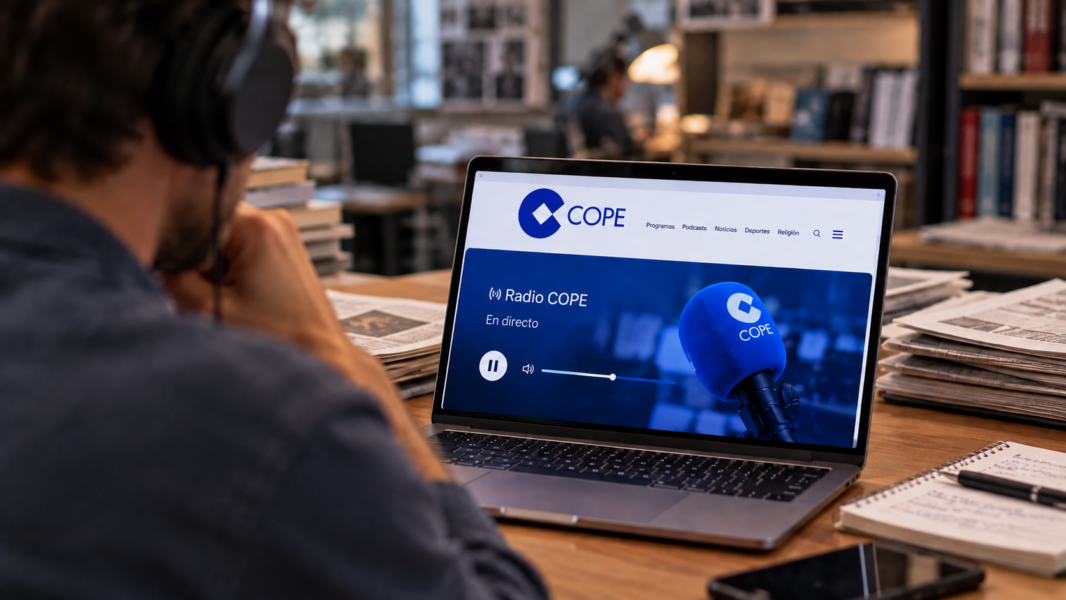
It is called COPE, billed as Radio Popular S.A., and it belongs to them in the most notarial sense of the word: 75% belongs to Ábside Media, «the Church’s communication platform», which the Plenary Assembly (that is, all the bishops, by show of hands) agreed to create in March 2020 by contributing the shares of the Episcopal Conference and, behind them, those of the majority of the dioceses and ecclesiastical bodies that had held them since the days when the distribution was fifty percent to the Conference, twenty percent to the dioceses, and the rest to Jesuits and Dominicans. The Conference appoints those who run it and maintains a monitoring commission for the company chaired by its vice-secretary for economic affairs, Fernando Giménez Barriocanal, who also chaired the house for twelve years. It is not a Catholic radio station in the sense that it is one that prays a lot. It is a radio station of the bishops in the sense that an apartment belongs to whoever holds the deed.
That is why we are opening this section today, which will be called what the thing is called: COPE, the bishops’ radio station. Starting this morning, and every morning, we will listen to that station and tell you what we find of interest: what is announced at one in the morning and what is kept quiet at eleven in the morning, what guest says what and who answers, how many times the Pope is heard and how many times the spot asking that the diocese be included in the will (eleven, on Wednesday), what vocabulary is used by the sports wardrobe that bills in the name of the episcopate and is paid, in short, from the collection plate. The first day has yielded a betting house sponsoring a section at one and seven, a YouTuber explaining at eleven twenty that missionaries are «brainwashers» without anyone contradicting him, a State campaign telling a sixteen-year-old girl that aborting «is fine» and twenty-four hours of episcopal airtime without a single bishop answering, and a «fucking hell» at one and three. The rest will come out. It gives for a lot.
When a radio station allows missionaries to be said to wash brains, the person responsible is not a commercial director or a late-night host. The person responsible is the owner, and the owner is them: all the Spanish bishops, each one personally, as a member of the Assembly that approved the company, as administrator of the diocese that contributed its shares, and as part of the Conference that chooses who sets the line. A bishop is responsible for what is preached in his cathedral even if he does not go up to the pulpit himself. The same goes for what is broadcast on his radio station. No one will be able to say they did not know: they will read it punctually every morning in this section.