


Let us take the Pope at his word. If the Córdoba of Islam was, as he taught us today before the King, that “space of contact, conversation and dialogue about the meaning of truth,” let us do tourism through that concord. Let us set the calendar to the year 925 and go down to the Guadalquivir, a river that will soon become, according to the official account, the stage of a fruitful cultural exchange.
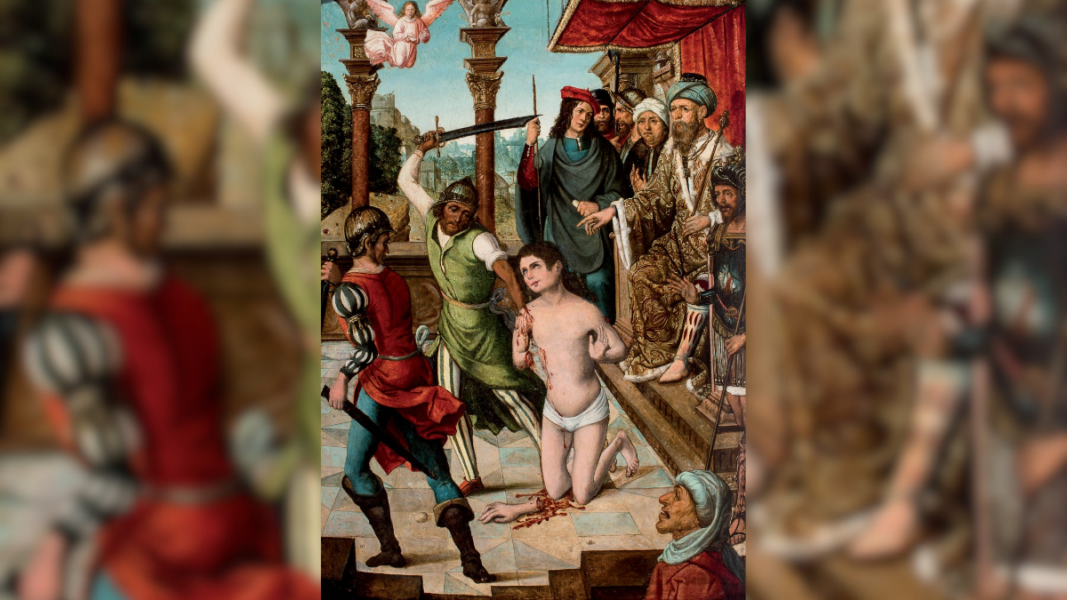
The setting is exactly what the brochure promises. Abd al-Rahman III—still emir, already almost caliph, splendid in any case—presides over the most cultured city in the West. There will be libraries, astronomers, irrigation channels, verses. Everything the catechist of diversity recites from memory. And amid so much light, a small logistical hitch: a thirteen-year-old Christian boy, held at court as a pledge for an uncle bishop captured in battle. His name is Pelayo. He has been a hostage for three years. And, alas, the boy has an attitude problem.
Because Pelayo polarizes. He is politely invited to integrate into the rich complexity of the caliphate—to apostatize, in the crude and simplifying language of the time—and the boy refuses. He clings, with an identitarianism unbecoming of his age, to his faith and his body. He does not appreciate the nuances. He does not abandon divisive narratives. Where an open soul would see an opportunity for intercultural encounter, he insists on seeing, how primitive, an enemy. He populates his small world with ghosts. He is, in a word, a fanatic ten centuries before the word came into fashion.
And this is where the history of Spain went wrong for lack of the right mediator. Let us imagine that in that Cordoban courtyard there had appeared, providentially, a gentleman of good bearing and polished Latin—let us call him Bob, for the sake of it—willing to make peace. He would have placed a hand on the boy’s shoulder and whispered what was reasonable.
Pelayo, son, do not be divisive. For the love of truth, abandon those polarizing narratives. Flee from identitarian approaches that explain everything but fill your head with enemies. The emir only wants to dialogue with you about the meaning of truth, and to savor your nectars. Let us not bless naïve enthusiasms nor feed sterile fears. Move from sterile simplification to the fruitful appreciation of complexity. Do not be seduced by the security of walls: one matures by advancing shoulder to shoulder with the other. Be yourself peace.
The boy, stubborn, polarized to the end. The chronicle—the Passio written by the presbyter Raguel—tells what concord then did to one who did not appreciate complexity: they dismembered him with tongs, limb by limb, and threw the pieces into the river. Into the Guadalquivir, of course. That space of contact and dialogue. There was, it must be said in honor of historical truth, contact. And prior conversation. Only that the minutes were drawn up by the executioner.
Pelayo was made a saint. Patron, in time, of half the Christian north, sung in Latin even by a Saxon nun who learned of the case a thousand kilometers and several borders away. His crime, let us remember, was not getting along. Not building bridges. Not understanding that the power that held him only aspired to a healthy coexistence. If instead of the palm of martyrdom he had been given a good counselor of the kind we have today, we would now have one more convert and one less saint, and Cordoban diversity would display him as a success story in integration.
The equidistant, whether tiger or lion, always arrives promptly to lecture the victim and never the executioner. He has a word for the child who resists—do not polarize—and not a syllable for the power that sharpens the tongs, except, perhaps, a thank-you for its fidelity to multilateralism. That is why one, while León invites us to raise our gaze toward the concord of Toledo and Córdoba, prefers to lower it a span, down to the water, and pray to a thirteen-year-old boy who had the poor taste not to understand complexity. Saint Pelayo, martyr, divisive, identitarian, patron of those who did not get along: pray for us. And, while we are at it, for His Holiness.