


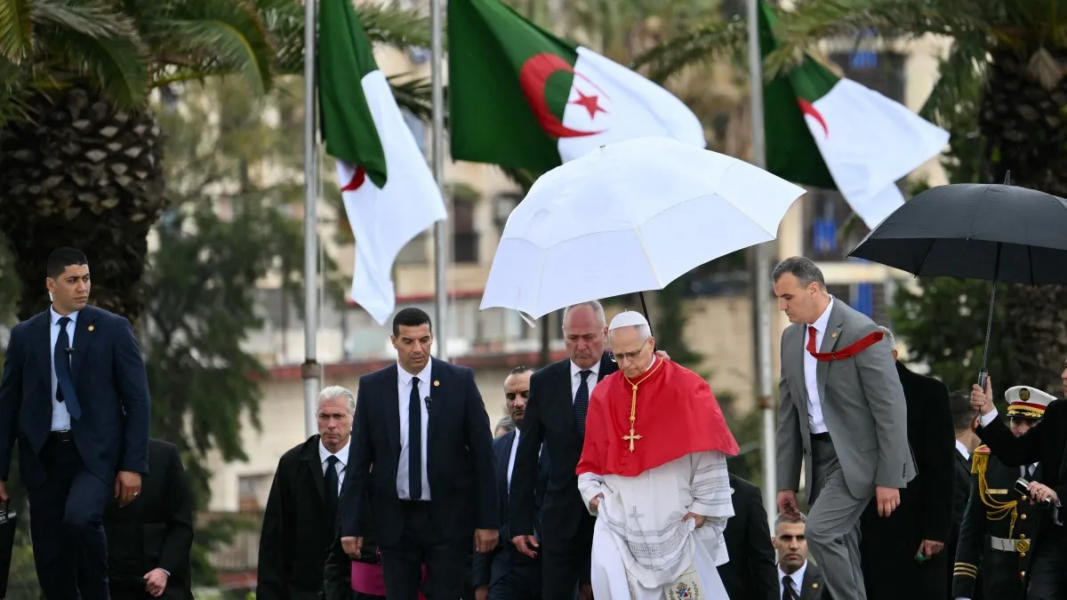
Pope Leo XIV delivered on April 13 in Algiers his first words of international weight since the beginning of his apostolic journey to Africa, in which he warned about the “continuous violations of international law” and the “neocolonial temptations,” while calling for building a peace based on justice and forgiveness. In his meeting with authorities, representatives of civil society, and the diplomatic corps, the Pontiff placed his intervention in the context of a world marked by conflicts, inequalities, and growing tensions.
A call for a new international order
Addressing public officials, Leo XIV urged them to assume an active role on the international scene: “You can become protagonists of a new course in history… in the face of the continuous violations of international law and neocolonial temptations”. The Pope emphasized that this change does not involve “multiplying misunderstandings and conflicts,” but rather respect for human dignity and solidarity among peoples.
In that same vein, he warned about the dynamics that generate exclusion: “Many societies that believe themselves advanced are plunging ever deeper into inequality and exclusion”, also denouncing those who “dominate over others” and end up “destroying the world that the Most High has created for us to live together”.
Politics at the service of justice
The Pontiff addressed a direct message to the authorities about the meaning of political power: “Authorities are called not to dominate, but to serve the people”. He recalled that public action must be governed by justice, a necessary condition—he indicated—for achieving authentic peace.
In this context, he referred to the role of Algeria as a crossroads between cultures and regions, and issued a warning: “Woe to us if we turn the sea and the desert into cemeteries where hope also dies!”, also denouncing those who “speculate with human life”.
From speech to gesture: memory and reconciliation
Hours after this institutional meeting, Leo XIV went to the Monument of the Martyrs (Maqam Echahid), where he participated in a commemorative act of the country’s history. After climbing the steps, he deposited a wreath of flowers in memory of those who gave their lives for Algeria’s independence, in a gesture that linked his message to the historical memory of the Algerian people.
Before about 2,000 people, the Pope resumed the axis of his intervention, centered on reconciliation: “God desires peace for every nation: a peace that is not only the absence of conflict, but an expression of justice and dignity”. However, he added that this peace cannot be achieved without an inner transformation: “It is possible only in forgiveness”, warning that “one cannot add resentment to resentment, from generation to generation”.
Peace, faith, and the future of peoples
Leo XIV placed his words in the context of current conflicts, stating that “the future belongs to men and women of peace” and that violence “will not have the last word”. He also emphasized the value of respect between cultures and religions as a basis for coexistence.
In the final part, he highlighted the religious dimension of the Algerian people: “A people that loves God possesses the truest wealth”, and warned about the risk of seeking goods that “illusion and disappoint”, recalling the words of Christ: “What does it profit a man to gain the whole world if he loses his life?”.
The Pope concluded his intervention with the proclamation of the Beatitudes, presenting them as a horizon of life for believers and as the foundation of a reconciled society.