


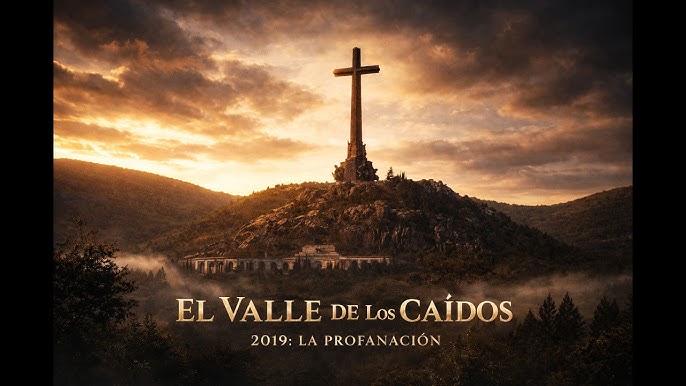
The documentary “El Valle de los Caídos 2019: La Profanación”, driven by popular initiative, once again places at the center of the debate the State’s intervention in the Basílica Pontificia del Valle de los Caídos in 2019, denouncing the desecration of the temple and a progressive deterioration of the monumental complex.
The work does not limit itself to reconstructing the facts of the exhumation, but proposes a broader reading of the Valley: as a sacred space, a place of memory, and a symbol whose nature—religious and historical—has been the object of political intervention that continues to generate controversy.
A monumental complex of a religious and funerary nature
The documentary places the Valle de los Caídos in its original dimension: a pontifical basilica and a cemetery where the remains of more than 30,000 people from different sides of the Civil War rest.
From this perspective, the complex is not presented solely as a monument, but as a place of worship marked by a spiritual purpose. The 152-meter-high cross, the largest in Christendom, is accompanied by an architectural complex that includes the basilica carved into the rock, the monumental sculptures, and the permanent presence of the Benedictine community.
Construction and historical debate
One of the axes of the documentary is the review of the construction conditions of the Valley. Through testimonies and documentation, it questions the official version regarding the use of forced labor.
The work presents how, along with free workers, prisoners also participated who availed themselves of sentence redemption systems, with regulated working conditions and the possibility of family coexistence.
Denunciation of neglect and deterioration
Beyond the past, the documentary focuses its attention on the current state of the site. It denounces a progressive deterioration of the complex, attributed to the lack of maintenance by Patrimonio Nacional.
It points out structural problems, the deterioration of the sculptures by Juan de Ávalos, and the closure of spaces in the site, along with the refusal to accept private initiatives for its restoration. This neglect would not be accidental, but a consequence of a lack of will for conservation.
The 2019 intervention and the denunciation of desecration
The narrative core is situated in the events of 2019, when the Government carried out the exhumation of Francisco Franco’s remains inside the basilica, denouncing that that action constituted a desecration of the temple, as it involved a civil power intervention in a sacred space protected by the agreements between Spain and the Holy See of 1979.
In this context, testimonies are gathered that denounce access restrictions to the basilica and difficulties for the normal development of liturgical life, which reopens the denunciation regarding the inviolability of places of worship.
A symbol in dispute
The impact of legislation on historical memory has reopened a division around a place that, in its original conception, aspired to a function of reconciliation.
Along with this, it also points to the lack of political consensus on the future of the site, in a context in which different positions continue to clash over its meaning and conservation.
A debate that remains open
This documentary once again puts on the table an issue that transcends the specific case of the Valle de los Caídos, reminding us that it is not just a monumental complex. It is a pontifical basilica and a place of worship whose inviolability has been questioned by political power intervention.
The issue, therefore, is not limited to a specific decision, but affects the respect due to sacred spaces and the limits of the State over them.