


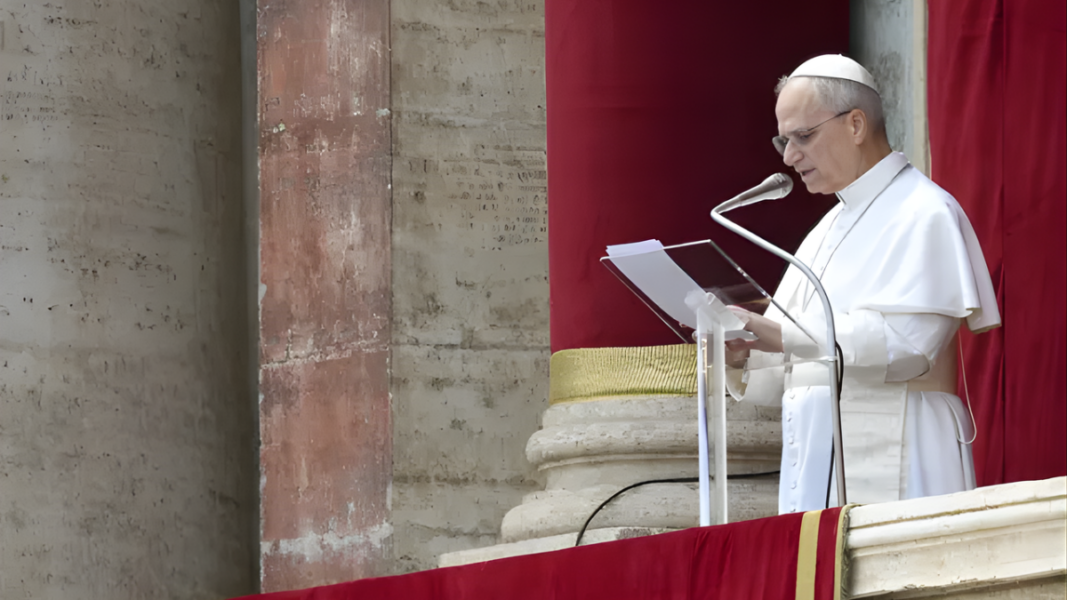
In the Regina Caeli prayer this Divine Mercy Sunday, Pope Leo XIV centered his message on the need to recover the centrality of the Sunday Eucharist as the source of faith and Christian life. In a context marked by war and international instability, the Pontiff emphasized that the encounter with the Risen Christ in the community and in the Eucharistic sacrifice is not optional, but indispensable to sustain faith and bear witness to charity, reconciliation, and peace in the world.
We now leave you with the words of Leo XIV:
Dear brothers and sisters, happy Sunday and happy Easter!
Today, the second Sunday of Easter, dedicated by St. John Paul II to Divine Mercy, we read in the Gospel about the appearance of the Risen Jesus to the Apostle Thomas (cf. Jn 20:19-31). The event occurs eight days after Easter, while the community is gathered, and it is there that Thomas encounters the Master, who invites him to look at the marks of the nails, to put his hand into the wound in his side, and to believe (cf. v. 27). It is a scene that makes us reflect on our encounter with the Risen Jesus. Where to find him? How to recognize him? How to believe? St. John, who narrates the event, gives us precise indications: Thomas encounters Jesus on the eighth day, with the gathered community, and recognizes him in the marks of his sacrifice. From this experience springs his profession of faith, the highest in the entire fourth Gospel: “My Lord and my God!” (v. 28).
Certainly, believing is not always easy. It was not for Thomas, nor is it for us. Faith needs to be nourished and sustained. For this reason, on the “eighth day,” that is, every Sunday, the Church invites us to do the same as the first disciples: to gather and celebrate the Eucharist together. In it we hear the words of Jesus, we pray, we profess our faith, we share God’s gifts in charity, we offer our lives in union with Christ’s Sacrifice, we are nourished by his Body and Blood, so that we too may then be witnesses of his Resurrection, as indicated by the term “Mass,” that is, “sending,” “mission” (cf. Catechism of the Catholic Church, 1332).
The Sunday Eucharist is indispensable for Christian life. Tomorrow I will depart for the Apostolic Journey to Africa, and precisely some martyrs of the African Church from the early centuries, the martyrs of Abitene, have left us a beautiful testimony in this regard. Faced with the proposal to save their lives in exchange for renouncing the celebration of the Eucharist, they responded that they could not live without celebrating the Lord’s Day. It is there that our faith is nourished and grows. It is there that our efforts, though limited, by God’s grace merge as actions of the members of a single body—the Body of Christ—in the realization of a single great plan of salvation that encompasses all humanity. It is through the Eucharist that our hands too become “hands of the Risen One,” witnesses of his presence, his mercy, and his peace; marked by work, by sacrifices, by illness, by the passage of years that are often engraved on them, as well as by the tenderness of a caress, a handshake, or a gesture of charity.
Dear brothers and sisters, in a world that so needs peace, this commits us more than ever to be assiduous and faithful to our Eucharistic encounter with the Risen One, so as to go forth from it as witnesses of charity and bearers of reconciliation. May the Virgin Mary help us in this, blessed because she was the first to believe without having seen (cf. Jn 20:29).
_____________________________
After the Regina Caeli
Dear brothers and sisters:
Today many Eastern Churches celebrate Easter according to the Julian calendar. To all those communities I address my most cordial wish for peace, in communion of faith in the Risen Lord, which I accompany with a more intense prayer for all those who suffer because of the war, particularly for the dear Ukrainian people. May the light of Christ bring consolation to afflicted hearts and strengthen the hope for peace. May the attention of the international community to the drama of that war not diminish!
I am also very close to the beloved Lebanese people in these days of pain, fear, and invincible hope in God. The principle of humanity, inscribed in the conscience of every person and recognized in international law, entails the moral obligation to protect the civilian population from the atrocious effects of war. I exhort the parties in conflict to cease fire and urgently seek a peaceful solution.
Next Wednesday marks three years since the beginning of the bloody conflict in Sudan. How the Sudanese people suffer, innocent victims of that inhuman drama! I renew my urgent appeal to the belligerent parties to silence their weapons and begin sincere dialogue, without preconditions, aimed at stopping that fratricidal war as soon as possible.
And now I welcome all of you, Romans and pilgrims, in particular the faithful who have celebrated Divine Mercy Sunday at the Shrine of Santo Spirito in Sassia.
I greet the Musikverein Kleinraming, from the Diocese of Linz in Austria, and the faithful from Poland; as well as the young people from the Collège Saint Jean de Passy, in Paris, and those of various nationalities from the Focolar Movement. I greet the pilgrimage from the community of San Benedetto Po and the confirmands from Santarcangelo di Romagna and San Vito.
Tomorrow I will depart on a ten-day apostolic journey to four African countries: Algeria, Cameroon, Angola, and Equatorial Guinea. I ask you, please, to accompany me with your prayers.
Happy Sunday to all!