


This year I decided to live a Holy Week as an urban hermit in the parish of my town of tens of thousands of inhabitants in the Barcelona belt. It was the first of the last 5 years that, for reasons that don’t matter, I had no choice but to attend the Offices and Masses in the parish. I had had the fortune in previous years to attend the traditional Holy Week, pre or post 1955 reforms. This year I provided myself with the necessary, warned my parents that I would have the phone disconnected and asked for vacation days at the company. And, from Palm Sunday to Easter Sunday, I only went out to attend the parish, while spending the days with monastic discipline at home, praying all the offices of a 1888 breviary and praying with the propers of the Mass with a bilingual missal from 1947.
For doing things like this, and although I haven’t been seen much around the parish for a long time, my parish priest a while ago proposed consecration in the ordo virginum to me. But I think we’ll talk about that another day. Today I would like to focus on the account and reflection of what sixty years of a very poor liturgy may have meant for the faith of the Mystical Body of Christ, aggravated for those who have had the fortune of knowing the traditional liturgy by the sensation of attending the ruins of what was once Heaven on earth, a superior, divine liturgy.
In the Tridentine Divine Office of 1888 the antiphons, the lectios and the choice of psalms, read along with the propers of the Mass, not only represent hours of liturgical prayer, but have the effect of immersing those who pray in this way in a profound contemplation of the mysteries of these holy days. When one reads about the actions in the sanctuary of the priest and his ministers, about the great quantity and complexity of prayers and rubrics loaded with spiritual depth and Sacred Scripture, when one understands the meaning of the blessing of the palms and olive branches and, after it, the procession, with its prayers – of which the pilgrim Egeria was already a witness in the Holy Land in the 4th century and which reached Rome around the 9th century –, when one hears the Easter proclamation and sequence, witnesses the blessing of the water in the baptismal font, loaded with profound symbolism…. Then, only those who can label a perfect society, such as the Catholic Church, as “obscurantist” out of ignorance are worthy of pity; a Church that, guided by the Holy Spirit, was capable, over the centuries, of fostering the organic development of the divine liturgy. A development that experienced peak moments in no less than a thousand years that are also considered a dark age, the Middle Ages, which in reality constitute the luminous centuries of Christendom. We are surrounded by so much ugliness and vulgarity, both in the world and in the Church, which has wanted to imitate it in its buildings and ornaments, that it is very difficult for a large number of souls to realize the importance of beauty, and how it leads to God, being one of His attributes.
And we can only also be worthy of pity, we who have been stripped of such richness and handed over to an insubstantial, horizontal, superficial liturgy, in which not even the rubrics of the Missal that could help the faithful preserve the faith are respected.
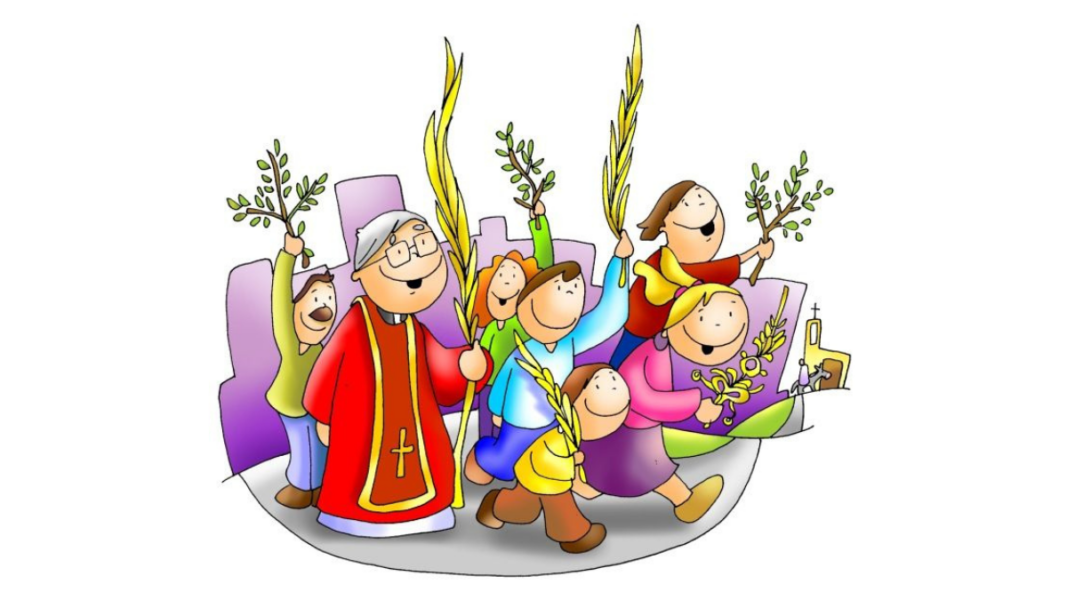
After a morning deepening in the Office and the Missal of Palm Sunday, one arrives at the parish, with that hubbub of blessing branches in the square, the priest vested in red, jokes to entertain the children, the mini-pseudo-procession, which is a disorderly entrance into the temple, while half of those who came to bless the branches do not attend Mass, and one wonders what has happened. What is this and what does it have to do with that divine liturgy?
After Palm Sunday, as Evelyn Waugh said, in the Holy Week reformed from 1955 it seems that nothing happens until Holy Thursday afternoon, while the previous liturgy also granted importance and depth to Holy Monday, Tuesday, and Wednesday. And then we arrive at the Paschal Triduum, the holiest days of the year. I must say that Holy Thursday and Good Friday surprised me with a novus ordo worthy (for what post-1955 Holy Week is, understand). Some announcements made by a nun, the youth group and their guitar songs, the priest praying the Eucharistic Prayer I (called Canon, though it isn’t), a foot-washing of men, women, and children placed in the front pews. That is, for being the Mass attended by 90% of Roman Catholics, correct and worthy.
Finally, the Easter Vigil was a true disaster. The most disturbing liturgical nightmare experienced in years, which made me remember why I stopped attending the novus ordo. Paschal proclamation and other hymns, announcements, left in the hands of the youth, changing not only the melody but also the lyrics. And haste, a lot of haste. The shortest Easter Vigil I have attended: an hour and a half. It was pitiful. We can’t even say that it was a weak shadow of the traditional rite. Because, directly, it was a scam. You can’t preach in the sermon that we are in the most important night of the year and then destroy the Vigil in that way, not provide the spiritual nourishment that that Mass has the power to provide to the faithful.
In any case, the conclusion I reached after the shock of the Easter Vigil, reflecting more calmly on Easter Sunday, is that, celebrated more or less worthily, it is impossible not to notice that the Mass of Paul VI is a different rite from the Mass that the Church celebrated for centuries. It is not a matter of two forms of celebrating the same rite, but of two rites. And, worse still, in addition to the changes, omissions, eliminations – that is, the fact that priests pay no attention to the rubrics –, what remains could be said to be a liturgy and, therefore, a diluted faith; less dense, as if the message arrived weaker, like an echo.
In this flat, anthropocentric, immanentist liturgy, the focus shifts from the sacred mysteries to man, lowering the sacrality and provoking an atmosphere of worldliness.
There is no representation of the mystery that moves man in his entire being, although it is capable of moving him tenuously, at the level of a more superficial feeling, for the truth is still there, however hidden and weakly announced. If we think that what we pray is what we believe (lex orandi lex credendi), faith, by receiving only this insufficient nourishment, weakens. We believe in a way that is progressively weaker because we pray in a weak way. These rites offer some unexpected flash of what they once were, but in general, they are only ruins. A weak reflection of what was once the great opus dei, the work of God, which built and sustained the greatest civilization in history for centuries. Like the liturgy, as a consequence of the collapse of the liturgy, that civilization has also collapsed, not only the faith of individual persons.
The reality of being before something infinitely greater than him, superior to him, does not reach man, as reflected in the very high ceilings of medieval temples, in which man sees himself in the ensemble at scale like a Lego-sized doll. This liturgy, despite its isolated flashes, the power of the Word of God, even in our language, in which we can understand every word, is a liturgy at human scale. Similarly, the height of the ceilings of the new temples, by the way, flat over our heads.
The terrible thing, when one stops to think, is that this superior liturgy was dismantled from within the Church by the hierarchy, above all, and by some laity. They didn’t want it. They denigrated it. It wasn’t suitable for the “modern man”. It was obsolete. If the ruin had been the consequence of an earthquake, it could have been rebuilt. But it was discarded, dismantled, and fabricated ex novo from within.
As an anecdote, in the Good Friday Office (or whatever it’s called), four ladies who together added up to many more than 300 years, sitting in the pew behind mine, were commenting that “this year (the priest) is doing everything differently”. I don’t know what differences they were referring to, but if the changes disturb them so much, I can’t imagine how they lived through the whirlwind of the years 1955 – 1969. Anyway…
To those people who don’t understand why we keep talking about the liturgy prior to the mid-20th century changes, because we didn’t know it, I earnestly beg them to attend just once a vetus ordo Mass. A low and said Mass or a solemn one, private or public, authorized by the bishop or in catacombs. Only then does one realize what has been stolen from us and why the Church and the faith have collapsed. After centuries of organic development of a divine liturgy, work was done in secret, with premeditation and treachery, from Rome and from Central European groups, on the dismantling of the liturgy and its replacement with a protestantized placebo that maintained the consecration in order to speak in positivist terms of its validity. Between 1948 and 1975 (although experiments were already being done in the countries bathed by the Rhine since the 1920s) systematic work was done on the dismantling of the Mass and the Divine Office; a work, I would say, so well done for evil, that the sensation is that it is not purely human, but preternatural. There is a superior, malign, anti-Catholic intelligence in all that machinery that has been able to continue unfolding in the subsequent decades only for the weakening of the faith, for the protestantization and worldliness of the Catholic Church. An attack on the Catholic carried out by ordained pastors of the Church, by the hierarchy.
What hope do we have left? All of it, because we know that Christ has overcome the world. But for those fathers and grandfathers who live their faith and wonder what they did wrong, that their descendants have completely disengaged from the Church, they would find the solution by praying, of course, and in the return to the traditional liturgy. Not imposed by prohibiting Paul VI’s novus ordo, as the pope and bishops did in the 1970s, but that the faithful seek it, authorized or prohibited. It is then, attending that silence loaded with sacrality, or those Gregorian chants, when one realizes what has been taken from us, why the new generations have progressively lost the faith. Even for those who are comfortable in their parish, which “works”, I would tell them to make that effort, to seek a traditional Mass. It is not something foreign to us: it is the tradition of the Church, the Mass with which so many people were sanctified and gave glory to God over the centuries. The restoration of the traditional Mass is not a whim, something accessory, to which an ornamental, anecdotal indult can be granted. I am convinced that the renewal of the Church, the return of its vigor, depends on the traditional liturgy. Because, moreover, it is accompanied by a more intense practice of piety and a deepening in the perennial doctrine of the Church.
As Peter Kwasniewski says, the modernist hierarchy not only persecutes the traditional Mass per se, but because those who attend it live as true Catholics; and that goes against the plan drawn up from above for the secularization of the Church.