


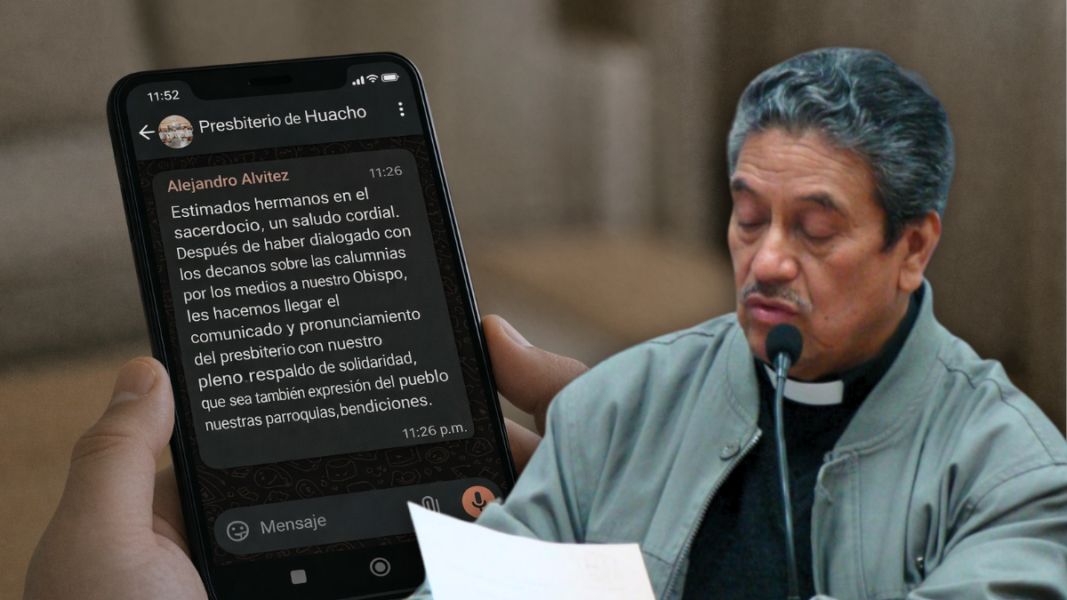
The dissemination of a statement on behalf of an entire presbytery without effective support from its members is not a minor detail or a formal issue. It is a symptom. In the Diocese of Huacho, the vicar general, Alejandro Alvites, has promoted and distributed a text presented as the unanimous expression of the diocesan clergy in defense of the bishop, Mons. Antonio Santarsiero Rosa. The problem is that this unanimity does not exist.
Infovaticana has had access to the internal messages from the presbytery’s WhatsApp group, the channel through which the statement was conceived and disseminated. What is observed is not a process of consultation, deliberation, or voting, but the imposition of a already finalized text, presented to the priests as a done deal. Alvites himself introduces it as the “statement and pronouncement of the presbytery,” attributing to it “full support of solidarity,” without any mechanism recorded to justify that claim.
Full transcription of the message sent by Alejandro Alvites:
“Dear brothers in the priesthood, a cordial greeting after having dialogued with the deans about the slanders in the media against our Bishop, we send you the statement and pronouncement of the presbytery with our full support of solidarity that it may also be an expression of the people of our parishes, blessings”
The scene is revealing. There is no trace of contrast, nuance, or discrepancy. There is no individual or collective signature. There is no procedure. Only a will to project outward an image of cohesion that has not been built internally.
The content of the statement aggravates the situation. It does not limit itself to expressing closeness or asking for prudence, but fully enters into qualifying the accusations as “unjust and defamatory.” That is, it prejudges and points to alleged victims that include a minor. And it does so in the name of all the priests of the diocese. In canonical terms, this is not a minor imprudence, but a direct interference in any present or future investigation. The Church has clearly established that in the face of denunciations of this nature, the response must be articulated around processes: preliminary investigation, adoption of precautionary measures, formal instruction. Here there is none of that.
The recourse to an alleged support from the presbytery is not only inaccurate, but it introduces an element of environmental pressure. Whoever disagrees is implicitly placed outside of communion. An artificial consensus is thus built that protects authority, not the truth. It is a primary power scheme: first the innocence is affirmed, then the denunciation is discredited, and finally unity is invoked to close any debate.
It is not a matter of style, but of substance. This way of proceeding reveals insecurity. When an institution trusts its own legal mechanisms, it does not need to shield itself through dubious collective statements. It lets the facts be investigated, the evidence be assessed, and the decisions be made in accordance with the law. Here the opposite occurs: the verdict is anticipated and the presbytery is instrumentalized to sustain it.
The result is doubly damaging. Outwardly, it compromises the credibility of the Church in a particularly sensitive area like abuse denunciations. Inwardly, it erodes trust among the priests themselves, who see how their name can be used without their consent to endorse positions they have not subscribed to and that may mark them for life.
There is no possible justification for this type of practices. Neither pastoral nor legal. The Church cannot afford to function through forced adhesions via the most relevant institutional positions in the diocese. In situations like this, there is only one serious path: processes, investigation, measures. Everything else is noise, and in this case, moreover, a scandal.