


The Peruvian Episcopal Conference has reacted to the information published by Infovaticana just two days ago with an official statement that introduces a relevant shift regarding the line followed so far from the diocesan sphere. In contrast to the defensive and closed messages disseminated in Huacho, the Peruvian episcopate acknowledges the existence of the reported facts, states that actions are being taken to clarify them, and announces the departure of Mons. Antonio Santarsiero Rosa himself from one of his key positions.
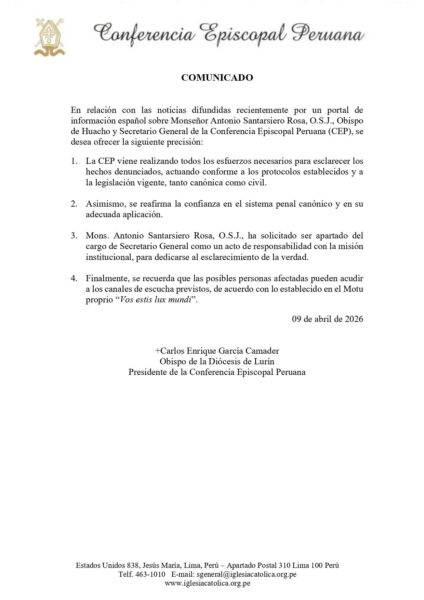
The statement, dated April 9, 2026 and signed by the president of the Episcopal Conference, Mons. Carlos Enrique García Camader, indicates that «all necessary efforts are being made to clarify the reported facts,» emphasizing that these actions are being carried out in accordance with established protocols and current legislation, both canonical and civil. The assertion implies that the case has entered, at least formally, an institutional treatment phase.
The most significant point is the decision of Mons. Santarsiero to step aside from the position of general secretary of the Peruvian Episcopal Conference. The text presents it as an «act of responsibility toward the institutional mission,» aimed at facilitating the clarification of the truth. It is a measure of a political-ecclesial nature, but it introduces an element that had been absent until now: the assumption that the situation requires distancing and not shielding.
The statement also insists on confidence in the canonical penal system and its proper application, in an attempt to convey the idea that the process will be channeled through the formal channels provided by the Church. But the most relevant element is not there, but rather in the explicit openness to possible new victims. The Episcopal Conference reminds affected persons that they can resort to the reporting channels provided in accordance with the motu proprio Vos estis lux mundi. This point marks a substantial difference compared to other recent crises: in contrast to the tendency to discredit or point fingers at those who report, here a clear institutional message of availability to listen is launched. It is an important gesture, because it shifts the focus from corporate defense to welcoming possible affected individuals.
A partial resignation that does not resolve the underlying problem
The decision to abandon the general secretariat introduces, however, an evident contradiction. Santarsiero leaves an institutional representation position, but keeps intact the core of his real power: he remains bishop of Huacho, continues to lead the training of seminarians, and retains control over the economic and patrimonial structure of the diocese. In practical terms, the measure does not alter his governing capacity or his hierarchical position.
The result is an artificial split between the representative and the effective. Visibility in the Episcopal Conference is sacrificed, but authority in the diocese is preserved. If the situation is serious enough to justify a withdrawal at the national level, it is difficult to sustain that no measures are required in the sphere where the bishop directly exercises his authority.
The CEP acts within its competencies
It is worth specifying the competency framework. The Peruvian Episcopal Conference has acted correctly within its limits. It does not have the authority to suspend a bishop in the exercise of his ministry or to impose precautionary measures on his diocesan governance. Its capacity is limited to the internal positions of the conference itself, and in that sphere the action is the only possible one: removing Santarsiero from the general secretariat.
Moreover, the fact that the statement reminds possible affected individuals that institutional listening and reporting channels exist is not a minor detail. In a context where the first ecclesial reaction has so often consisted of closing ranks or casting suspicion on the accuser, here the Peruvian bishops have wanted to convey something different: that there is an institution willing to listen. That openness deserves to be recognized.
Now the responsibility passes to Rome
But precisely because the Episcopal Conference cannot go further, the ball is now in Rome’s court. If there are serious complaints, if the need for clarification is acknowledged, and if an institutional withdrawal has already occurred, the absence of additional measures by the Holy See would turn the entire movement into something difficult to understand.
The situation is thus defined with considerable clarity. The Episcopal Conference has done what it could. But if no measures are adopted from Rome regarding the pastoral governance of the diocese, Santarsiero’s relationship with the seminarians, or his continuity at the head of the administration and entities linked to the diocese, the resignation from the general secretariat runs the risk of remaining an incomplete gesture. It would make no sense to remove him from a representation position and leave everything else intact.