


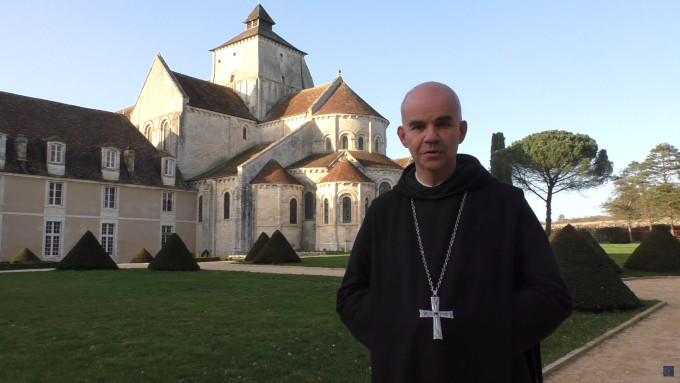
The current liturgical crisis in the Church cannot be understood without taking into account the abuses, the silences, and certain ideological readings that have marked the last decades. This is what the abbot of Fontgombault, Dom Jean Pateau, states in an interview granted to Silere Non Possum, in which he reflects on the origin of the tensions and points to the need for real reconciliation.
His words are framed in a moment when Pope Leo XIV has called to reduce the confrontation around the liturgy and to favor greater understanding between sensitivities.
Abuses and silences that have fueled the tension
Referring especially to the French case, the abbot acknowledges that liturgical abuses have occurred for years and that there has not always been an adequate response from the authorities. That combination, along with other factors such as shortcomings in catechetical formation, has contributed to generating distrust and alienation among some faithful.
As he explains, this situation has led to tensions, resentments, and even divisions within families and ecclesial communities.
“The liturgy is not a banner”
In the face of this scenario, Dom Pateau warns against two opposing risks: the use of the ancient rite as an identity element and the ideological reading of the liturgical reform.
“The liturgy is not a banner,” he emphasizes, insisting that it should not become an instrument of confrontation. In his view, when its purpose—leading to God—is lost sight of, the liturgy is reduced to a field of dispute.
From his monastic experience, he recalls that liturgical life is not called to prove anything, but to sustain the relationship with Christ and communion in the Church.
Moving out of confrontation
The abbot observes that many opposing positions arise from ignorance and partial visions, which hinder serene dialogue. For this reason, he considers it necessary to abandon the logic of blocs and recover a broader gaze, capable of integrating diversity without breaking unity.
Leo XIV and the path of reconciliation
In this context, Dom Pateau welcomes with hope the words of Leo XIV, who invite the faithful to a “new gaze” and to seek concrete solutions to integrate those linked to the traditional rite.
In his judgment, this approach, centered on mutual understanding and charity, is the only one that can open a fruitful path in the long term.
The abbot acknowledges that the current situation remains painful and, in many aspects, blocked. However, he reminds us that the life of the Church does not stop in conflict: “there is no Good Friday without Easter morning.”