


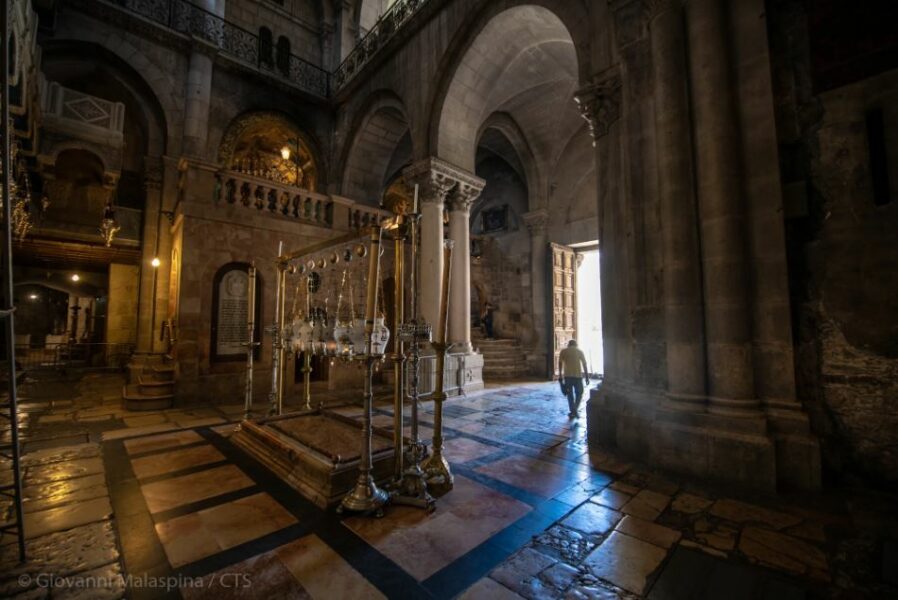
The Church of the Holy Sepulchre has reopened its doors this Thursday, putting an end to 40 days of closure that have exceptionally marked religious life in Jerusalem and, in particular, the recent Holy Week.
After weeks in which access was restricted by decision of the Israeli Government —amid the conflict with Iran—, the faithful have returned to the temple where tradition places the Passion, Death, and Resurrection of Christ. The image now contrasts with that of the past days: open doors, pilgrims entering without impediments, and a certain sense of recovered normality.
From restricted access to reopening
During this time, Jerusalem has experienced an unusual situation even in contexts of tension. The restrictions not only limited the influx of the faithful but directly affected the liturgical celebrations in the Holy Sepulchre.
Holy Week developed under extraordinary conditions. Services with reduced capacity, minimal presence of pilgrims, and a general climate of restraint marked the Paschal Triduum in the holiest place of Christianity. Added to this were episodes that generated unease, such as the difficulties for ecclesiastical authorities to access the holy places.
A return laden with meaning
This Thursday’s reopening means the recovery of access to the place where liturgy is celebrated daily and toward which the devotion of millions of Christians worldwide converges.
Throughout the day, the faithful have returned to enter the Holy Sepulchre, resuming a practice that was interrupted for weeks. Also in other points of the city, such as the Western Wall, the return of pilgrims has been recorded.
After a Lent lived amid restrictions and a Holy Week celebrated with forced sobriety, Jerusalem now begins to recover its usual rhythm.