


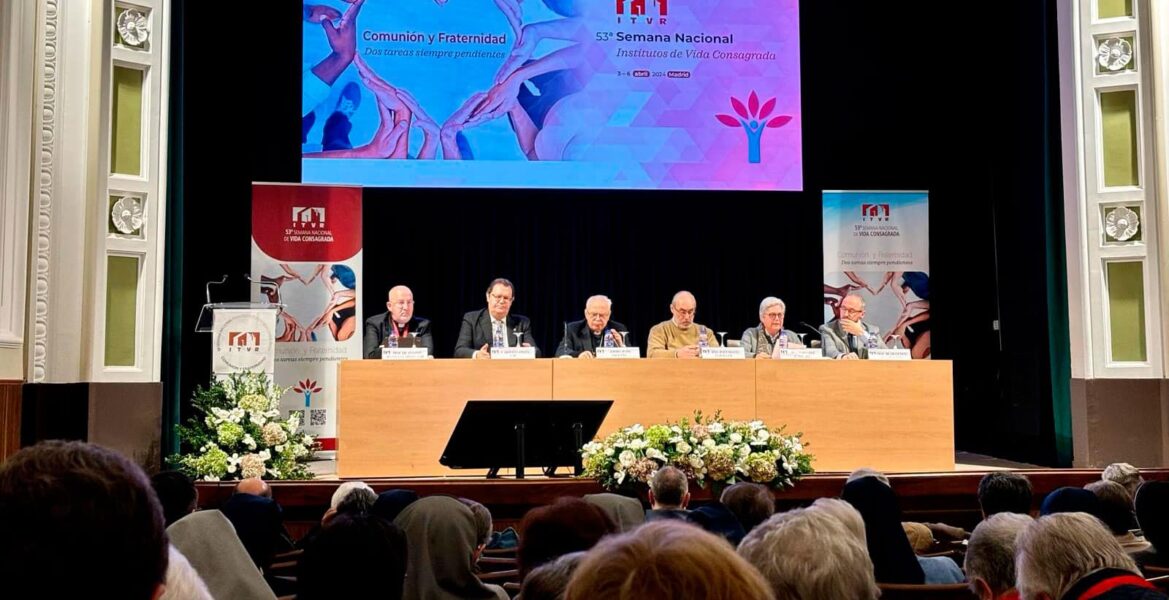
Vida Nueva presented the inauguration of the 55th National Week of Consecrated Life as an act of reflection on the vocational crisis and the numerical reduction of religious life in Spain. The person in charge of opening the event was Fernando Vidal, sociologist, professor at the Pontifical University of Comillas, and director of the Amoris Laetitia chair. The Week is held from April 8 to 11 in Madrid, in both in-person and online formats, under the motto “Facing the Reduction. Walking and Dwelling in the Desert.” According to the official program and the prior presentation of the event, it is organized by the Theological Institute of Religious Life, a center founded by the Claretian Missionaries in 1971, and at the helm of this edition is the director of the ITVR, the Claretian Antonio Bellella. I have not found a public relation of a “selection committee” that details who chose each speaker; what is verifiable is that the program comes from the ITVR and that Bellella appears publicly as responsible for the Week and its general approach.
The context is no small matter. This is not a marginal talk or an intervention lost in a secondary panel. Vida Nueva expressly emphasized that Vidal was “in charge of the opening conference,” and the official program places him at 11:30 a.m. on Wednesday, April 8, with the lecture “Ecclesial Crossroads. Collapse or Reconstruction?” In other words, he was not an accidental guest or a name added to fill the agenda: he was a voice chosen to set the intellectual tone of the Week from the first major interpretive framework.
What he said is even more revealing than his mere presence. According to Vida Nueva, Vidal argued that there is a “non-devotional, but political, reaction that calls for a return to Catholicism,” and he concluded that this would be “ideologization without conversion.” He added that there are no data accrediting an increase in Catholicism among young people, although there is a slowdown in the decline, and he defended that the Church must bet on a “proximity Christianity,” less supported by new movements and more focused on “being on the frontiers” and “dwelling in the streets.” In that same line, he presented the future of Spanish Catholicism as that of a minority toward 2100, even venturing that only 25% of Spaniards will consider themselves Catholic and that today only 15% of young people would be practicing Catholics.
The underlying thesis is transparent. The problem, for Vidal, would not be the re-emergence of a Catholic consciousness with public, cultural, or civilizational pretensions, but precisely that this reaction does not accept remaining in a domesticated, intimate, aesthetic, or accompaniment religiosity. What bothers him is not a caricature of “ideologization” detached from faith, but the very possibility that Catholicism stops asking forgiveness for existing in public space and aspires again to order personal, social, and political life from the truth of Christ. When he says that the Catholic rebirth would be “political” and not “devotional,” the maneuver is of almost brutal clarity: it preemptively discredits any recovery of historical, moral, or institutional density of Catholicism by labeling it as suspicious.
And there lies the real scandal. Spain suffers a permanent legislative and cultural offensive against life, the family, natural law, the education of children, religious freedom, and the very idea of objective moral truth. In that landscape, one would imagine that a Week of Consecrated Life would invite to open with a call to holiness, to conversion, to reparation, to apostolic courage, or to the spiritual reconquest of a demolished society. Instead, a sociologist is chosen whose inaugural intervention consists of warning against those who want a “return to Catholicism” understood also in a public key. It is not a casual error. It is a perfect symptom.
Fernando Vidal, moreover, is not a Martian who fell into a conference hall. Comillas presents him as director of the Amoris Laetitia chair, researcher at the University Institute of the Family, and a stable figure in various boards and social intervention spaces. There are also prior public references that defined him as “affiliated to the PSOE,” and his name appears associated with environments of left-wing Christianity and the Ignatian universe of CVX. That does not prove by itself each of his current positions, and it is advisable not to force beyond what is documented; but it does sketch with considerable clarity the ideological ecosystem from which he comes and from which he speaks.
But it is not even advisable to dwell too much on Vidal, because Vidal is secondary. He is a coherent product of an ecclesiastical system that has been rewarding exactly this profile for decades. The drama is not that a sociologist says what one would expect from him. The drama is that an exhausted ecclesial structure turns him into an inaugural voice to speak to religious and consecrated persons in the midst of vocational collapse. The problem is not the speaker. The problem is the taste of the convener. The problem is the criterion of the apparatus. The problem is that those who have emptied churches, novitiates, seminaries, schools, and Catholic language continue to hand out microphones as if they were the last serious men in the room.
Because that is the underlying obscenity: those responsible for decades of sterility now present themselves as specialists in managing sterility. The same environments that replaced faith with sociology, mission with accompaniment, authority with group dynamics, doctrine with narrative, conversion with processes, and Christian civilization with the nebula of “frontiers” now pretend to give lessons on how to survive in the desert. But the desert did not fall from the sky. They have administered it. They have justified it. They have decorated it with mottos, days, panels, and religious consulting language.
Vidal speaks of a “more Pauline” Church that gives reasons. The expression sounds elevated until it is confronted with reality. Saint Paul was not a manager of resigned minority. He did not go out to explain that the problem of Christianity was its temptation to recover power. He did not go around the Mediterranean telling the faithful to be careful about wanting to transform the world too much. Saint Paul preached Christ crucified and risen as Lord of all. He founded communities, corrected errors, combated heresies, spoke of judgment, sin, purity, authority, obedience of faith. He did not ask permission to be significant. He did not administer the setback. He converted a world.
Here, on the other hand, something else has been imposed: a pastoral of satisfied impotence. We are told that being a minority can be very fruitful. And in the abstract, it is true. The Church has been a minority many times and from there saints have sprung. But the Christian minority is only fruitful when it preserves supernatural fire, doctrinal clarity, and missionary ambition. Not when the minority becomes a psychological alibi to justify irrelevance. Not when it is presented almost as a relief to have gotten rid of the duty to build a Christian society. Not when some seem to enjoy diagnosing the loss of Catholic influence more than fighting it.
And there the phrase about the “temptation to recover power” reveals an entire sick ecclesial anthropology. As if the only way of Catholic public presence were domination. As if one had to choose between clericalism and dissolution. As if a Christian civilization were by definition an authoritarian nostalgia. As if the alternative to aggressive secularization could not be a society penetrated by the law of Christ, by the truth about man, by the defense of life, by the stable family, by legitimate authority, by Catholic education, and by the subordination of politics to the common good. The reduction of the Catholic horizon to pure private humility is one of the great cultural victories of the enemy. And the tragic thing is to see so many ecclesiastics administering it from within.
It is no less significant that, when a possible “Catholic revival” emerges, the reflex reaction of a part of the ecclesial establishment is not to examine whether there is a sincere search for truth, a sacramental thirst, a return to liturgy, a reopening to doctrine, or a possibility of cultural reconstruction, but to rush to deactivate it with suspiciously ideological categories. Those who have emptied Catholicism of public density are more disturbed that some young people discover the political value of faith than the fact that Spain has been crushed for decades by iniquitous laws. They are more alarmed by the risk of “ideologization” of those who return than by the certainty of the already consummated institutional de-Christianization.
And here appears the responsibility of the hierarchy and the Spanish clerical structures. It is not enough to lament that there are no vocations. One must ask why a young person would dedicate their life to a machinery that so often seems ashamed of the Catholic tradition, suspicious of every restorative impulse, and prefers the tired language of indefinite accompaniment to the virile proclamation of truth. If religious are offered as a horizon not heroic sanctity but the amiable administration of decline, it is no wonder that there are no replacements. Vocations are born where there is something worth burning for, not where one is invited to manage ruin with good manners.
The issue, therefore, is not Fernando Vidal. Fernando Vidal barely lends an academic voice of the fifth rank to a bureaucratized, aged Church fascinated by its own failure. A Church taken, too many times, by ecclesial elites who have confused prudence with surrender, dialogue with disarmament, presence with insignificance, and humility with incapacity to reign socially with Christ. It is those environments that have made defeat a spirituality. It is those environments that have decided that any attempt at Catholic regeneration must first pass through their filter. It is those environments that have been stifling for years anything that smells of conviction, authority, tradition, cultural combat, or reconstruction of Christendom.
That is why what happened at the inauguration of the Week of Consecrated Life is not an anecdote. It is an x-ray. A speaker is invited who looks with distrust at an eventual Catholic awakening with public projection. He is given the opening of days dedicated precisely to thinking about the collapse and reconstruction. And it is done from a structure that perfectly knows the symbolism of that choice.
Then there will be speeches about the vocational winter, analyses about the social irrelevance of religious life, appeals to hope, and roundtables about new paths. But as long as suspicion continues toward the Catholic energy capable of rebuilding a civilization, all that will be rhetorical administration of the sinking.
The Church needs to stop handing over its platforms to those who consider it dangerous for Catholics to start behaving again as if the Gospel were truth also for the polis, for culture, for law, and for history. That is what is unbearable about this episode. Not that Fernando Vidal said what one would expect. But that, while Spain bleeds morally, there are those within the Church itself who continue to think that the problem is that some Catholics still want to rebuild it.