


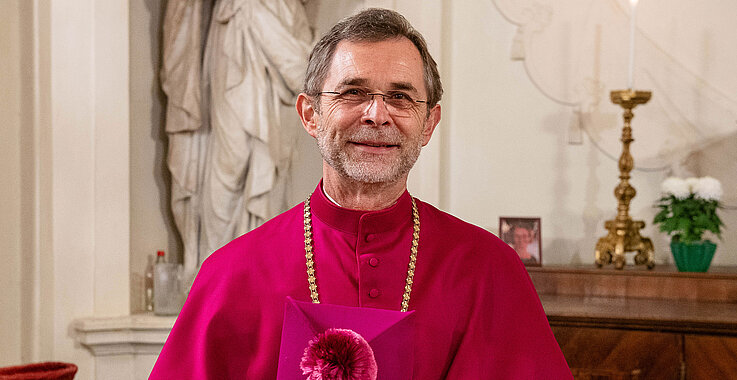
The Archbishop of Vienna, Josef Grünwidl, has defended celibacy as a “great form of life,” although he has opened the door to reviewing its mandatory nature for the priesthood, according to Katholisch.de based on an interview granted to the Austrian press.
The prelate, who has been living celibacy for four decades, stated that he does not consider this discipline as something outdated, but raised the question of whether it should continue to be a necessary condition for exercising the priestly ministry.
Celibacy, valued but questioned in its mandatory nature
Grünwidl defined celibacy as a “tolle Lebensform”—a valuable form of life—and emphasized his positive personal experience. At the same time, he introduced a relevant nuance by questioning whether the priesthood must necessarily be tied to this requirement.
In his approach, the archbishop suggested the possibility that those who feel called to celibacy live it freely, but that there could also be the option to exercise the priesthood within a family life.
Nevertheless, he ruled out that an eventual modification of this discipline would mean an automatic solution to the vocations crisis, stating that neither the abandonment of celibacy nor the so-called “women’s question” will make the Church “grow again and enthuse the masses.”
The archbishop framed the issue of celibacy in the theological realm, noting that it is a matter that must be clarified. He also recalled that in the history of the Church, the same discipline has not always existed in this area.
The Faber case and the difficulty of applying the discipline
Grünwidl also referred to the situation of the Viennese priest Toni Faber, known for his public appearance alongside a woman whom he describes as a “very good friend” and regular companion.
Although he praised his pastoral commitment, the archbishop acknowledged that the solution adopted by Faber regarding celibacy is problematic for him. As he explained, both maintain conversations with the aim of finding a way out of the situation.
Reforms in continuity with the synodal process
The current Archbishop of Vienna, in office since January, had already expressed before his ordination his willingness to raise changes regarding celibacy, insisting on the need to do so in communion with the Church.
In that same line, he has recently defended the convenience of reviewing certain norms and traditions, including the so-called “women’s question,” based on the conclusions of the last synodal assembly.