


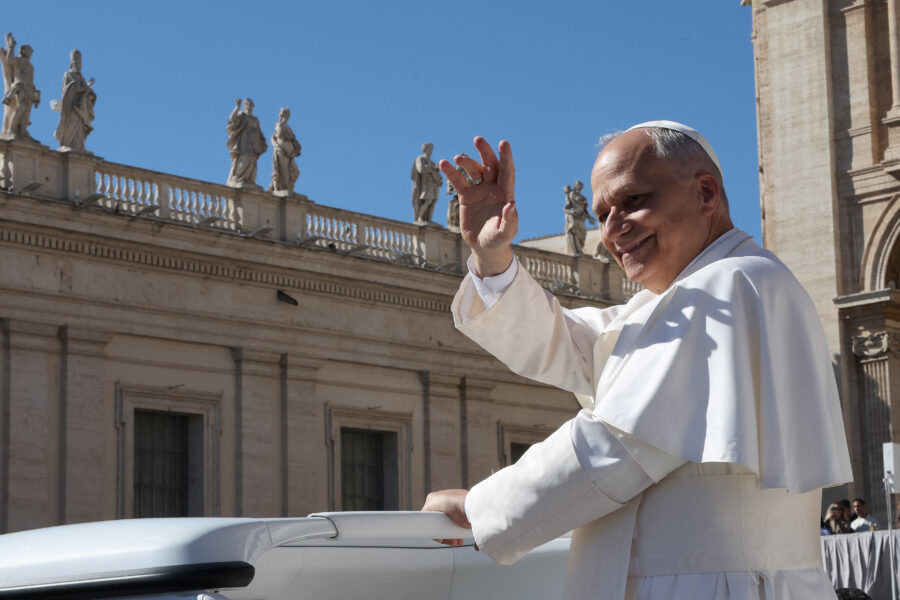
Pope Leo XIV centered his catechesis at the general audience this Wednesday on the universal vocation to holiness, recalling that it is not an ideal reserved for a few, but a call directed to all the baptized. In his reflection on the constitution Lumen gentium of the Second Vatican Council, the Pontiff emphasized that holiness consists in living charity and conforming to Christ in everyday life.
During the audience held in St. Peter’s Square, the Pope also made an appeal amid the tension in the Middle East, inviting to accompany with prayer the ongoing diplomatic efforts, and renewed the call for a prayer vigil for peace scheduled for next April 11 in the Vatican basilica.
We leave below the full message from Leo XIV:
Dear brothers and sisters, good morning and welcome!
The Constitution of the Second Vatican Council Lumen gentium (LG) on the Church dedicates an entire chapter, the fifth, to the universal vocation to holiness of all the faithful: each one of us is called to live in the grace of God, practicing the virtues and conforming to Christ. Holiness, according to the conciliar Constitution, is not a privilege for a few, but a gift that commits every baptized person to strive for the perfection of charity, that is, to the fullness of love toward God and neighbor. Charity is, in fact, the heart of the holiness to which all believers are called: infused by the Father, through the Son Jesus, this virtue «governs all the means of sanctification, informs them, and leads them to their end» (LG, 42). The highest level of holiness, as at the origin of the Church, is martyrdom, the «supreme witness of faith and charity» (LG, 50): for this reason, the conciliar text teaches that every believer must be ready to confess Christ even to the shedding of blood (cf. LG, 42), as has always happened and continues to happen today. This readiness for witness becomes a reality every time Christians leave signs of faith and love in society, committing themselves to justice.
All the sacraments, especially the Eucharist, are nourishment that makes a holy life grow, assimilating each person to Christ, the model and measure of holiness. He sanctifies the Church, of which He is Head and Shepherd: holiness is, in this perspective, a gift of His, which manifests itself in our everyday life every time we welcome Him with joy and respond to Him with commitment. In this regard, Saint Paul VI, in the general audience of October 20, 1965, recalled that the Church, to be authentic, wants all the baptized to «be saints, that is, truly worthy, strong, and faithful children of hers». This is realized as an interior transformation, by which each person’s life conforms to Christ through the power of the Holy Spirit (cf. Rm 8,29; LG, 40).
The Lumen gentium describes the holiness of the Catholic Church as one of its constitutive characteristics, which must be welcomed in faith, insofar as it is believed to be «indefectibly holy» (LG, 39): this does not mean that it is so in a full and perfect way, but that it is called to confirm this divine gift during its pilgrimage toward the eternal goal, walking «amid the persecutions of the world and the consolations of God» (S. Augustine, De civ. Dei 51,2; LG, 8).
The sad reality of sin in the Church, that is, in all of us, invites each one to undertake a serious change of life, entrusting ourselves to the Lord, who renews us in charity. Precisely this infinite grace, which sanctifies the Church, entrusts us with a mission that we must fulfill day by day: that of our conversion. For this reason, holiness has not only a practical nature, as if it could be reduced to an ethical commitment, however great, but concerns the very essence of Christian life, personal and communal.
In this perspective, a decisive role is assumed by consecrated life, which is addressed in the sixth chapter of the conciliar Constitution (cf. nn. 43-47). In the holy people of God, this constitutes a prophetic sign of the new world, experienced in the here and now of history. In fact, signs of the Kingdom of God, already present in the mystery of the Church, are those evangelical counsels that shape every experience of consecrated life: poverty, chastity, and obedience. These three virtues are not prescriptions that chain freedom, but liberating gifts of the Holy Spirit, through which some of the faithful consecrate themselves totally to God. Poverty expresses full surrender to Providence, freeing from calculation and self-interest; obedience has as its model the self-giving that Christ made to the Father, freeing from distrust and domination; chastity is the giving of an integral and pure heart in love, at the service of God and the Church.
By conforming to this way of life, consecrated persons give witness to the universal vocation to holiness in the entire Church, in the form of a radical following. The evangelical counsels manifest full participation in the life of Christ, even to the cross: it is precisely through the sacrifice of the Crucified One that we are all redeemed and sanctified! Contemplating this event, we know that there is no human experience that God does not redeem: even suffering, lived in union with the Lord’s passion, becomes a path to holiness. The grace that converts and transforms life thus strengthens us in every trial, pointing to our goal not a distant ideal, but the encounter with God, who became man out of love. May the Virgin Mary, all-holy Mother of the Incarnate Word, always sustain and protect our journey.