


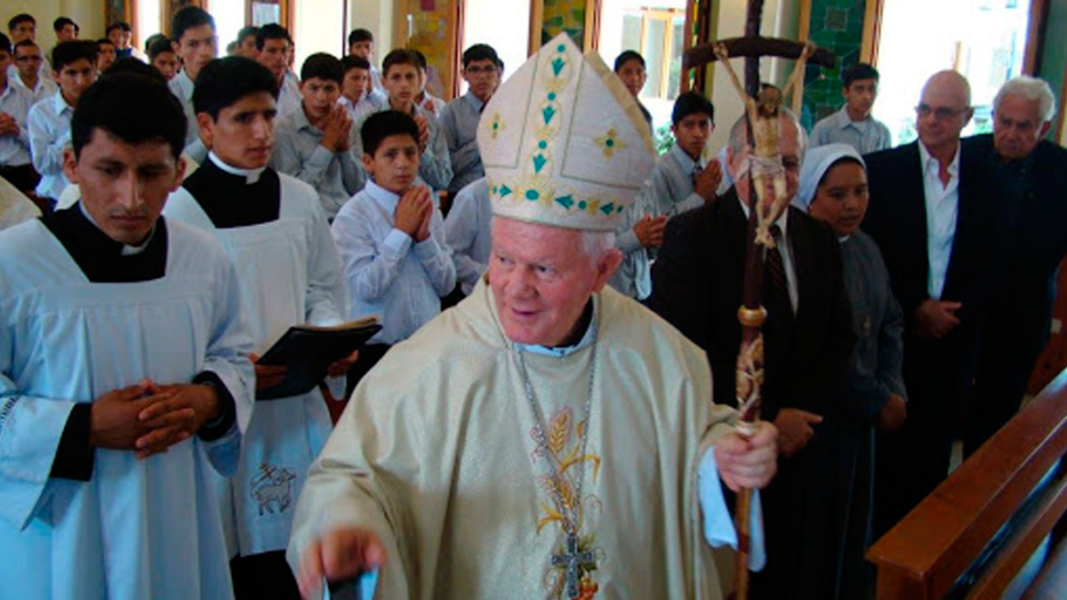
InfoVaticana has had exclusive access to a notarized letter dated March 26, 2026, duly certified and hand-delivered to the Apostolic Nunciature in Lima on the 31st of the same month, which contains a formal complaint against Mons. Antonio Santarsiero Rosa, OSJ, general secretary of the Peruvian Episcopal Conference and bishop of the diocese of Huacho, for alleged systematic sexual abuses and psychological mistreatment of persons under his authority.
According to the documentation consulted by this medium, the file has been simultaneously forwarded to the apostolic nuncio in Peru, Paolo Rocco Gualtieri, and to Cardinal Víctor Manuel Fernández, prefect of the Dicastery for the Doctrine of the Faith. Part of these same events, always according to the dossier and the testimonies incorporated into it, had already been brought to the attention of Vatican authorities in 2024 and 2025. To date, no public response from Rome or statement from the accused bishop is on record.
The case affects one of the most relevant positions in the Peruvian episcopal structure and raises questions not only about the conduct attributed to the prelate, but also about the reaction—or lack thereof—on the part of the competent ecclesiastical authorities.
A formal complaint with two main testimonies
The main complaint comes from a young layman—whom we will identify as D. to preserve his privacy—, now around thirty years old, from a rural area in the northeastern highlands of Peru and from a humble and large family. His testimony describes an alleged escalation of abuses that, according to his account, began when he was a minor, shortly after entering the minor seminary of the diocese of Huacho, and continued for several years.
According to the complaint, the reported events include forced hugs, genital touching, and pressure mechanisms linked to promises of scholarships and employment in diocesan companies. The legal representation of the victims maintains that, if these facts are confirmed, they could fit into some of the most serious offenses contemplated by current canonical penal law regarding abuses committed by clerics against minors.
The profile described in the documentation is that of a particularly vulnerable person: young, poor, moved far from his family environment, and in a situation of economic, emotional, and institutional dependence on the bishop. According to the account provided, that position of authority would have been used to access him repeatedly.
“I felt very uncomfortable. He would hold me by the waist, touch me (…) It was traumatizing. I couldn’t understand how a person admired and revered by so many people could do those things.”
— Testimony of D., declaring victim
The dossier also includes the testimony of a priest—whom we will call Fr. B.—, currently residing outside Peru, who lived with Santarsiero Rosa for several months as a personal assistant in the early years of his episcopate. In his statement, the priest describes a pattern of alleged psychological manipulation, non-consensual caresses, sexually explicit behaviors, internal defamation, and progressive reprisals when he resisted the bishop’s advances.
According to his testimony, the prelate himself would have repeatedly labeled him as homosexual as an instrument of pressure and control, going so far as to use that attribution to obstruct or delay his priestly ordination.
Media anonymity, but not legal
The decision of both persons to maintain public anonymity in this phase does not stem, according to their representatives, from a lack of willingness to report, but from fear of reprisals in an ecclesial environment that they consider hostile toward those who accuse members of the hierarchy.
One of the victims claims that in Peru there are hardly any independent canonists willing to represent complainants in cases against clergy members and that those who try face pressures or reprisals.
Denouncing a bishop in a context of strong institutional, economic, and pastoral dependence has a personal and professional cost that very few are willing to assume openly, especially in small or peripheral dioceses.
Communications sent to Rome
One of the most delicate elements of the case is that, according to the file and the incorporated testimonies, the Vatican authorities would have been informed beforehand.
Fr. B. claims to have sent a personal report in November 2024 to the then-prefect of the Dicastery for Bishops, Cardinal Robert Prevost, now Pope Leo XIV. Months later, always according to his testimony, he traveled personally to Rome and delivered the same report to the Holy Father’s office in December 2025. He assures that to date he has received no response. Santarsiero was received in June along with the bishops of Peru by Leo XIV.
“Our Pope Leo XIV states that it is important to listen to victims of sexual abuse. I, humbly, ask His Holiness: when will the day come when He has to listen to me? How many more years must I wait?”
— Fr. B., presbyter, 2026
The relevance of this point lies not only in the eventual receipt of the documents, but in the absence of a known response or action that has come to light. InfoVaticana has not obtained confirmation of the opening of a formal canonical investigation related to these events.
Internal coherence and plausibility of the dossier
The anonymity of the priest and the other victim does not in itself detract from the value of their statement. The two testimonies present a detailed narrative in time, space, and form, and include specific references to people, places, and institutions of the diocese of Huacho. This medium has not been able to independently verify the entirety of the allegations, but it has been able to speak with some of those involved and confirm that the dossier contains extensive, signed accounts accompanied by documentation sent to ecclesiastical authorities.
One of the elements that gives the most weight to the file is the existence of two accounts from different people, in different roles and positions, who independently describe similar patterns of behavior attributed to the same prelate in different contexts.
Therefore, it is not a isolated accusation based solely on rumors or indirect references, but a set of consistent testimonies whose veracity must be investigated and determined by the competent instances.
A small diocese, concentrated power
Huacho is a diocese with little media visibility, limited external oversight mechanisms, and an internal structure in which the bishop exercises very broad power. That context, according to various analyses on institutional abuse in closed environments, can favor dynamics of silence, dependence, and lack of effective control.
Santarsiero Rosa, of Italian origin, has directed this ecclesiastical jurisdiction for years and also holds a position of maximum relevance within the Peruvian episcopate. That dual condition—local power and national institutional weight—adds gravity to the accusations and to the need for a quick and credible clarification.
In addition, according to the victims and their representatives, there is a parallel civil judicial file in the mixed court of Oyón that would investigate a priest from the same diocese for alleged sexual violence against a minor. The same sources claim that Bishop Santarsiero would be actively covering up that case.
The questions Rome must answer
InfoVaticana has contacted the Dicastery for the Doctrine of the Faith to obtain its version of the events, without receiving a response by the close of this edition. Mons. Santarsiero Rosa has also been contacted by this medium and has not submitted any statement.
The case raises questions that go beyond the individual responsibility of the accused bishop. If the Vatican authorities received documented communications in 2024 and 2025, what follow-up was given to those complaints? Was any prior investigation opened? Were the alleged victims heard? Were the mechanisms provided for by current canonical regulations activated?
The answers are especially relevant at a time when the Holy See insists repeatedly on the need to listen to victims and act diligently in the face of abuse complaints.
In the absence of official explanations, the people who claim to have reported these events affirm that they continue to wait, in some cases for years, for a response that never came.
RESPONSE RECEIVED FROM BISHOP SANTARSIERO
1.- I have received through your communication the news of the existence of a notarized letter, delivered on March 31, 2026, in which I am pointed out as the alleged author of serious conduct. I want to state that, up to this moment, I have not received said letter nor have I been officially notified of such an accusation. It is through you that I become aware of this document and of the accusations alleged against me.
2.- In this circumstance, I find myself unable to offer a response to the aforementioned accusations since without concrete information, I cannot exercise a precise defense nor respond to the imputations referred to.
3.- Nevertheless, I categorically deny the conduct attributed to me, the accusations of sexual abuse and psychological mistreatment that you indicate in your communication, since these totally contradict my trajectory and principles as a priest and bishop, in which I have always acted with rectitude, respect, and pastoral commitment.
4.- I believe that any attack against a person must be made known at the time, and in this regard I have had no claim, much less for misconduct that I am unaware of.
5.- I kindly request, if possible, that you send me a copy of the documentation of said notarized letter, so that I can take note and take legal action, if applicable.