


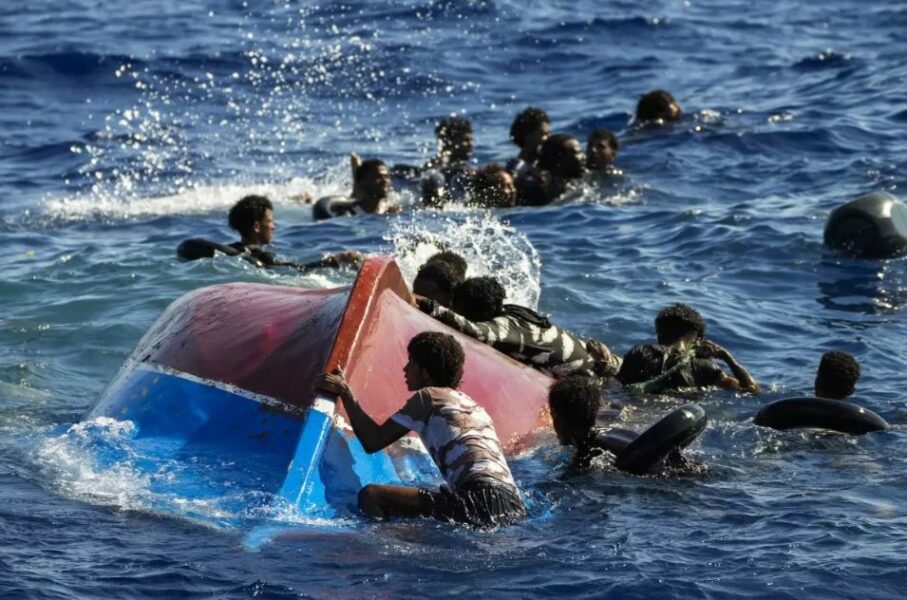
At least two people have died and more than 70 remain missing after the shipwreck of a migrant vessel in the central Mediterranean during Easter night, off the coast of Libya. The incident, far from being exceptional, once again highlights the persistence of illegal routes marked by extreme risk and sustained to a large extent by dynamics that continue to push thousands of people to undertake these journeys, as reported by Vatican News.
A route marked by death and deception
The vessel, a wooden boat about 12 to 15 meters long, had departed from the vicinity of Trípoli with migrants from Pakistan, Bangladesh, and Egypt. After about 15 hours of navigation, the poor sea conditions caused water leaks that eventually led to the boat capsizing.
A total of 32 people were rescued, while more than 70 remain missing. The shipwreck occurred in a search and rescue area under Libyan control.
This type of episode repeats frequently in the central Mediterranean, which has become one of the deadliest routes in the world for years. Behind each journey operate networks that organize departures in precarious conditions, taking advantage of the desperation of those seeking to reach Europe.
Between tragedy and narrative
Reactions have not been long in coming. The president of the Migrants Foundation, Monsignor Carlo Perego, spoke of an “Easter of death,” while the Sant’Egidio Community has called for intensifying rescue operations.
However, alongside these appeals, the underlying debate remains open. The repetition of tragedies like the one that occurred on Easter raises questions about how this phenomenon is presented. On not a few occasions, the focus shifts to arrival or rescue, while the reality of routes dominated by abuse, violence, and death takes a backseat.
That way of narrating the phenomenon, centered on the final destination, risks diluting the severity of the journey and conveying, even indirectly, the idea that the trip is manageable or even justifiable.
A toll that continues to rise
According to the International Organization for Migration (IOM), at least 900 migrants have died so far in 2026 in the central Mediterranean, a figure that confirms the continuity of this crisis despite the reduction in arrivals.
The data reflects a persistent reality: thousands of people continue to embark on routes where the probability of death is high, in many cases encouraged by criminal networks that turn these crossings into a business.
The background of the “pull effect”
In this context, the messages or approaches with which these facts are addressed or interpreted can contribute to reinforcing what is known as the “pull effect.” It is not only about specific policies, but also about the perception generated around these routes.
Read also: The “pull effect” and the romanticization of migration routes
When the point of arrival is presented as an accessible horizon and the journey takes a backseat, a powerful incentive is created for those who are still at the origin or in transit. That expectation, added to the action of mafias, fuels a cycle that repeats with dramatic consequences.
The challenge, therefore, is not limited to the immediate response to each shipwreck, but requires addressing with realism the dynamics that sustain these routes.