


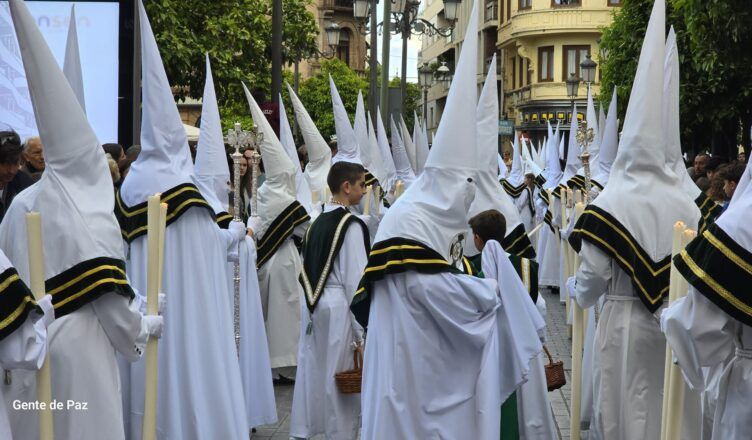
The Ministry of Equality has decided to extend its actions on various Spanish brotherhoods following the Sagunto case (Valencia), where a brotherhood chose to maintain its traditional statutes after an internal vote. According to various media reports, the Institute of Women has sent new requirements to three brotherhoods—two in Córdoba and one in Albacete—to review their participation rules, in an initiative that confirms a change in scale in institutional intervention on these realities.
From a specific case to a line of action
What happened in Sagunto has not remained an isolated episode. That conflict, which arose after a brotherhood refused to modify its internal rules on women’s participation, has served as a starting point for broader oversight. From there, the focus has shifted to other brotherhoods where similar rules exist, outlining a line of action that is increasingly defined by the Executive.
In this context, individual complaints—three in this case—act as a trigger, but the scope of the response points to a more general objective: reviewing the internal functioning of brotherhoods in light of the equality criteria promoted by the Government.
The highlighted cases: Córdoba and Albacete
This movement is now materializing in several brotherhoods. According to Equality, in Córdoba, the Nuestra Señora de los Dolores brotherhood has been questioned for not allowing women to participate as costaleras or the existence of mixed groups. In the same province, in Aguilar de la Frontera, the Hermandad del Santo Sepulcro limits female presence to a reduced number and without access to the same rights as men.
In parallel, in Albacete, the Cofradía del Silencio y Santo Vía Crucis has been singled out for requiring a minimum height of 1.70 meters for costaleros, a criterion that, according to the Ministry, could imply indirect discrimination.
Although each case presents its particularities, they all share a common denominator: the existence of internal rules that respond to their own tradition and that are now subject to review from external instances.
The fit between law and tradition
The Institute of Women bases its actions on current legislation, reminding that all associations must respect the principle of equality. However, this direct application of the norm becomes a demand on entities that do not arise as administrative structures, but as expressions of popular religiosity with centuries of history.
To what extent can a uniform criterion be applied to realities that have been shaped by different logics, often linked to traditions, symbolism, and their own forms of organization?
The Sagunto precedent and its consequences
The Sagunto case also introduces a new element that conditions the entire debate. The Government’s decision to initiate proceedings to withdraw the National Tourist Interest declaration from its Holy Week has added a component of pressure that transcends the merely legal.
It is no longer just about formal requirements, but about the possibility that public recognition—with its social and economic implications—depends on the brotherhoods’ adaptation to certain criteria. This precedent projects its effects on the rest of the brotherhoods, which observe how internal decisions can end up having relevant external consequences.
The issue is no longer limited to who can or cannot participate in a procession, but to the real margin these associations have to maintain their rules without being forced to reinterpret them under parameters alien to their tradition.