


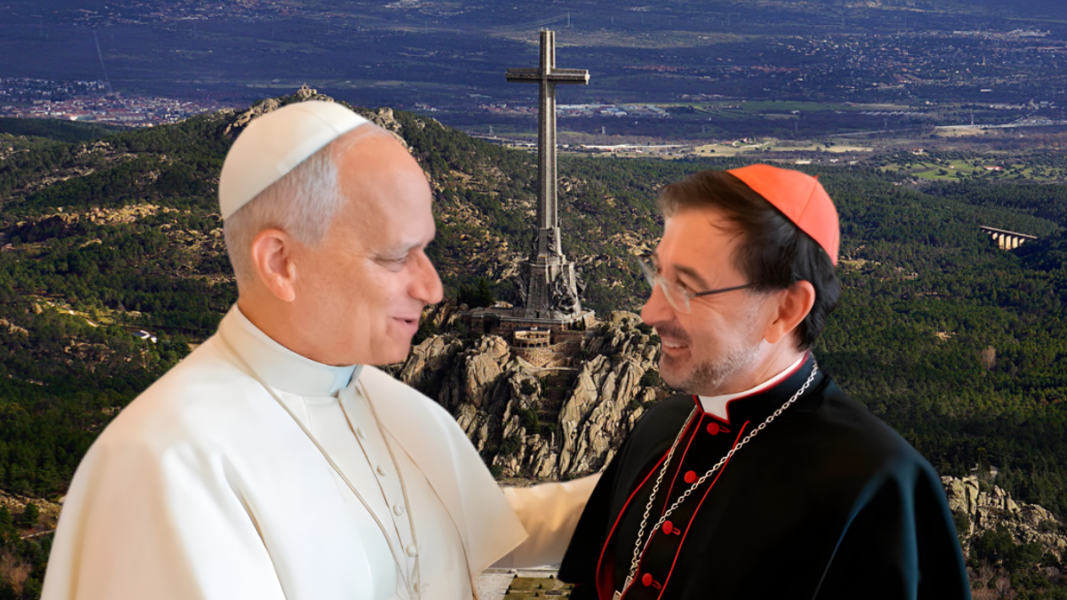
The visit of Leo XIV to Spain, scheduled from June 6 to 12, continues without a detailed official itinerary finalized beyond the fixed destinations in Madrid, Barcelona, and the Canary Islands. This is why data and speculations continue to circulate about possible destinations or places that would like to receive the Pope, but also about those that would have been left out of the route.
In this context, the information published by Artículo14 stands out—which, amid assessments on various matters—introduces an element that has not been covered so far by other media: the possibility that a visit to the El Escorial monastery was considered in a first draft of the trip, but ultimately discarded due to its proximity to the Valley of the Fallen.
A draft that points to the Valley
According to the disseminated information, which claims real sources, the stop at El Escorial—a monastery of deep historical and religious significance, visited in its day by Benedict XVI—would have been evaluated in an initial planning phase. However, its proximity to the Valley of the Fallen would have weighed in the decision to discard it.
Although there is no official confirmation and the Holy See has expressly requested prudence regarding unclosed itineraries, the data is significant insofar as it suggests that the environment of the Valley might be conditioning, even indirectly, decisions related to the papal trip.
In contrast, the inclusion of the Canary Islands in the itinerary, in line with the desire expressed by Francis, seems to have been assumed without difficulty in a context in which the Government is promoting the mass regularization of illegals with episcopal support.
The Valley, a sensitive point
The Valley of the Fallen, where the pontifical basilica of the Holy Cross and a Benedictine community with established liturgical life are located, has become one of the main points of tension between the Government and the Church in Spain.
The “re-signification” process promoted by the Executive is not perceived as a merely cultural intervention, but as an operation with direct implications on a place of worship. Added to this is a particularly controversial element: the agreement signed by the Archbishop of Madrid, Cardinal José Cobo, which would allow limiting the liturgical use of the basilica to a specific part of the temple, leaving the rest of the space open to museographic interventions.
Also read: For the love of truth: ten questions to Cardinal Cobo about the Valley of the Fallen
According to Canon Law, a consecrated temple cannot be fragmented into “sacred” and “non-sacred” zones, since its dedication affects the entirety of the precinct. The very consecration of the basilica involved the integral blessing of the space, not only of the altar, but of its walls and the entire architectural ensemble.
The liturgical tradition of the Church is unequivocal: the sacrality of a temple is not limited to a part, but encompasses its totality. Attempting to reduce religious use to a specific area while the rest is destined for unrelated purposes implies, in practice, altering its nature.
An issue that transcends the logistical
Beyond the concrete veracity of this draft, the fact that a visit to a site like El Escorial could be conditioned by its proximity to a pontifical basilica like that of the Holy Cross raises a lamentable scenario.
The role of the Archbishop of Madrid, Cardinal José Cobo, is decisive. The agreement signed with the Government within the framework of the “re-signification” process has been interpreted as an ecclesiastical endorsement of an intervention on the basilica that affects its integrity as a sacred place and consolidates a scenario in which the Valley of the Fallen appears as a point of tension that is sought to be avoided, and not only that, but that sites like El Escorial—of undeniable historical and spiritual relevance—may be left out of the papal route due to proximity to a territory that is now censored.