


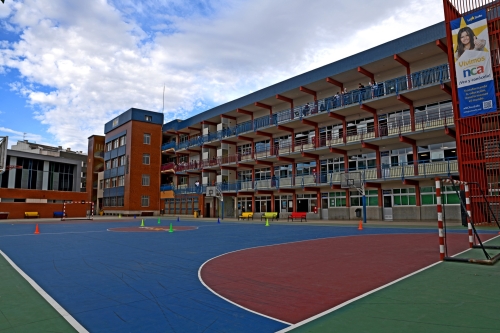
The La Salle ARLEP School, a Catholic identity educational center in Benicarló (Castellón), hosted on April 2 the so-called “Commemoration of the Death of Christ”, the annual event of Jehovah’s Witnesses in which they remember the death of Jesus Christ from doctrinal postulates incompatible with the Catholic faith.
A recurrent event in a Catholic space
This is not an isolated incident. As has been verified, this type of event has already been held on other occasions in the same space, which reinforces the concern over the repeated lending of Catholic facilities to groups that deny essential elements of Christianity.
Jehovah’s Witnesses reject central truths such as the divinity of Christ, the Most Holy Trinity, or the sacramental nature of the Church. Their doctrine, therefore, lies outside the Catholic faith, making it difficult to justify Catholic educational centers hosting their celebrations.
What Jehovah’s Witnesses celebrate at Easter
Unlike the Catholic Church, Jehovah’s Witnesses do not celebrate Easter Sunday or the Resurrection of Christ as a solemnity. They consider that these celebrations have no biblical basis and that many of their customs are linked to human traditions alien to Christianity.
Instead, they center their religious practice on the so-called “Commemoration of the Death of Christ”, the only annual event they consider mandated by Jesus, in reference to the words of the Gospel: “Do this in memory of me” (cf. Lk 22:19-20). This commemoration is held each year according to the lunar calendar that, according to their interpretation, coincides with the date of Christ’s death.
From their perspective, the practices associated with Easter Sunday—including those of a cultural nature—do not have divine approval, as they consider them influenced by traditions external to primitive Christianity. For this reason, they reject their celebration and defend a religious practice based exclusively on what they interpret as a biblical mandate.
A concession that generates confusion
The issue goes beyond a simple rental of spaces. Allowing this type of event in facilities linked to the Church contributes to generating confusion among the faithful and transmits an image of normality that does not correspond to doctrinal reality.
Catholic institutions are called to safeguard their identity and avoid any practice that could dilute it. Lending their spaces to groups that hold teachings contrary to the faith does not favor dialogue, but rather introduces ambiguity where there should be clarity.