


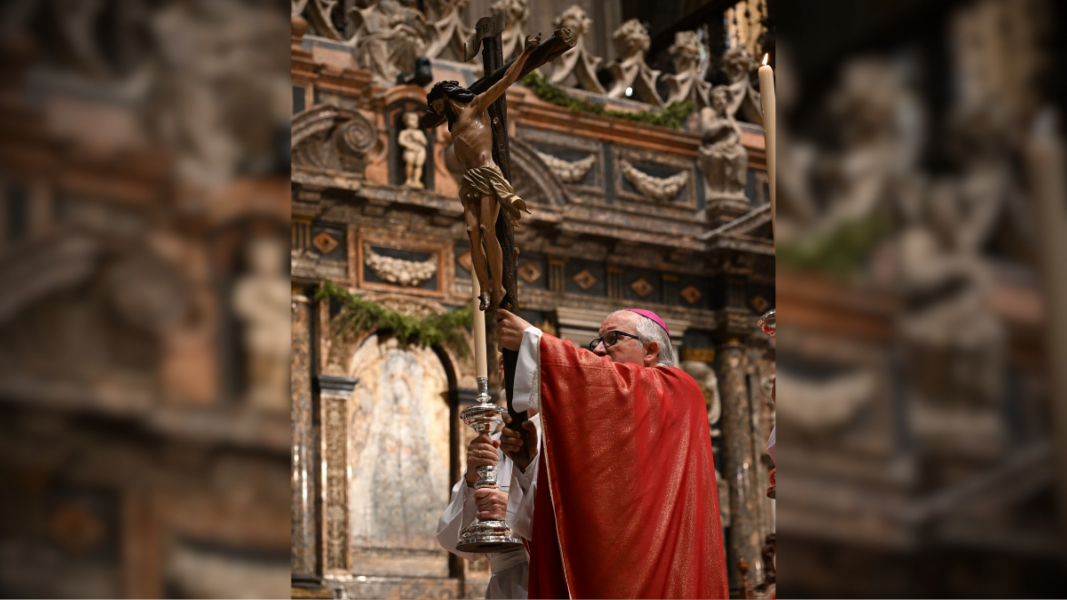
The recent Holy Week left us the memory of some liturgical traditions that, although common in the Church for centuries, are now preserved in very few places. Among them stands out the sung proclamation of the Passion of Christ, one of the oldest and most solemn practices of Good Friday, which still survives in a few temples such as the Cathedral of Seville.
According to the Archdiocese of Seville, this practice—reserved for the celebration of the Lord’s Passion—not only possesses profound religious value, but also constitutes a historical and musical heritage of great richness. The former master of the chapel of the Cathedral of Seville, Herminio González Barrionuevo, analyzed this tradition and proposed improvements to recover a more faithful and expressive interpretation of the sacred text, in line with the technical study he has dedicated to the singing of the Passion 0.
A tradition with centuries of history
The singing of the Passion has its roots in the Middle Ages. Before the liturgical unification promoted by Rome, in Spain different modes of interpretation coexisted, including the Roman tone and the Hispanic one. At the local level, unique variants developed such as the Aragonese tradition, documented from the 13th century, and the Castilian-Toledan one, which emerged in the 15th century.
In the Cathedral of Seville, this latter tradition became established from the 16th century onward, applied to the parts of the narrator and of Christ. The people’s interventions—the so-called turbas—were performed in polyphony, with compositions by the master Francisco Guerrero preserved in the cathedral’s musical archive. This practice endured for centuries, at least until the 19th century.
From the single voice to choral development
In its origins, the Passion was sung by a single deacon, as recorded in the ancient liturgical texts. However, as early as the 9th century, precise indications appear to differentiate the voices of the different characters through variations in tone, rhythm, and intensity.
Over time, especially between the 14th and 15th centuries, the interpretation in three voices became generalized: one for Christ, another for the narrator, and a third for the other interlocutors. Later, the choir’s interventions were incorporated to represent the people, enriching the dramatic and liturgical dimension of the singing.
The purpose of the singing: to serve the word
From a musical point of view, the so-called tonus passionis belongs to the Gregorian repertoire and is characterized by its recited form. It does not seek melodic display, but rather the clear and solemn proclamation of the sacred text.
As González Barrionuevo emphasizes, this type of singing does not aim to superficially embellish the text, but to amplify it, give it body, and facilitate its understanding. Cantillation, situated between declamation and singing, allows the word to achieve greater expressive force and to be perceived with greater depth by the faithful 1.
In this sense, the liturgical tradition has always insisted that music is not an end in itself, but an instrument in the service of the word, which is the true protagonist of the celebration.
Changes after the Council and loss of the practice
The liturgical reform following the Second Vatican Council introduced the use of vernacular languages, which also affected the singing of the Passion. However, far from strengthening its practice, in many places this adaptation contributed to its progressive disappearance.
Today, there are few temples in Spain where this tradition is maintained, even in Spanish. In the Cathedral of Seville, however, the sung proclamation of the Passion according to Saint John has been preserved, using a melodic adaptation based on the traditional Latin model.
Nevertheless, González Barrionuevo himself warns that some of these versions present technical deficiencies, especially in the relationship between text and melody, making a review necessary that respects the proper laws of liturgical cantillation.
A heritage that calls to be recovered
The studies of the chapel master insist on the importance of preserving this tradition, not only as a historical legacy, but as a living expression of the liturgy. The singing of the Passion once again highlighted during Good Friday that liturgical music was born to serve the word and to make the central core of the Christian faith resonate with greater depth.
Its progressive disappearance in many temples reflects a broader loss of the sense of the liturgy and its traditional richness. Recovering this practice is not only an aesthetic or musical issue, but a necessity to restore to the celebration its depth, its dignity, and its capacity to transmit integrally the mystery of the Passion of Christ.