


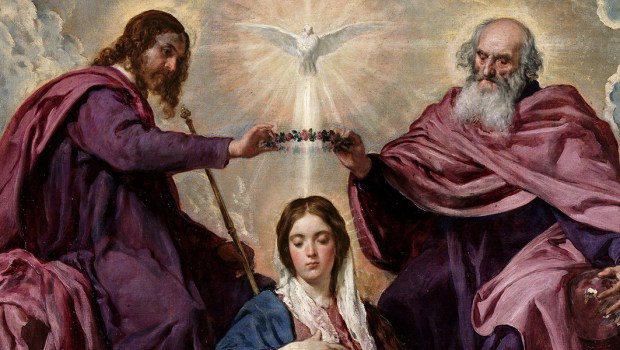
The idea of Mary’s universal mediation constitutes an important element of the MV. It comprises two aspects: on the one hand, Mary’s historical participation in the Incarnation and in the redemptive work of her Son Jesus Christ on the cross, insofar as, through her faith and her following, she freely accepted on behalf of humanity God’s redemptive grace for all men; and on the other, her current intercession before the exalted Lord, in which she implores for each man God’s actual graces, that is, by sustaining and manifesting through her prayer the free acceptance of grace in the personal act of the one praying, in solidarity with other men. Since actual graces cannot be interpreted as an addition to God’s unique historical self-communication, but only as its effect in the plurality of realizations of human life, the two mentioned aspects should not be formally separated.
Biblical indications: In his Word made flesh, God is the subject of the historical-eschatological realization of salvation. For this reason, the Son of God, Jesus Christ, is called the only mediator between God and men (1 Tim 2,5; Heb 8,15; 1 Jn 2,1 ss.), insofar as in his human nature he encompasses all men and introduces them historically and currently into immediacy with God. It is a personal-dialogical unity of love, in which God is the origin and content of salvation, but to which, on the part of man, belongs the creaturely form of acceptance sustained by grace. The grace of God in Jesus Christ therefore implies the response of freedom sustained by it, but not annulled. In the act of the Incarnation, in which God wants to give himself to humanity as universal salvation, Mary’s freedom is empowered for the believing surrender of herself. And in the unity of grace and freedom, she is the virginal mediator. In the structure of redemption, therefore, the “yes” of Mary sustained by the Holy Spirit enters as an internal moment of it. The fact that Mary is “full of grace” finds its correspondence in the fullness of her faith (cf. Lc 1,28.38). She belongs entirely to the side of Christ, not in the sense that she supports him in his work, but insofar as in her the full resonance of grace in the creature becomes visible. For this reason, she also represents humanity that receives grace, insofar as she distributes what she has received, since to each one his gift of grace is given for the benefit of others (cf. 1 Cor 12,7). However, Mary’s union with Jesus is not limited to birth. Mary is intimately united to the suffering of Jesus (cf. Lc 2,35) and to the beginning and end of the manifestation of the divine glory of Jesus, both in the wedding at Cana (Jn 1,11) and in his death on the cross (Jn 19,25). Furthermore, Mary is united to the event of the coming of the Holy Spirit upon the nascent Church, which had been definitively configured through the encounter with the Risen Lord (cf. Hch 1,14).
In general, it can be said that, in the New Testament understanding, the intercession of the members of the Church for one another plays an important role. It does not limit the action of Christ in his Church, but rather unfolds it in ecclesial coexistence and shows the responsibility of each one for the brothers and for the common destiny of the Church. Thus, Paul hopes that through his prayer the Jews will be saved (Rom 10,1). The community must pray for the apostle so that the word may spread (2 Tes 3,1) and a door may be opened for the word (Col 4,3). In prayer for one another (Hch 8,24; Ef 6,18; Heb 13,18) the communion of the Church in Christ is deepened (2 Cor 9,14) and thanksgiving to God is multiplied (Rom 1,9; 2 Cor 1,1; 1 Tes 1,2; Flp 4,22; Ef 1,15; Col 1,3.9). The prayer of intercession does not obtain the grace of justification, but helps growth toward perfection in Christ (Col 4,12). For the prayer of the righteous, following the example of Elijah, has great efficacy if it is fervent (Sant 5,16). Indeed, Jesus is our advocate before the Father when one of the brothers has sinned, because He is the expiation for the sins of the whole world (1 Jn 2,1 ss.). But precisely through Him, who hears our prayers and has already granted in advance our petitions conformed to his will, Christians are exhorted to pray for the brother whose sin is not unto death. Because of the prayer of intercession, God will give the sinner the life of the Son and the Father (1 Jn 5,16). For he who brings back the brother who has strayed from the truth performs a great service (Sant 5,19 ss.). Reciprocal service as administrators of the manifold grace of God is realized in perseverance in charity, which covers a multitude of sins (1 Pe 4,8 ss.; Sant 5,20) and leads the community to its fullness in God and in the brothers in eternal life.
In the period after the New Testament, this idea is expanded in mutual communion within the single path of salvation, including also the heavenly Church of the already glorified saints, for the deceased are not separated from the earthly Church, but rather, through their communion with the Risen Lord, are even more deeply united to it in love (cf. Rom 14,8 ss.; Heb 12,22-24; Ap 6,9-11).
Historical developments: Decisive for the formation of the idea of the Mediatrix was the antithesis Eve-Mary of the early patristic period (Justin, Dial. 100: PG 6,711; Tertullian, De carne Christi 17: CChr.SL 2,905). Just as Eve, mother of the human lineage, by her disobedience (unbelief) became the cause of ruin for herself and for humanity, so Mary, by her faith (obedience), in welcoming God as grace made man into her body and soul and carrying him in her womb, became the cause of salvation for herself and for the new humanity in Christ (Irenaeus, Adv. haer. III,22,4: Harvey 2,123). This vision, according to which death came through Eve and life through Mary, remained determinative also for later patristics, which understood Mary as the mother of the living (in Christ) (Epiphanius of Salamis, Panarion III, haer. 78,18: PG 42,728 ss.; cf. Cyril of Jerusalem, Cat. 12,5,15: PG 33,741; Jerome, Ep. 22,21: PL 22,408; John Chrysostom, Hom. in S. Pascha 2: PG 52,768; idem, Expos. in Ps 44,7: PG 55,193; Augustine, De agone Christ. 23: PL 40,303; Peter Chrysologus, Sermo 140: PL 3,576; Bede the Venerable, Homil. 1 and 2: PL 94,9 and 16). A deeper development of this thought is the expression of Mary’s role through the concepts of cooperation (cooperatio) and mediation. For Augustine, Mary cooperated through her love in the birth of the faithful in the Church as members of the body whose head is Jesus Christ (De sancta virg. 6,6: PL 40,399). In this sense, Mary can be explicitly called universal mediator and dispenser (dispensatrix) of graces and cause of life (Andrew of Crete, In nat. Mariae: PG 97,813, 865, 1108; Germanus of Constantinople, In dormit. Deiparae hom. 5,2: PG 99,721). The numerous praises of Mary for the fullness of her graces in religious hymns must be taken into account. In the famous hymn “Akathistos” she is exalted as “bridge from earth to the kingdom of heaven” and as reconciliation of the whole world (cf. Meersemann I 100-127). In Paul the Deacon, the term Mediatrix applied to Mary appears for the first time. She is, as intercessor of sinners, “mediator between God and men” (PL 73,682; ActaSS Febr I 48 ss.).
Medieval theology remains fully in this line and attempts to understand with greater conceptual and linguistic depth Mary’s participation in the work of redemption. Special attention is paid to Mary’s consent to her inclusion in the event of the Incarnation. In this sense, the idea of Mary’s cooperation in redemption in the sense of co-redemption arises (cf. Fulbert of Chartres, Sermo 9: PL 141,336 ss.; Peter Damian, Sermo 45: PL 144,741,743; Sermo 11: PL 144,558). Anselm of Canterbury (Oratio 4-7: Schmitt III 13-25) affirms that all the gifts of God in Jesus Christ (reconciliation of the sinner, new life, preservation in the final judgment) have also come to us through Mary, who gave us Christ. He who sins against the Son also sins against the Mother. And he who, on the contrary, obtains the intercession of the Mother (ex opere operantis — and thus is reconciled with her), also obtains reconciliation with the Son. Here is the origin of the idea “through Mary to Jesus.” It is situated, therefore, on a different plane from the Trinitarian scheme of the prayer “through the Son in the Holy Spirit to the Father” and must not be confused with it as if it were a chain of successive instances (cf. Bernard of Clairvaux, Sermo 2 in assumpt. B.M.: Leclerq V 229; idem, Sermo 2 in die Pentecostes: Leclerq V 166 ss.; idem, In nat. B.M.: Leclerq V 275-288; Ep. 174: Leclerq VII 389: “Magnifica gratiae inventricem, mediatricem salutis, restauratricem saeculorum”).
The metaphor of Mary as bridge, aqueduct, or heavenly ladder of salvation becomes popular (in reference to the image of Jacob’s ladder: Gen 28,10-22; cf. Richard of St. Victor, In Cant. Cant. 26: PL 196,483; Adam of St. Victor, Seq. 25: PL 196,1502). The concept of Mary as cooperator (coadiutrix) and companion (socia) of Jesus in the work of salvation is developed by Albert the Great (Mariale: Op. Omn. 37,81), Bonaventure (Sermo 6 de annunt. B.M.: Opera Omnia 9,705), Bernardino of Siena (Sermo 7,1,3 in Fest. B.M.: Opera omnia 4, Paris 1635, 126), Antoninus of Florence (S. th. IV, tit. 15, cap. 14,2), Denis the Carthusian (De praeconio et dig. Mariae 3,25: Opera Omnia 35, Tournai 1908, 563), and Gabriel Biel (De festis B.M. v. 15, Brescia, 1583, 82). In Thomas Aquinas, there is a broad reflection on Mary’s role in the history of salvation. By virtue of the hypostatic union, Christ is the total cause of salvation in his redemptive work. By reason of his divinity, he is the sole subject of the divine saving action, but in his human nature, which he received from his Mother Mary, he is the created means assumed by God through which men are led to unity with God. Therefore, Christ is, in the hypostatic union, “principaliter et effective” the only and perfect mediator between men and God. But since his humanity is the means permanently sustained by the Logos, those who, by his grace, have become members of his body can become “cooperatores” in the union of men with God, although only “dispositive et ministerialiter.” They do not complement Christ’s mediation, but make it present in the historical and social dimension of the life of the Church (cf. S. th. III q. 26).
If, according to the Scholastic understanding, the juridical foundation of the efficacy of supplications directed to the saints resides in their merits, it must be added that the merits of the saints do not first provoke God’s grace and help for the supplicants, but rather, on the contrary, the merits are only effects of grace, that is, nothing other than its full realization in man’s free exercise (cf. S. th. I-II q. 114). In his universal saving providence, God could bind the distribution of many gifts to the intercession of the brothers, without calling into question his total causality with respect to the grace of reconciliation, so that the communion of all in salvation and in the path toward it might become visible (cf. S. th. II-II q.17 a.4; S.c. g. III, cap. 117). In the universal order of grace, God presupposes free acceptance on the part of the creature, because without free surrender grace would not be itself, that is, cause, means, and content of God’s union with the creature in the form of personal and dialogical love. Therefore, Mary’s “yes” enters originarily into the historical configuration of the event of redemption. Since her consent was pronounced on behalf of the entire human community (cf. S. th. III q. 30 a. 1), her saving solicitude for us, sustained by Christ and implicated in his mediation, has the character of a dispositive mediation of intercession with a universal dimension that extends to all men.
The current mediation of prayer is not realized through a always new intervention of Mary and the saints in heaven, but rather is more the permanent effect of love, insofar as their union with God in life and its consummation in death have acquired a definitive eternal actuality. Therefore, Mary, in perfect conformity with God’s universal saving will, herself wills the salvation of the pilgrim Church, which has been, so to speak, begotten as the ecclesial body of Jesus Christ from her “yes” (cf. Suppl., q. 72). Since Mary, as mediator, received the fullness of the graces that God has granted us in the humanity of Christ and offered them to the world in the event of birth, from her, so to speak, all grace passes to the Church (dispensatrix). By virtue of this singular union with the Incarnation, Mary surpasses all the saints and can be invoked as universal mediator of the prayer of all the members of the Church toward the Head, as well as, in the inverse sense, acts in the communication of grace from the Head to the members of the body of Christ—although in the sense of a receptive, instrumental, and dispositive mediation (cf. S. th. III q. 27 a. 5 ad 1).
The universal position of Mary as mediator of actual graces is expressed by theologians through various images. Bonaventure understands Mary as the door of heaven (Comment. in Luc 1,70; 2,37: Op. Omnia 7,27; 52). Interpreting the image of the mystical body, Mary is presented (although with a somewhat unfortunate comparison) as the neck between Christ as head and the faithful as body (Jacobus de Voragine, Bernardino of Siena). Despite the questionable nature of this image, the content it points to has largely become common heritage of theology (Gabriel Biel, Robert Bellarmine, Denis Petavius, Francisco Suárez, Jacques-Bénigne Bossuet). Finally, this thought has also been taken up in papal encyclicals (Leo XIII, enc. Jucunda semper, 1894; Pius X, enc. Ad diem illum, 1904; Benedict XV introduced the Mass and office of Mary Mediatrix of graces). However, the use of this idea in magisterial texts does not mean a dogmatization of the title of Mediatrix, much less in the sense of co-redemption. For pre-Vatican II theology, the alternative was posed between a more Christotypic vision (Mary on the side of Christ, the Head, vis-à-vis the Church) or a more ecclesiotypic one (Mary as eminent member of the Church, praying alongside Christ, the Head). In chapter 8 of the constitution on the Church, the Council attempts to situate Mary’s role historically and currently in the mystery of Christ and the Church. The equivocal title “co-redemptrix” is avoided, which in itself only seeks to express Mary’s universal activity as mediator. The Council confesses, beyond her function in the Incarnation and in the life of the historical Jesus, Mary’s motherhood for the Church, which endures in the historical and ecclesial economy of grace. Since she is intimately united to Christ (by virtue of her full redemption in the bodily assumption into heaven), she cares for the pilgrim Church through her intercession, which can invoke her under the titles of “advocate, helper, succor, mediator” (LG 62). However, this must not be affirmed in a univocal way with respect to mediation. Christ’s total mediation needs no complement, but includes within itself an analogous participation in it (for example, in the priesthood of the faithful or of ordained ministers), so that interpersonal mediations do not constitute an addition to Christ’s mediation, but its effects on the plane of the personal being-with of the members of the body of Christ. In this sense, a subordinate function corresponds to Mary, so that, through her cooperation—which springs from the source of Christ’s mediation—the faithful may unite more deeply with Him. Mary’s closest union with the person and work of Jesus Christ implies that she surpasses the current intercession of all the saints and, in this sense, can be called mother of all believers, who on their path to fullness recognize in her the model of man’s union with God in faith, hope, and charity (LG 65).
Ecumenical issues: The criticism of the invocation of the saints and the idea of Mary’s current universal mediation constitutes the main objection, formulated with extreme harshness by the Reformation, against Catholic Mariology and hagiography. Mary as mediator seems to contradict head-on the Reformed principle of God’s unique causality (solus Deus), of the unique mediation of justifying grace through Jesus Christ (solus Christus), and of the unique appropriation of grace through faith without meritorious cooperation of the creature (sola gratia). To “invoke” means to place the confidence of salvation solely in God and to expect from Him reconciliation, which has its foundation only in divine mercy and not in an action provoked by our merits or those of the saints. Therefore—according to Luther—Mary is turned into an idol (WA 30/11 348) when Christ is imagined as a severe judge before whom one must flee to Mary, considered more benign, so that, as intercessor, she may make him propitious and calm his wrath, thus preserving us in God’s judgment (WA 30/11 312; Apology of the Confession 21: BSLK 239; 319). Behind this criticism is the idea of a chain of instances, as if one reaches Christ through Mary and the Father through Christ, resorting first to Mary as more humanly close and capable of exerting greater influence on her Son. The decisive point is the supposed suppression of the soul’s immediate relationship with God through a mediating hierarchy of many saints. Catholic polemical theology, before and after the Council of Trent, rejected these objections as a misunderstanding and sought to demonstrate their consonance with the patristic and Scholastic tradition. Probably, both the Reformed criticism of late medieval practice and the Catholic defense start from common premises and only draw opposite conclusions. For current dialogue, it is necessary to situate the doctrine of the mediation of Mary and the saints not so much in Christology or soteriology, but in ecclesiology. It is about the structure of the God-man relationship and the historical and ecclesial mediation of the event of Christ. God’s forgiveness in Christ is not only a declaration, but a real encounter in history. God is the total cause of salvation, but in such a way that human freedom, through divine self-communication, reaches its realization in a personal and dialogical relationship with God. Therefore, the human reception of grace is part of the historical configuration of the mystery of salvation. Mary’s free “yes” is therefore consequence and expression of God’s self-communication as truth and grace. In this sense—and only in this—Mary can rightly be called “mediator of grace,” insofar as she expresses her solidarity with the salvation of all men. In the concrete life of the believer, this mediation can be lived with varying intensity. The Marian dogmas are part of the Church’s creed, and the liturgy celebrates her feasts, but always with doxological orientation toward God’s saving action in Christ. Devotion to Mary does not add anything from outside to Christ’s mediation, but proceeds from it and is sustained by it. Insofar as this mediation presupposes Mary’s free “yes,” the veneration is also directed toward her. This is expressed in the Magnificat: all generations will call her blessed. Likewise, Elizabeth proclaims her “mother of my Lord” (Lc 1,42 ss.). Mary’s mediation, in the service of that of her Son, cannot be denied in principle, although in personal life it may occupy a more or less prominent place; however, the experience of the Church shows that its emphasis favors and fructifies Christocentric piety. G. L. Cardinal Müller (January 2024)
Bibliography: H. M. Köster, De corredemptione mariana in theologia hodierna (1921-1958), in: Mar 24 (1962) 158-182. – H. Volk, Maria, Mutter der Gläubigen, 1964. – K. Rahner, Der eine Mittler u. die Vielfalt der Vermittlungen, in: Escritos de teología VIII, 1967, 218-235. – C. A. de Ridder, Maria als Miterlöserin, 1965. – G. Söll, Mariologie, in: HDG III/4, 1978. – A. Müller, Maria und die Erlösung, in: MySal III/2, 499-510. – Id., Glaubensrede über die Mutter Jesu, 1980, 115-135. – Beinert-Petri (1984) 232-439. – J. Galot, Maria, la donna nell’opera della salvezza, 1984, 239-292. – G. L. Müller, Gemeinschaft u. Verehrung der Heiligen, 1986. – Id., Marien- u. Heiligenverehrung, in: Cath(M) 40 (1986) 165-186. – DThC IX/2 2339-2474. – NDMar II 920-935. – H. M. Köster, Die Mittlerschaft Mariens, 51988. – J. Stöhr, in: Maria unsere Mutter, 1991, 23-93. – L. Scheffczyk, in: Scripta de Maria 8 (1985) 503-523. – M. Hauke, in: Brandenstein-Zeppelin (ed.), 2008, 19-50. – G. L. Müller, Mariologie, in: Kath. Dogmatik, 2016, 472-508. G. L. Müller / A. Dittrich
Revised version of the article “Mediatrix of Grace. I. Catholic Theology” by G. L. Müller, ML vol. IV (1992) pp. 487-493; with more recent bibliography. Published in Marienlexikon and on Infovaticana with the permission of its author.