


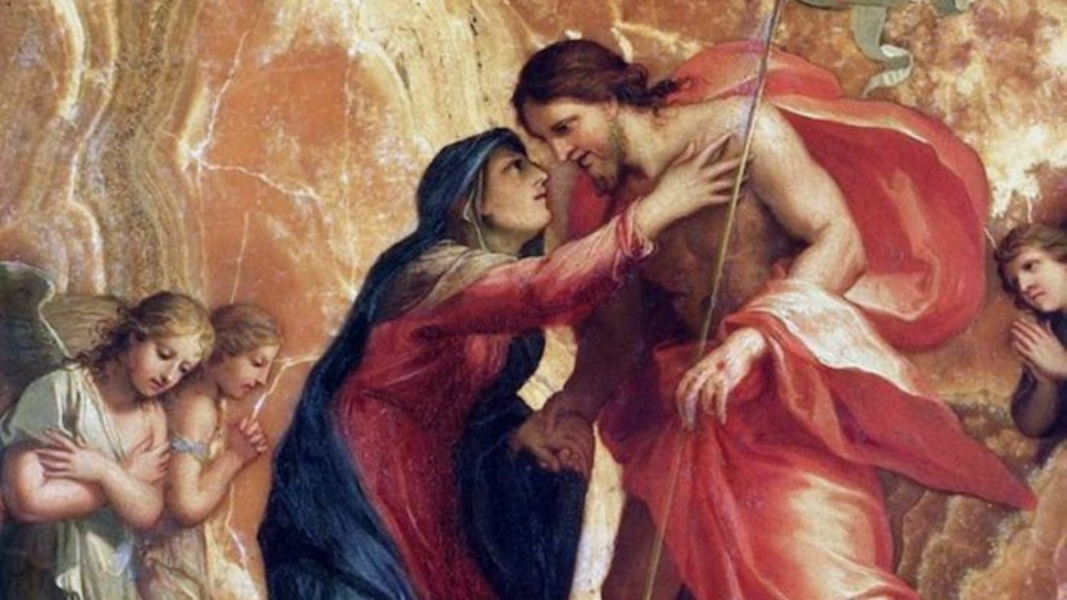
Certain silences in the Gospel are not absence but contained fullness; spaces where the silent Revelation invites the soul to delve deeper with faith and love. Perhaps the most delicate of all is that of Easter morning in relation to the Most Holy Virgin. If the Gospels tell us nothing of an encounter between the risen Christ and his Mother, the praying Church, the saints, have seen there a moment of ineffable density.
In one of her Accounts of Conscience, written in Salamanca in 1571, Teresa of Jesus writes: «He [Christ] told me that, upon rising, he had seen Our Lady, because she was already in great need; and that he had been with her for a long time, because it was necessary, until he consoled her». This is not an imaginative license from Teresa, so firm in discernment, so opposed to «silly devotions.» Her interior experience breathes truth and is not something isolated. The Vita Christi by Ludolph of Saxony, so widely read in the 16th century, already suggested that encounter. And, with his sober and contemplative piety, in his Spiritual Exercises Saint Ignatius of Loyola explicitly invites the exercitant to consider how Christ, risen, appears first to his Mother. Not as a historical assertion intended to supplement the Gospel, but as a key to deeply theological contemplation. It is not a matter of curiosity, but of the logic of love: if the Passion had in Mary its purest participation—standing by the cross when everything seemed to collapse—, how can we not think that the light of the Resurrection, which is the victory of Love, had in her its first reverberation? Where the pain was deepest, consolation must arrive first; where faith was most naked, the light must bloom first.
Teresa says it with tenderly human expression: “because she was already in great need.” The Virgin does not doubt, does not despair or rebel when her Heart, pierced by the sword, descends to the limit of redemptive suffering. And her Son, upon rising, fulfills with the Lady of the Greatest Sorrow the most intimate office of his victory: “he had been with her for a long time… until he consoled her.”
Because the Resurrection is not only a fact that inaugurates a new order; it is also an act of love that restores and consoles. As Saint Ignatius of Loyola teaches, in the risen Christ we must look at “the office of consoling that he brings.” And that consolation, which will later pour out upon the disciples, upon the nascent Church, and upon all times, has its first vas honorabilis et insignis devotionis in the Most Pure Heart of his Mother.
There is here a profound theological fittingness: Mary, uniquely associated with the work of redemption, also participates in a singular way in its fruits. If she was co-redemptrix through her fiat and in being intimately united to the sacrifice of her Son, she is also, in some way, in the order of consolation: the first to receive the paschal joy, to taste the new life that springs from the empty tomb. She is, as a Jerez brotherhood that processes her with an angel looking at her and consoling her as if to dry her tears calls her, “Our Lady of Consolation.”
And so, Easter morning, which we so often contemplate from the surprise of the women or the incredulity of the apostles, acquires a new depth when we look at it from Mary. Before the races to the tomb, before the doubts and the announcements, there is a silent encounter, without human witnesses, where the history of salvation gathers in a dialogue of love between a Son and his Mother.
Christ lives to console, to restore what pain had carried to its extreme, to fulfill the promises of his eternal Love. For this reason, this day of the Resurrection asks us to turn our eyes to Mary and remain by her Heart, Domus aurea et fœderis Arca where Christ consoles first, where the Church learns to receive his joy, where Love manifests itself without words. Then, with Mary, the soul understands that Easter is not only victory over death, but also the delightful triumph of divine tenderness.