


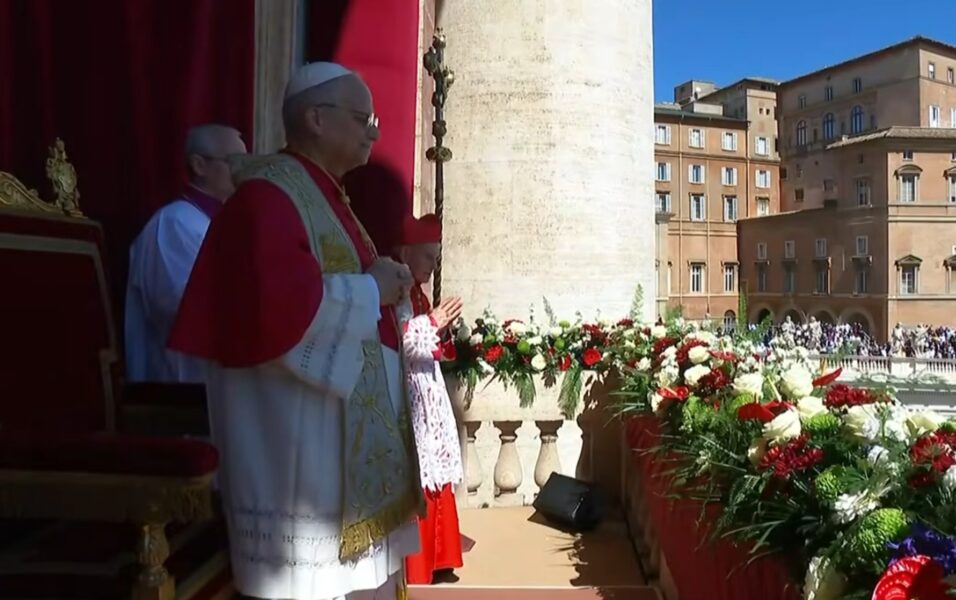
The image has not gone unnoticed. Alongside Pope Leo XIV, in the central loggia of St. Peter’s Basilica during this Easter Sunday’s Urbi et Orbi blessing, was Cardinal Ernest Simoni, one of the most moving figures in the current College of Cardinals and a man whose biography encapsulates like few others the persecution against the Church in the 20th century.
Simoni does not represent just any sensitivity within the Church. His life was marked by the repression of the Albanian communist regime, which kept him in prison and forced labor for many years for faithfully exercising his priesthood. In his figure is concentrated the memory of a faith lived under threat, tested in suffering, and maintained without fanfare but with extraordinary firmness. His mere presence alongside the Pope, precisely in a blessing centered on peace, violence, and the suffering of peoples, acquired evident symbolic force thereby.
It is not just a matter of a survivor of persecution, but also of a cardinal identified with the Church’s liturgical tradition. Simoni has shown on various occasions a clear closeness to the Traditional Mass. That affinity became visible again recently with his presence at the Traditional Mass celebrated in St. Peter’s during the ad Petri sedem pilgrimage, offered by Cardinal Burke.
Also at the beginning of the year, his name drew attention again when he decided not to concelebrate at the consistory Mass. At his ninety-seven years, with already very pronounced physical fragility, he remained kneeling during the Eucharistic Prayer, in a gesture that many interpreted as an expression of a priestly spirituality deeply centered on Christ’s sacrifice and on recollection before the altar. Beyond interested interpretations, the fact is that his way of being in the liturgy conveys an uncommon interior continuity and a sobriety that impresses.
Therefore, seeing him this Easter Sunday alongside Leo XIV in one of the most solemn and visible moments of the Roman liturgical calendar cannot be considered a minor detail. While the Pope denounced indifference to the death of thousands of people and called for laying down arms and choosing peace, at his side was a cardinal who knows from personal experience what persecution, ideological violence, and fidelity maintained amid pain mean.
In times of confusion, his presence needs no excessive explanations. Simoni speaks above all through what he has lived. And perhaps for that reason his figure, silent and almost fragile, became one of the most eloquent images of the Easter day in Rome this Sunday.