


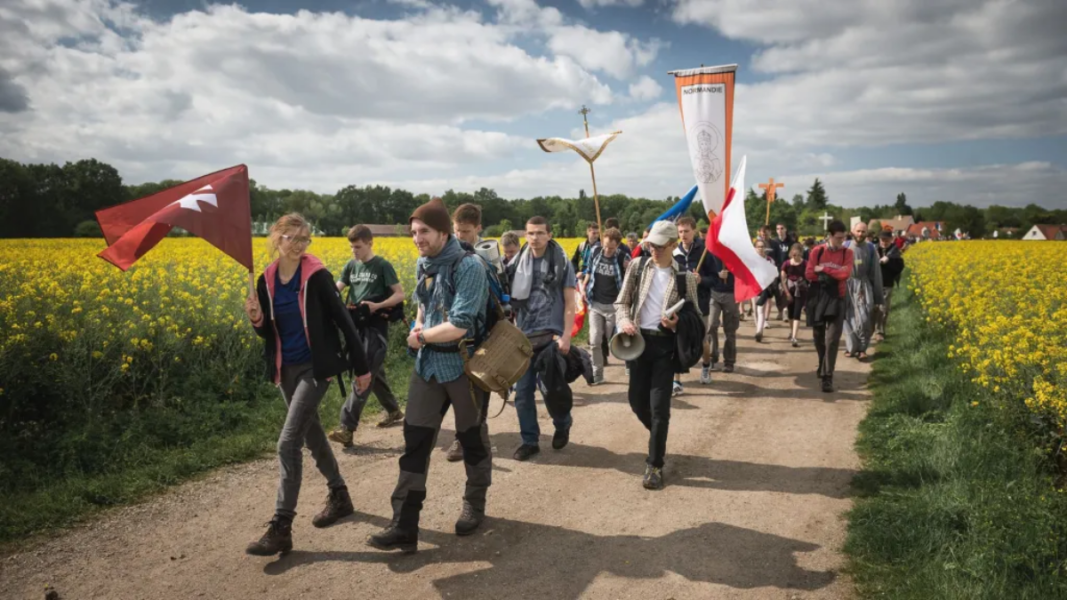
The Notre-Dame de Chrétienté pilgrimage to Chartres will once again demonstrate this year a strength that belies many narratives about the exhaustion of Catholicism in Europe: nearly 20,000 pilgrims are preparing to walk from May 23 to 25 in the 2026 edition, marked by an explicitly missionary emphasis, with a very clear underlying idea: it’s not enough to arrive in Chartres; one must return from there ready to bear witness to Christ in the world.
It’s not just a striking figure, though it is. The strong increase in registrations—which, according to information disseminated by Aleteia, surged from the first hours of opening—confirms that the Chartres phenomenon cannot be labeled as a marginal expression of liturgical nostalgia. For years, this pilgrimage tied to the Catholic tradition has been growing steadily, attracting thousands of faithful, especially young people, at a time when much of the Church in Europe continues to wonder how to awaken a faith weakened by decades of secularization.
Read also: Sarah denounces the drift of the Church: «It is not an NGO, it has forgotten its mission»
Chartres is no longer just a pilgrimage
What is happening in Chartres is beginning to take on the value of a sign. While in other ecclesial spheres diagnoses, pastoral plans, and increasingly worn-out languages abound, this pilgrimage continues to summon with a concrete, visible, and demanding force. It summons not from compromise, but from exigency. It attracts not through comfort, but through sacrifice. It does not rely on adaptation to the world, but on a clear proposal of faith, liturgy, doctrine, and Christian life.
That is probably one of the most important underlying facts. The success of Chartres does not seem to be due to a strategy of religious marketing, but to something much simpler and much deeper: there are Catholics, and above all many young people, who seek an integral faith, an unadulterated liturgical beauty, and an experience that unites prayer, sacrifice, doctrine, and community.
That is why it is significant that the organizers have wanted to place the question of mission at the center this year, under the motto: «You will be my witnesses to the ends of the earth». The approach is clear: the pilgrimage should not be reduced to an intense and private spiritual experience, as if it were a pious parenthesis in the middle of the year. The goal is not just to walk, pray, and arrive, but to leave strengthened to proclaim Christ throughout the world.
Mission is not an option
For too long, in many Catholic circles, mission has been reduced to the language of specialists, to very concrete initiatives, or to distant territories. However, Christ’s call was not directed to an elite of experts, but to his disciples. And that condition extends to every baptized person.
The underlying intuition of this Chartres edition points precisely there: the Christian does not receive faith to keep it private, but to transmit it. One does not pilgrimage only to strengthen oneself, but also to learn to live facing others, with awareness of apostolic responsibility.
In that sense, the tone chosen by the organizers seems to go beyond a simple annual theme. There is an intention to remind that mission belongs to the very core of Christian identity. It is not an addition, nor a decorative complement, nor an optional activity for particularly motivated faithful. It is an obligation born of baptism.
Tradition proves fertile once again
The case of Chartres once again puts on the table an issue that some prefer not to face head-on: the liturgical tradition continues to show a real capacity for attraction, especially among young people and those approaching the faith for the first time.
That fact should not be overlooked. For years, traditional liturgy has been portrayed as a closed bastion, unable to radiate or speak to contemporary man. However, concrete experience seems to indicate otherwise. Not a few young people have found precisely through traditional liturgy their first serious contact with the Catholic faith. They did not arrive at it as the culmination of a prior journey, but as a starting point.
This has consequences. It forces us to recognize that beauty, reverence, the sense of the sacred, and doctrinal depth remain profoundly missionary. They attract. They challenge. They open questions. They break the dominant superficiality. And, in some cases, they lead to fully entering the Church.
Read also: One more on the list: Roche also nuances his speech on the Traditional Mass
A youth seeking more than what is offered
Another standout fact in this edition, as indicated by Aleteia, is the growing weight of young people. Half of the pilgrims are under 30 years old. It is not a secondary detail. It is a sign that there is a new Catholic generation that does not settle for soft formulas or empty speeches.
In an aging and spiritually weary Europe, seeing thousands of young people willing to walk dozens of kilometers to Chartres cannot be interpreted as mere sociological curiosity. There is a demand for meaning, truth, sacrifice, and belonging. And also a silent correction to certain pastoral approaches that have confused closeness with banalization, and openness with loss of identity.
The youth who come to Chartres do not seem to seek a diluted faith, but a faith capable of truly demanding. And that explains to a large extent the strength of this summons.
The “Route de Jérusalem” broadens the horizon
The creation of a new modality, the so-called “Route de Jérusalem”, is also significant, designed for those who cannot tackle the usual 100 kilometers. With a more accessible itinerary of about 70 kilometers and a gentler pace, the organization seeks to broaden participation without diluting the sense of the pilgrimage.
There are many faithful who wish to join Chartres but cannot do so under ordinary physical conditions: older people, families with young children, people with health limitations or real personal difficulties. Opening a concrete path of participation for them strengthens the ecclesial character of the pilgrimage and prevents the missionary impulse from being reserved for a too homogeneous group.
Chartres, a challenge for the Church in Europe
What is happening in Chartres cannot be read only in a French key. It has broader reach. In a continent where it is repeatedly said that Christianity has entered its terminal phase, this pilgrimage shows that faith can continue to summon multitudes when presented with clarity, beauty, truth, and exigency.
That does not mean idealizing everything or turning Chartres into an automatic solution for all ills. But it does begin to show an answer to questions about tradition, beauty and sacrality in the liturgy, and the need for a clear, authentic faith without dilutions..
The 2026 edition, expressly centered on mission, seems ready to take a further step. It is no longer just about noting that Chartres is growing. It is about seeing if that spiritual vigor can be translated into a more visible, more articulated, and more fruitful witness in the midst of a de-Christianized Europe.