


By the Ven. Archbishop Fulton J. Sheen
It seems to be a fact of human psychology that, as death approaches, the human heart directs its words of love to those it considers closest and dearest. There is no reason to suspect that it is otherwise in the case of the Heart of hearts.
If He spoke in a gradual order to those He loved most, then we can expect to find in His first three words the order of His love and affection. His first words were directed to enemies: «Father, forgive them»; the second, to sinners: «Today you will be with Me in Paradise», and the third, to saints: «Woman, behold your son». Enemies, sinners, and saints: such is the order of Divine Love and Consideration.
The crowd anxiously awaited His first word. The executioners expected Him to cry out, for all those nailed to the scaffold of the Cross had done so before Him. Seneca tells us that the crucified cursed the day of their birth, the executioners, their mothers, and even spat at those who looked at them. Cicero relates that, sometimes, it was necessary to cut out the tongues of the crucified to stop their terrible blasphemies. Therefore, the executioners expected a cry, but not the kind of cry they heard.
The scribes and Pharisees also expected a cry, and they were very sure that He who had preached «Love your enemies» and «Do good to those who hate you» would now forget that Gospel before the piercing of feet and hands. They felt that the atrocious and agonizing pains would scatter to the wind any resolution He had made to keep up appearances.
Everyone expected a cry, but no one, except the three at the foot of the Cross, expected the cry they actually heard. Like some fragrant trees that bathe in perfume the very axe that cuts them, the great Heart on the Tree of Love poured from its depths something that was less a cry than a prayer: the soft, sweet, and low prayer of forgiveness and mercy. . . .
The next two words, the fourth and the fifth, reveal the sufferings of the God-Man on the Cross. The fourth word symbolizes the sufferings of man abandoned by God; the fifth word, the sufferings of God abandoned by man. . . . When Our Blessed Lord uttered this fourth word from the Cross, darkness covered the earth.
Truly, all was darkness! He had given His Mother and His beloved disciple, and now God seemed to abandon Him. «Eli, Eli, lamma sabacthani?» «My God! My God! Why have You forsaken Me?». It is a cry in the mysterious Hebrew language to express the tremendous mystery of a God «abandoned» by God. The Son calls to His Father, God. What a contrast to the prayer He once taught: «Our Father, who art in Heaven»! In some strange and mysterious way, His human nature seems separated from His Heavenly Father and yet not separated, for otherwise how could He cry out: «My God, My God»?
He atoned, first of all, for atheists, for those who at that dark noon half-believed in God, as even now, in the night, they half-believe in Him. He also atoned for those who know God but live as if they had never heard His name; for those whose hearts are like paths where the love of God falls only to be trampled by the world; for those whose hearts are like rocks where the seed of God’s love falls only to be quickly forgotten; for those whose hearts are like thorns where the love of God descends only to be choked by the cares of the world.
It was an atonement for all who have had faith and lost it; for all who were once saints and now are sinners. It was the Divine Act of Redemption for all abandonment of God, at that moment when He was forgotten.
[The fifth word] is the shortest of the seven cries. Although in our language it consists of two words, in the original it is a single one. . . . He, the God-Man, who hurled the stars into their orbits and the spheres into space, who «spun the earth like a jewel on His wrist», from whose fingertips planets and worlds sprang forth, who could have said: «Mine is the sea and with it the streams of a thousand valleys and the cataracts of a thousand hills», now asks man —man, a piece of His own handiwork— to help Him. He asks man for a drink!
Not a drink of earthly water, that is not what He meant, but a drink of love. «I thirst» —for love! The previous word was a revelation of the sufferings of a man without God; this word was a revelation of the sufferings of a God without man.
The Heavenly Father, in His divine mercy, wanted to restore man to his primitive glory. So that the portrait might again be faithful to the Original, God wanted to send His Divine Son to earth, after whose image man was made, so that the earth might once more see the kind of man God wanted us to be. In the fulfillment of this task, only Divine Omnipotence could use the elements of defeat as elements of victory.
Now the battle was over. For the last three hours He had been occupied with His Father’s affairs. The artist had given the final touch to his masterpiece and, with the joy of the strong, uttered [the sixth word], the song of triumph: «It is finished».
His work is finished, but is ours? It is for God to use that word, but not for us. The work of acquiring divine life for man is finished, but not its distribution. He has finished the task of filling the reservoir of sacramental life from Calvary, but the work of letting it flood our souls is not yet finished. He has finished the foundations; we must build upon them.
His seventh and last word is a word of perspective: «Father, into Your hands I commend My Spirit». The sixth word looked toward man; the seventh word looked toward God. The sixth word was a farewell to earth; the seventh, His entrance into Heaven. Just as those great planets only after a long time complete their orbit and return again to their starting point, as if to greet Him who set them on their way, so He, who had come from Heaven, having finished His work and completed His orbit, now returns to the Father to greet Him who sent Him on the great work of the redemption of the world: «Father, into Your hands I commend My spirit».
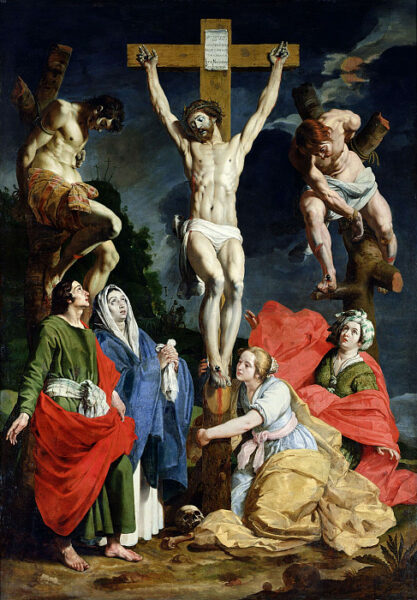
Meanwhile, Mary remains at the foot of the Cross. In a short time, the new Abel, murdered by his brothers, will be taken down from the scaffold of salvation and laid in the lap of the new Eve. It will be the death of Death!
But when the tragic moment comes, to Mary’s tear-dimmed eyes it may seem that Bethlehem has returned. The head crowned with thorns, which had no place to lay in death except on the pillow of the Cross, may, through Mary’s blurred vision, seem the head she pressed to her breast in Bethlehem.
Those eyes before whose fading even the sun and moon darkened were for her the eyes that looked up from a manger of straw. The helpless feet bound with nails seem to her once more the feet of the child before which gold, frankincense, and myrrh were laid. The lips, now parched and bloodied, seem the pink lips that once in Bethlehem were nourished by the Eucharist of her body. The hands that can hold nothing but a wound seem, once more, the hands of the baby that were not long enough to touch the huge heads of the cattle.
The embrace at the foot of the Cross seems the embrace by the manger. In that sad hour of death, which always makes one think of birth, Mary may feel that Bethlehem is returning again.
These passages are excerpts from The Seven Last Words & Life of Christ by Fulton J. Sheen, who will be beatified in St. Louis, Missouri, on September 24, 2026.
About the author
The Ven. Fulton John Sheen was born in El Paso, Illinois, on May 8, 1895. He attended St. Paul Seminary in Minnesota and was ordained in 1919. After further studies at The Catholic University, he earned a doctorate in philosophy from the Catholic University of Louvain in Belgium. In 1930, Msgr. Sheen began a Sunday night radio program, «The Catholic Hour», and in 1951 the then Bishop Sheen launched «Life Is Worth Living», which became one of the most watched television programs in the United States and earned him an Emmy in 1952. He was elevated to archbishop by Pope Paul VI in 1969. He died on December 9, 1979. He was declared Venerable Servant of God by Pope Benedict XVI on July 28, 2012.