


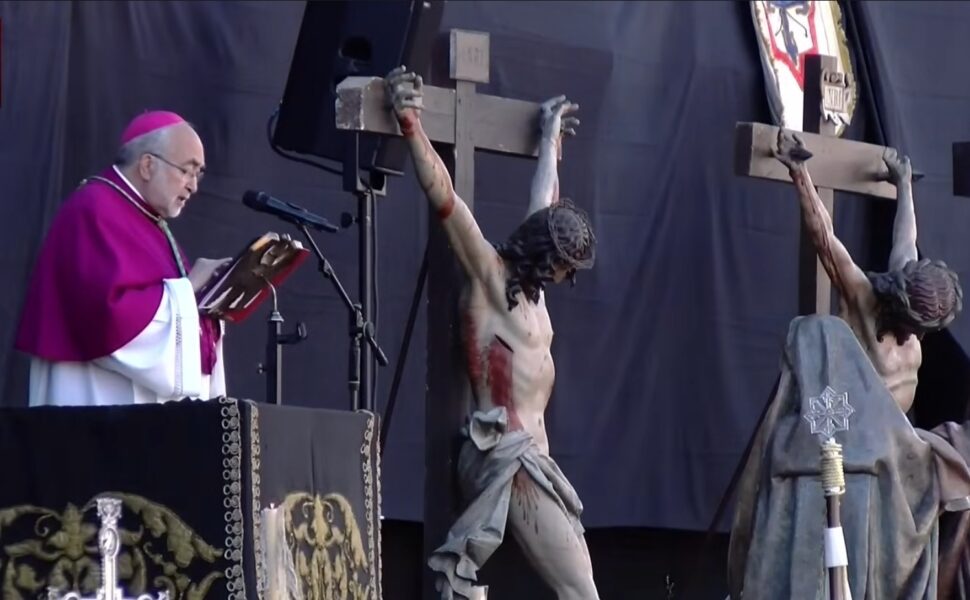
The Plaza Mayor of Valladolid hosted this Good Friday of 2026 a new edition of the traditional Sermon of the Seven Words, delivered this year by Monsignor Jesús Sanz Montes, Archbishop of Oviedo. Below is the full text.
SERMON OF THE SEVEN WORDS
Good Friday, Valladolid 2026
Preacher: Mons. Jesús Sanz Montes, Archbishop of Oviedo
Most Excellent and Most Reverend Metropolitan Archbishop of Valladolid, Most Excellent Mr. Mayor, president of the City Council of Valladolid and president of the Honorary Patronage of the Board of Brotherhoods of Holy Week in Valladolid, Most Illustrious Mr. President of the Provincial Deputation of Valladolid, foreign ambassadors accredited in Spain, Most Eminent and Most Reverend Mr. Ricardo Cardinal Blázquez Pérez, Most Excellent and Most Reverend Emeritus Archbishop of the Diocese of Santander, Mr. Manuel, civil and military authorities, mayor, president of the Brotherhood of the Seven Words, president of the Board of Brotherhoods of Holy Week in Valladolid, Reverend Mr. parish priest of the Pastoral Unit of Santiago El Salvador, brothers of the brotherhoods of Holy Week in Valladolid, faithful people gathered in this Plaza Mayor, and all those who peek at it through our media.
May the Lord give you His peace and fill your heart with His good.
There were many improvised pulpits in synagogues or at crossroads and the thousand circumstances where the truthful, kind, and beautiful word of the Master was heard. He said so many things in public and in private, with beautiful parables when there was hope to announce, and like a double-edged sword when there were abuses to denounce.
But there remained a final sermon from a strange, humiliating chair, without subsequent dialogue or a receptive audience. They will be the seven words for a sermon as such, not pronounced by the Master’s lips, but which constitute the tight synthesis of an unparalleled donation by this humanized God who was Jesus, the Son of God, the Father’s beloved.
They are seven cries, like one who intones the swan’s song in the cantata of love never heard before. It is the epilogue of an entire life woven with bittersweet chiaroscuros, between the most infinite gift from the Lord and the saddest resistance from the recipient man.
We witness today here in Valladolid, in this square, witness to the listening of these seven words for so many years, already from its beginning, properly on that April 23, 1943, in this square, Plaza Mayor of Valladolid, sidewalk of my dear father San Francisco, a square that is a particularly landmark space.
Here the swings of our hurries take place, the innocent games of our little ones, the enamored raptures of those who love each other, and the parsimony of our wise elders. Square of secrets that its airs guard in time. Square of dreams when we take off our nightmares and look at the sky. Square of encounters, of friendly kisses and words that embrace you in the comings and goings of the welcomes that receive you and the goodbyes that bid you farewell always with longings.
On this Good Friday morning, this great and majestic square through which the life of Valladolid passes, we prepare to listen once again to the seven words, letting ourselves be moved by Christ’s sermon from the pulpit of the wood of His crucifixion.
They are well-known words, heard, meditated, and wept so many times through the history of the Christian people. Before them, saints and mystics shed their tears. With them, our most celebrated musicians have composed cantatas and symphonies. With these seven words, our sculptors have immersed themselves with their chisels and the painters with their brushes. They were the object of the pen of our best writers and of all those with immense talent and beauty who came before to comment on them here with blushing emotion so many orators.
They were words heard at the end of that first Holy Week in history. How many previous words were received from the Master, the Lord Jesus. He did not stop preaching them in so many ways in any circumstance. To children, to young people, to fiancés, to the sick and the elderly, to the just, to sinners, to countrymen, to foreigners. Only those who were deaf censors preferred their own darkness to the light, their violences to peace, their rigidities to tenderness. The evangelist Saint John said it when, already old, he wrote his Gospel, that the light came into the world and the darkness despised it; He came to His house and His own did not receive Him.
In an unstoppable way, we go fulfilling years that draw whites in the hair, wrinkles on the face, and a certain startle when we sit down and look back sideways. All the lights and shadows, the joyful moments and those that could have harmed us, there they are in our immediate past. Dreams that came true filling us with peace, nightmare awakenings that altered us, people who left us like other people who came to us. Certainties that became doubt or questions that found the answer. So many things, feelings, memories or projects. So many presents that have come greeting us or cornering us or blessing us. We have dreamed and toasted for so many things, but there have also been not a few that have broken us in tears, that have sown fear and tiredness. So many episodes and intimate circumstances in the heart or evident on the outskirts of the soul make each year’s Holy Week have a premiere date and draw a novel landscape with all its lights and all its shadows.
Jesus’ journey was long. As brief as they may seem, the few years He shared with us were of immense intensity. 33 years where everything the Gospels tell us happened: the tears that Jesus wiped away, the children’s games He observed, the sins He could forgive and the disastrous lives He guided. There was no human corner in which He was not present with a word to say and a grace to offer.
That week was intense in words and signs, like one who knows that the sunset of a journey so woven with verses, kisses, silences, and tears is coming. We plunge face-first into this final outcome, where on a cross as a pulpit, Jesus will offer us His seven words that will never fall silent, because they respond to the drama of the history of humanity in all its places, in all its times, as an echo of God’s cry in the midst of humanity’s sordid contradiction.
This is the sermon on the mount. Let us listen.
FIRST WORD
«Father, forgive them, for they know not what they do»
It was the end of the journey. An entire human life behind with so many moments. Back now open like a furrow where the stingy weed wanted to leave the author’s signature of the most infinite incomprehension, the most exacerbated hatred, and the most ruthless closure.
Behind remained an entire life, so many turns of the path in which Jesus passed doing good. His encounters with people, His peculiar way of embracing the human problem: sometimes offering His joys, as in Cana at those weddings; others, weeping their sufferings next to Lazarus dead in Bethany; on occasions, healing all kinds of ailments, or illuminating all kinds of darkness, or satiating all kinds of hungers; and on others, angry against the merchants in the Temple and against the Pharisees in the market of faith. Jesus who blesses, who teaches, who prays, who heals, who frees, who denounces, and who points out.
Now is the ultimate and final moment of this human and divine drama. The arrival station is located, Calvary, called «the Skull», macabre name on the part of those who lost their heads. His final travel companions also go in the same lot, with the same outcome, but for unequal reason.
After the description of the scene and the imposed company, as if they were supporting buffoons, the first word of this particular sermon approaches. «Father, forgive them, they know not what they do.»
It was not a press conference, nor a response in a court before an accusing prosecutor. This word, like the remaining six, is a soliloquy with His Father God, as in so many other moments of His life as God made man. It is that Father for whom He rose early every day or stayed up late every afternoon, seeking in that encounter the obedient listening in the most sublime prayer. From that filial conversation would flow afterward the sweet and true words as kind benefit, and the healing and liberating gestures of every perverse spell.
The Father was His main interlocutor. Now Jesus, in full light, in the heat of that Good Friday, fixes His gaze on the Father to ask for the pardon before so many evildoers who were enveloping Him from their blind eyes and obtuse hearts, for the great ignorant censure of who was His true and only Savior.
Thus Jesus prayed filially as never before His Father God. «Forgive them, they know not what they do.»
Is the ignorance of harm perhaps an extenuating circumstance to obtain undeservedly the most gratuitous forgiveness? Our contradictions that make us cynical, the hypocrisies that disguise our costume, the sins of life that deny what our lips proclaim on loan. It is not the ignorance of not knowing what they did, what we do not know how to do, that redeems us with the embrace of forgiveness, but precisely this plea felt in the heart of Christ as the last beat of the pulse of His love.
He wanted to intercede, to place Himself again between heaven and earth, between His brothers men and His Father God. His prayer will open the most merciful and undue exit door in the dead-end alley closed tight of our most fearsome and feared darkness.
We know not what we do. No, we do not know when we declare the wars that confront and destroy peoples. When we lie profusely to save at all costs our privileges and our governances. When we steal what does not belong to us with the most contentious greed, or when we abuse the most innocent with a perversion that kills. When we stain beauty with our most coarse appearances, when we debase goodness with a calculated wickedness brutishness, and when we relativize truth with a post-truth that knowingly deceives us; we know not what we do, neither then, nor now, nor there, nor here.
It is the most culpable ignorance, which does not attenuate our daily responsibility in the personal and in the social. But Jesus’ prayer to the Father continues to arrive as an intervening clamor, asking for the forgiveness that saves us. He is the advocate who tempers our bagpipes, who straightens our wrongs, who levels our arrogances, and who returns us to the true path after all our prodigal adventures, those that took us out of the place where we are always children, bad children perhaps, but never orphan children.
SECOND WORD
«Today you will be with me in Paradise»
Gestas wanted to obtain the level of his face wash, of his rigged pardon, of a luck he never and ever deserved. But it ended as such an obscene provocation that it was crude and gross blasphemy against the same God.
Without being a hostage to his painful past, the other evildoer had a different attitude. Dimas rebuked his companion for the disloyal trap that disguised his clumsy curriculum of curse and condemnation, and then made an act of faith in the holy fear of God. He confessed his sins with a hurried examination of conscience, accepting the deserved outcome for all his committed faults. Who knows where? Who knows when? Who knows against whom? But he accepted his drift rated by men as fatal sanction for all his errors.
«We deserve it, but Jesus absolutely not. We are two poor wicked thieves who have stolen so many things. Two violent murderers who have squandered so many lives. Two soulless rapists who have taken advantage of those we could deceive and seduce. Two compulsive liars who made deception a well-paid form of survival. But Jesus did nothing. Jesus passed doing good in everything He did and said before others.»
From this general confession of his sins, he made an unusual purpose of amendment. «My forgiveness is in your hand, Jesus. And when you arrive at that kingdom of yours of which you have spoken to us in so many ways, cast a glance at me. Extend your hand to me, make room for me in the loving home of your mercy and remember me.»
What a good confession Dimas made on that Good Friday, which obtained for him the title of «good thief», because without even pretending it, he managed to honestly steal from God the unimaginable booty of his entire disastrous life, when asking Him to enter His kingdom, Jesus gave him the ticket and entry into that world of love that only He who is love grants to those who open themselves to His gaze.
Thus arrives the second installment of this sermon of the Lord in His seven words: «Today you will be with me in Paradise.»
This means that Dimas was forgiven with the most infinite forgiveness, so much, so much, that it meant the first Christian canonization without the long processes of verification and discernment on the part of the Church, but by the clear recognition of God’s own judgment. Thus Jesus prepared for Saint Dimas the altar, the niche, and the pedestal, which only shine in heaven those whom God canonizes directly.
He is the first in the saga of the feast of All Saints, when the Church urges us to peek through another window that perhaps is not the one we frequent most in the course of our daily journey. And we are so often kidnapped by other names, other examples that steal our attention with their empty words, with their various corruptions and their unconfessable pretensions. We are invited to look at all the saints, and Saint Dimas first. They are from different eras, with different geographical, cultural, and political contexts, with a varied sensitivity, who lived the Gospel within the years of their age and in the home of their circumstances. There are martyrs of all time, doctors who illuminate us with their goodness and wisdom, dedicated shepherds who never left the flock assigned by God, and so much simple people, saints from next door, as Pope Francis said, who can be from our family.
They are all the saints, in whose first place on that list appears Saint Dimas, the good thief, who that afternoon entered Paradise.
THIRD WORD
«Woman, there is your son; there is your mother»
Mary did not leave us a spiritual diary, and yet we can access traces of her life that move us for their true humanity, so embraced by God’s grace.
Mary was someone who trusted in God, believing that what was impossible for her was not for Him. The different words of God that Mary will have to listen to in her life, and especially this one that she will have to hear at the foot of Jesus’ cross, will not mean the macabre riddle or the endless puzzle of a God who delights in scaring or crushing His children.
The last word that God always reserves is a word of light and life that becomes the answer that He gives to the attitude of waiting and hope in so many moments of darkness and death. The last word that Mary will hear will not be the agonistic word of a dying son in the darkness of that Good Friday hour, but the word that, like morning dew, God will sing forever in His resurrection on the Sunday that does not end.
Nevertheless, Mary teaches us to listen deeply to that God for whom she decided her entire life in the listening of His word, be where and how He wants to tell us when He speaks to us the smooth, when He speaks to us the rough, or when silent He falls silent.
Christian artists of all times have known how to paint it in their paintings, sculpt it in their images, recite it in their verses or compose it in their musical cantatas.
The cross of Jesus has a complete scene on that first Good Friday in history. Calvary does not have a solitary cross, it is not alone flanked by two thieves, nor by the mocking curiosity of those who frivolously waited to see what happened. Because in addition to Judas’ betrayals and Peter’s tears, in addition to Pilate’s cowardly inhibition or the clumsy malice of a manipulated crowd, there was also a diverse presence. It is the one that the Christian liturgy celebrates in the invocation of the desolate mother next to the beloved disciple, the young John. Both are close to Jesus and close to each other. It was the communion of the closest, intimate, and spiritual life.
That woman who with her yes to God wanted to be at the foot of the life that was born from her by miracle in her virginity, will also be at the foot of that death of the Son who hung from a cross; at the foot of life and at the foot of the cross.
It is not Eve embraced by the tree of her forbidden fruit, but Mary who embraces the tree whose best and given fruit was her crucified Son.
She did not react with desperation or a sob of vengeance. She did not invoke the curse of the heavens, nor organize a revolt of men. Simply she was at the foot of that cross, trying to listen to a difficult word to hear, wondering the hard meaning of that apparent end with the martyrdom of her son Jesus. Her being there was a silent being, full of faith, peering even beyond that harshest appearance with her maternal eyes full of tears.
This is the astonishing lesson that Mary will give us in the Calvarys of life, in our various desolations, next to our daily crosses.
Being mother of Jesus was interchangeable with being mother of John. Jesus does not mention John by name, nor Mary by hers. He extrapolates them to give them a horizon of universality. It is the woman who becomes mother, it is the disciple who becomes son. But a true motherhood is given that Mary assumes by indication of Jesus, welcoming the disciple John. And an authentic filiation is also given that John does by taking Mary from that moment as his own mother.
In the welcome of who arrives, one shares with him to the bottom, to the end, his entire precious universe. Mary thus arrives at the dramatic summit of her entire life in the proper sense of the expression «drama»: neither tragedy nor comedy, but drama. That is, to play your life risking your freedom for the only thing worth it. Tragedy is always bloody. Comedy is frivolity. Drama is a lived freedom.
Mary arrives with her yes maintained to the maximum drama, expropriating herself of the Son who delivers to the Father, as one who returns the immense gift of a received gift for the benefit of all humanity. It is then that she receives as a gift the son offered to humanity represented by John.
Thus we have learned at the foot of the cross to recognize ourselves in the person of the beloved disciple, the apostle Saint John, looking at Mary as our mother, so that life continues to be nourished and sustained by who with her blessed womb as mother always accompanies us.
FOURTH WORD
«My God, my God, why have you forsaken me?»
The clock marked its hours without pause or delay. There was no pause button to position ourselves measured and pious before the most extreme tear of a cry that became prayer.
The agony was not fiction or pose, but terrible end that reaches this limit of loneliness. The supreme hour arrived, the hour of none on that Good Friday in history. Life is dying, gasping on an incomprehensible and imposed cross.
There is only space for an abyssal silence that can silently in the depths that last dialogue of the Son with the Father, when the word became a humanly macabre monologue, which interweaves between spasms Jesus with His Father.
Thus, as one who opens a posthumous crack to the most undeserved forgiveness before the most unjust absurdity that was brewing, suddenly Jesus was heard reciting an ancient psalm with the tear proper to one who points out the most extreme loneliness: «My God, why have you forsaken me?»
Indeed, it was a borrowed psalm, but it translated an experience of abyss. When you look and no one appears before your eyes, when you scream and no one responds to your anguished voice, when you open your arms and apparently no one comes to meet your dismay, who will understand this supreme cry of God to God in this extreme plea between the beloved Son and His dear loving Father?
To this point Jesus wanted to solidarize with our human condition, so full of questions also for which we have no answer. When fears grip us, shadows corner us, and the escaped absentees who do not accompany us fill us with voids, or the burning doubts for which we have no reply.
It is thus that all the fleeing abandonments, all the tears that bleed us, the darknesses that extinguish us, the strayings that disorient us, the solitudes that isolate us, and the anguishes that unsettle us, all that was in that cry of Jesus. That cry resonates in all the abandonments of each of His brothers, of each human generation in every time and place.
Jesus wanted to make His own our cries of abandonment in loneliness, when we feel anguished that there is no one behind the curtain of our fear, nor does the balm exist that heals our wounds, nor the humble answer in the question that torments us, nor the illuminating light in the black and extinguished darkness.
It was not a devout walk through the nights that do not end plunging us into the most biting discouragement, but a true cry that, for being prayerful, did not cease to point out the most incomprehensible loneliness. The proof that is translucent or overshadowed in a God who apparently is not sustained by God, of a Son who does not perceive the closeness of the Father, of a Redeemer who is not saved by anyone, in the most inaudible gesture of the abandonment of Christ Jesus.
And yet, there is here a sublime gesture of divine solidarity, when in the argument of our tears, in the rebellion of our discontents, in the uncertainty of our desperations, we put that same cry of blessed Christ in our personal cries. He has not played with our most hollow and empty voids, as if the reasons for which we so often find ourselves desperate were not true.
Jesus’ abandonment is our same abandonment when all have gone and no one has arrived, plunging us into the desperate cry of our most terrible desolation.
Have we not experienced in our life that same tear when the incomprehension of the close ones, the cowardly flight of friends, the harassment of adversaries, the calculated injustice, and the insidious persecution reach us at the most inopportune moment to not offer us the help we needed?
We have all experienced that claw when bridling the abandonment of loneliness before an unforeseen illness or a natural catastrophe that upsets us, or a mishap of bad governance that leaves us on the edge of exposure.
But in that cry of Jesus we see how He also made His own all the deaths blinded by terrors before and after being born. Death as a consequence of any sin. There is Jesus opening His heart to us in the most torn pain, so that we do not feel alone when the trial that overwhelms us arrives. It is Jesus’ abandonment that embraces our frightened loneliness.
FIFTH WORD
«I thirst»
This laconic expression of someone who in his agony asks for a sip of water to cling to life is overwhelming.
Thirst is always corrosive when it tears your throat and leaves you breathless, speechless, with a mouth dry as a brick and the tongue stuck to the palate. Jesus felt thirst in that humanly so bleak hour.
We all remember biblical scenes where quenching thirst was a ritual trait. When in the desert of Sin, Moses struck the rock so that water would gush from it, with which God quenched the resentments of a thirsty, mutinous, and rebellious people. That resentful people cursed for their drift and escaped in the nostalgia of that Egypt left behind, where there was water but no freedom, where they had garlic and onions, but no reasons for dignity. It was a well-watered slavery that they clumsily and deceptively longed for from the purifying stage of a desert that tested their failed hope. This happened in Massah and Meribah, and there the act was drawn up of the clumsiness of an unbelieving Moses also, and of a people in rebellion.
The well in biblical literature is a place of encounter, a space to rest and share. The places where there is water determine the earthly and spiritual itinerary of that people who crossed a desert to reach the land of promise. That is why the well, the water, will become symbols of closeness that that God offers to His children.
There is a scene that Saint John’s Gospel recounts where thirst becomes ritual next to a well. It is well known that plot: a woman, a well, and Jesus.
The life of that woman had passed between husbands who overlapped, and between trips to the well to draw water incapable of quenching the true thirst. The insufficiency of an unfulfilled affection —her six husbands— and the insufficient water to calm an insatiable thirst —the well of Sychar— are displaced by the Lord, who presents Himself as the water that satiates and as the spouse who does not disappoint.
Whoever has a heart hardened by the traps of his heart or by the blackmails of idols that neither fill nor calm, will position himself at that threshold of a coarse, extinguished, mediocre life without horizon of joy or hope. May we hear the voice that opens us to love and to water for those who were truly made.
In this word of the crucified Jesus, the well has the shape of a cross. And He who came to give us living water cries out thirsty in the rattle of His agony. It is the water that becomes beggar on the dry lips of Jesus, as at another moment His gaze filled with light the eyes of the man blind from birth.
He comes to point out our contemporary contradictions. We could say just the opposite of what this opulent, frivolous, and unsolidary world claims: when we witness with astonishment the void with which our nothing is filled, «give me a little thirst because I am dying of water». Thus, exactly thus, backwards, would be the cry of a generation that, having almost everything, seems unable to discover the meaning of life when there are false waters for a true thirst.
From all our questions, from all of them, anxieties and concerns, from our aspiration to inhabit a more human and fraternal world than the one painted by the daily chronicle, God approaches us on our way, sits next to the edge of our wells to reveal Himself to us as our source and our thirst at the same time.
The Catechism of the Catholic Church commented on it in a number in which it quotes the great master Saint Augustine: «If you knew the gift of God. The wonder of prayer is revealed precisely there, next to the well where we go to draw our water. There Christ goes to meet every human being. He is the first to seek us and the one who asks us for a drink. Jesus thirsts. His request comes from the depths of God who desires us. Prayer, whether we know it or not, is the encounter of God’s thirst and man’s thirst. God thirsts for man to thirst for Him.» It is the thirst of Jesus next to the edge of His cross, knowing that we quench the thirst of our heart that is satisfied in the well of His living water.
SIXTH WORD
«It is finished»
[Note: the transcription of the sixth word has a gap due to a commercial break; the available fragment is included:]
…in silence we remained in the impressive Gothic church of the Franciscans of that beautiful Austrian city, in silence and without applause, prolonging before what that great musician captured in the staff of his funeral symphony remembering the end of the Lord’s Passion.
«It is finished.» That is, it has not been a deceptive farce nor a nefarious failure, but an entire life that reached its end with the duties done from His filial fidelity surrendered to the Father God.
But Jesus’ journey was long. Various scenarios where everything the Gospels tell us happened. So many turns of the path are left behind; He passed doing good.
«It is finished.» This drama of Jesus was not His but ours, but He so seriously assumed as His all our problems and sorrows, all our sins. There were no tears from our eyes with which He did not make His own weeping. There were no joys from our eyes with which He did not toast in His own feast.
This drama of Jesus’ Passion is very important: not so much what happened 20 centuries ago, but what has always happened, then and now, with those and with all the others who have come after to the stage of history.
Good Friday with Jesus’ seven words on the cross is such a sober day that it turns out taciturn and silent. There are no bells or glories. It is the only day of the year in which there is no Mass properly speaking, as if a mournful veil conditioned every instant, every corner of this unfinished world that fails to let the city of God be born that He eternally drew to enamour us.
All that was for me, with my name and my years, with my tricks and my fears, with my graces and sins. I was for Him the reason of every instant in those fourteen stations that had my biography as path and His love as arrival station. It is a grace of piety to see ourselves inside that Way of the Cross that belonged to us and that Jesus, making it His, walked to save us.
Let us be His Cyreneans, and let us be Cyreneans of those who today live badly and die badly on their painful paths for so many reasons and in so many scenarios.
Good Friday, day of Passion, of listening moved to that blessed account. There they were, without censorship and without adornments, all the stages of my life and all my sins.
«It is finished.» With His head bowed, the humanity of Jesus makes His last offering to the Father God.
SEVENTH WORD
«Father, into your hands I commend my spirit»
The farewell remained before the hill of Calvary was filled with darkness, outside the city walls. It was the goodbye that would end in the eternal embrace with that Father God.
From filial eternity Jesus came to us with the most overwhelming message of the love He had for us, who being bad children so many times were never wandering orphans before His gaze. Our sinful clumsiness was answered with the loving delivery of the Son God.
The account of Saint John’s Gospel tells us moved: «God so loved the world that He gave His Only Begotten. God did not send His Son into the world to judge the world, but so that the world might be saved through Him.» This was the most immensely gifted gift that man least immensely deserved.
The seventh and last word of Jesus on the cross has the guise of the final clause of an improvised testament in its sober brevity. It is not the defeat that overwhelmed collapses before the fatal abyss, but the end of the journey for those wandering feet that became missionaries in all our aimless paths, in our dead-end alleys, in our walls of separation, to be able to indicate the horizon that dilates our lost gaze and that draws the map of hope in a fraternity that we recover, and a closeness attentive to every destructive tragedy, to enter into the drama of sincere freedom without the comedies that make us false.
The great theologian Hans Urs von Balthasar described it well with his theodramatics, when he presented us the different plays of Jesus the Lord from the keys of Greek theater. Not a tragic God who despairs, nor a comic God who trivializes, but a dramatic God who embraces with freedom His destiny and with the affection of His heart approaches the avatars that corner and grieve us, kidnapping He the hope for which we were created.
In that final moment, without secondary goodbyes, without pantomimes of parody, but simply bowing His head, He offers us the final gesture of a delivery.
But behind remained so many crossroads, so many human crossroads: the eyes and tenderness of Mary, who felt Him grow in her womb, who saw Him in the light, who gave birth to Him in the birth among straw, who taught Him to say His first words and to take His first steps. The discreet, solicitous delivery of good Joseph also remains, who assumed a borrowed paternity in that enamored home next to his wife, guiding the little Jesus among workshop shavings for a wooden cross still not carved, in that endless Nazareth that had no hurry to bid farewell to the Messiah in His first wanderings.
How many were the paintings of love to which Jesus could peek? Even beyond the errors we humans make when we do not know how to live things as God points them out to us. How many the moments of pain in an infinity of circumstances: between the contempt of who does not understand, the injustice of who abuses, the loneliness of who isolates or is marginalized, the illness that imposes an expiration date when life hurts the most, the death that tears you away taking those you love most. All those paintings of loves and pains He could see with His own luminous eyes and caressed with His kind hands, making His own the feelings woven of longings that open to the trust that never fails us.
Indeed, there was no weeping of the people He met that did not run through the furrow of His own tears, nor did He approach the human feast in which He did not find the reason for His toast and revelry, truly human without ceasing to be truly divine, putting on the face of the same God the rictus of our pain.
Drawing strength from where He no longer had any, He had the opportunity to cry out for the last time with all His might, clamoring with a powerful voice: not to curse His drift, not to blaspheme for His luck, not to blame others for an undue condemnation, but to return to who gave Him everything that He received from Him. «Father, into your hands I commend my spirit.» And having said this, He expired. They were His last words.
EPILOGUE
There is a brief epilogue that comes to be like the eighth unfinished word, a word in the eternal dawn.
Because after Jesus’ seven words on the cross, silence was not made as muteness on His lips, nor did His deathly absence seal a dark and fatal void in any tomb. It was rather an eloquent silence and a burning absence, because those words of life that He left us as precious testament will continue to be heard through the centuries, in each generation, as the echo of the Gospel welcomed by so many men and women who will make themselves His listeners.
The sudden absence, after depositing His body in the tomb, will turn into resurrected presence, as an icon of His never-withered beauty, which will captivate those who peek at it with enamored adoration.
No, it was not muteness nor darkness what came after coming down from the cross, collected by Mary, by John, by Joseph of Arimathea, and by the pious women. Those almost 33 years continued to sound in the time of each age and in the history of each human corner. It is the account of something that continues to happen, because God continues to give His life and accompany ours as 20 centuries ago, as from all eternity and forever.
Will the betrayal of the modern Judases who will rig with their kiss the sad reward of thirty coins for their fatal drift be called otherwise? The garden of Gethsemane will appear different, where between sweats of blood and distracted drowsiness an innocent God will be arrested again. There will be other tears from the Peters who will shed in the courtyards of indifference or phobia against Christ. The Caiaphases, the Pilates, and the Barabbases will continue to come on stage, each with his cowardice, his exploitation, or his malice. And another name will carry the painful way in which those who delivered said their hosannas days before will repeat blasphemously their «crucify him» on the way.
But they will be unique those who, like Mary and John, are at the foot of the cross of every crucified, at the foot of that cross, the one of the crucified whom we are venerating today in this square of Valladolid.
Dear friends and brothers, we prepare to close. We are the listeners of these seven words and we keep them as Mary did in the depth of her womb, in the chest of our heart. From the beats of Christ’s heart live our Christian pulses. And in this unfinished story, we continue to write the page assigned to our biography.
His seven words continue to tell on our lips what God continues to narrate in them, just as with our small hands He continues to knead and distribute a new world that settles accounts with God’s beauty, goodness, and truth. His eternal dream of love, infinitely greater than all our fleeting nightmares.
Now it is up to us the eighth word and the following ones. After the seven that Jesus our Lord pronounced, we were born for a word that eternally God silenced to tell it to me and to tell it with me. We were born for a gift that eternally God withheld to give it to me and to distribute it with me.
We have the word. May God keep you and bless you always. Peace and good.
Amen.