


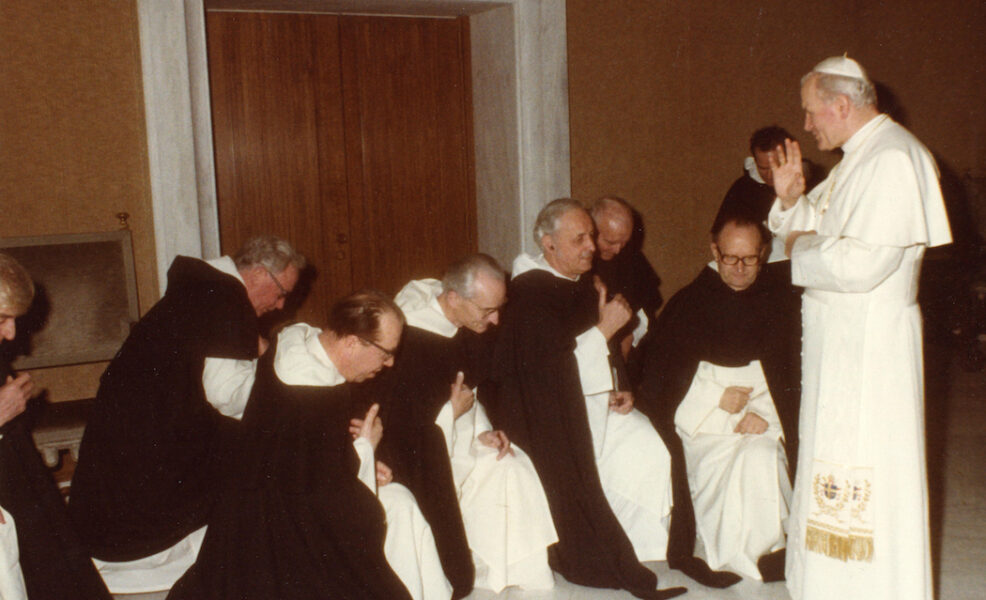
By Stephen P. White
Starting in 1979, Pope John Paul II adopted the custom of writing an annual letter to priests that was published on Holy Thursday, or just before. These letters allowed John Paul II a channel for constant meditation on the nature of the priesthood. Read together, they offer a detailed account of his understanding of the presbyterate and, therefore, necessarily, of both himself and the Lord.
The tone of these letters was always fraternal. He did not write as a superior addressing his subordinates, but as a priest writing to other priests about common concerns, hopes, fears, and joys. They were letters between brothers.
As he himself expressed in his first letter: «I think of you continually, I pray for you, I seek with you the paths of spiritual union and collaboration, because by virtue of the sacrament of Holy Orders, which I too received from the hands of my Bishop… you are my brothers». He continued, paraphrasing St. Augustine: «I want to tell you today: “For you I am a Bishop, with you I am a Priest”».
Holy Thursday, of course, is a natural occasion to reflect on the nature of the ministerial priesthood, being the day on which Christ himself instituted both the Eucharist and the order of the priesthood that flows from that same reality and serves it.
And, as expected, writing to the same audience each year on the same occasion, within the same liturgical framework, entails certain thematic repetition. But reading these letters as a whole allows us to see, precisely in that repetition, what Pope John Paul II considered most important to share with his brother priests.
In his first letter, in 1979, John Paul wrote about the importance of priestly perseverance, not only as a matter of personal fidelity, but as an example and witness for those whose vocation leads them along a different sacramental path:
[O]ur brothers and sisters, united by the bond of matrimony, have the right to expect from us, priests and pastors, the good example and witness of fidelity to one’s own vocation until death, fidelity to the vocation that we choose through the sacrament of Holy Orders, as they choose it through the sacrament of Matrimony. (Emphasis in the original)
This theme of perseverance and fidelity arises again and again in the Holy Thursday letters. When one remembers that tens of thousands of men voluntarily left the priesthood in the decade following the Second Vatican Council (and the consequent collapse of Catholic marriage rates in most of the West), the words of Pope John Paul II take on greater relevance.
During the Great Jubilee of the year 2000, Pope John Paul II wrote his Holy Thursday letter from the Cenacle, the Upper Room, in Jerusalem. This letter is especially moving, both because of the place from which it was sent—the physical space with all its tangible reminders of the historical events we commemorate at this time—and because of its sense of the human insufficiency of the men whom God calls to be priests:
Many times the human fragility of priests has made it difficult to see the face of Christ in them. Why should this surprise us here, in the Cenacle? Here not only did Judas’s betrayal reach its climax, but Peter himself had to face his weakness upon hearing the bitter prediction of his denial. In choosing men like the Twelve, Christ certainly had no illusions: it was upon this human weakness that he placed the sacramental seal of his presence. And Paul shows us why: «We carry this treasure in earthen vessels, to show that the transcendent power belongs to God and not to us». (2 Corinthians 4:7)
The fragility of men was not an obstacle to Pope John Paul II’s vision of the priesthood; it was a point of entry into the mystery of Christ’s own priesthood. The Incarnate Word washes the feet of sinners. He gives his life in service and sacrifice. And he invites us all—and his priests in a unique way—to do the same.
Great indeed is the mystery of which we have been made ministers. Mystery of boundless love, because «having loved his own who were in the world, he loved them to the end» (Jn 13:1); mystery of unity, which from the source of Trinitarian life pours out upon us to make us «one» in the gift of the Spirit (cf. Jn 17); mystery of divine diakonia that impels the Word made flesh to wash the feet of his creation, thus showing that service is the royal way in all authentic relationships between persons: «You also ought to wash one another’s feet. For I have given you an example, that you also should do as I have done to you». (John 13:15)
That particular line from the Gospel of John—«Having loved his own who were in the world, he loved them to the end»—moved John Paul II deeply, who returned to it repeatedly in his Holy Thursday letters. In fact, his last letter to priests, written from Gemelli Hospital just a few weeks before his death, begins precisely with that passage.
Jesus loved them to the end. So too, the good priest loves those entrusted to him. John Paul II understood this. More than that, he lived it. And having received the grace to give his life for those entrusted to him, he felt filled with immense gratitude. What Christ gave him, he was able to give in turn.
Pope John Paul II’s Holy Thursday letters to priests are an extraordinary testimony of a priesthood well lived. A saint is someone who lives in such a way that Christ shines through him; a saint is transparent to Christ. St. John Paul II was transparent to the beauty and mystery of the priesthood: a great priest, model of the Great High Priest.
About the author
Stephen P. White is executive director of the St. John Paul II National Shrine and a fellow at Catholic Studies at the Ethics and Public Policy Center.